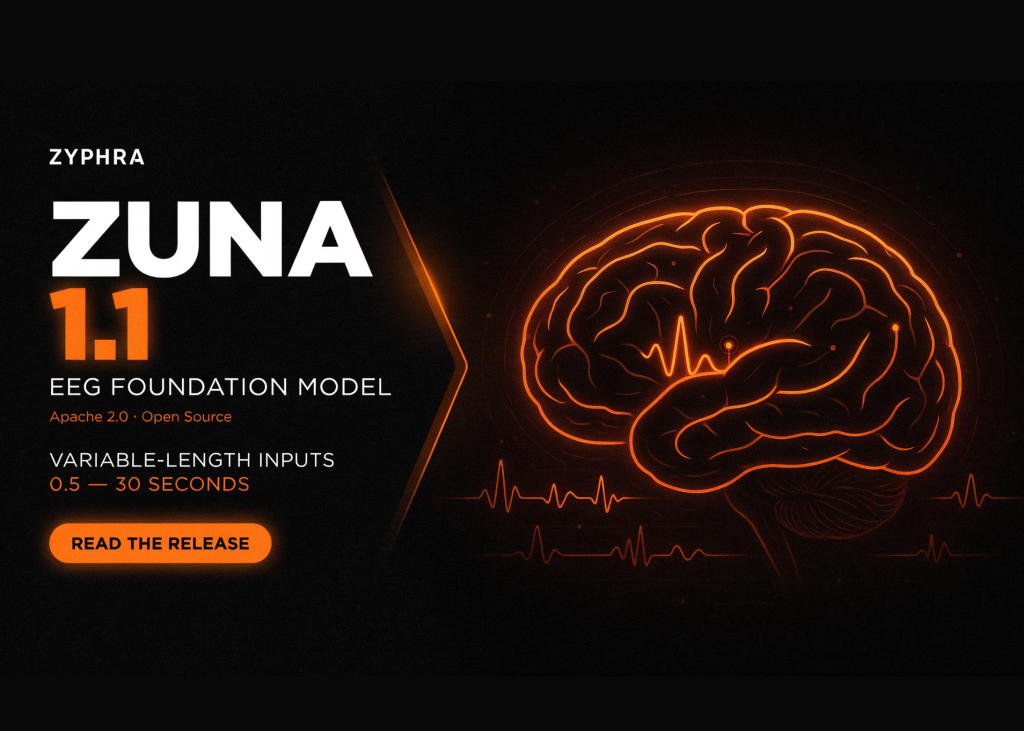
This week, Zyphra released ZUNA1.1 under the Apache 2.0 license. The EEG foundation model reconstructs, denoises, and upsamples data across arbitrary channel layouts. It builds on ZUNA1, the Zyphra’s earlier open EEG foundation model.
The main change is flexibility, not a jump in raw accuracy. Real EEG recordings are messy. Sessions vary in length, and channels go noisy or drop out mid-session. Montages range from four-electrode headbands to 256-channel research caps. ZUNA1 processed only fixed five-second segments. ZUNA1.1 accepts variable-length inputs from 0.5 to 30 seconds.
What is ZUNA1.1?
To understand that flexibility, start with what the model does.
ZUNA1.1 is a 380M-parameter masked diffusion autoencoder for scalp-EEG signals. Given a subset of channels, it denoises existing EEG segments and channels. It reconstructs missing ones. It also predicts novel channel signals given physical coordinates on the scalp.