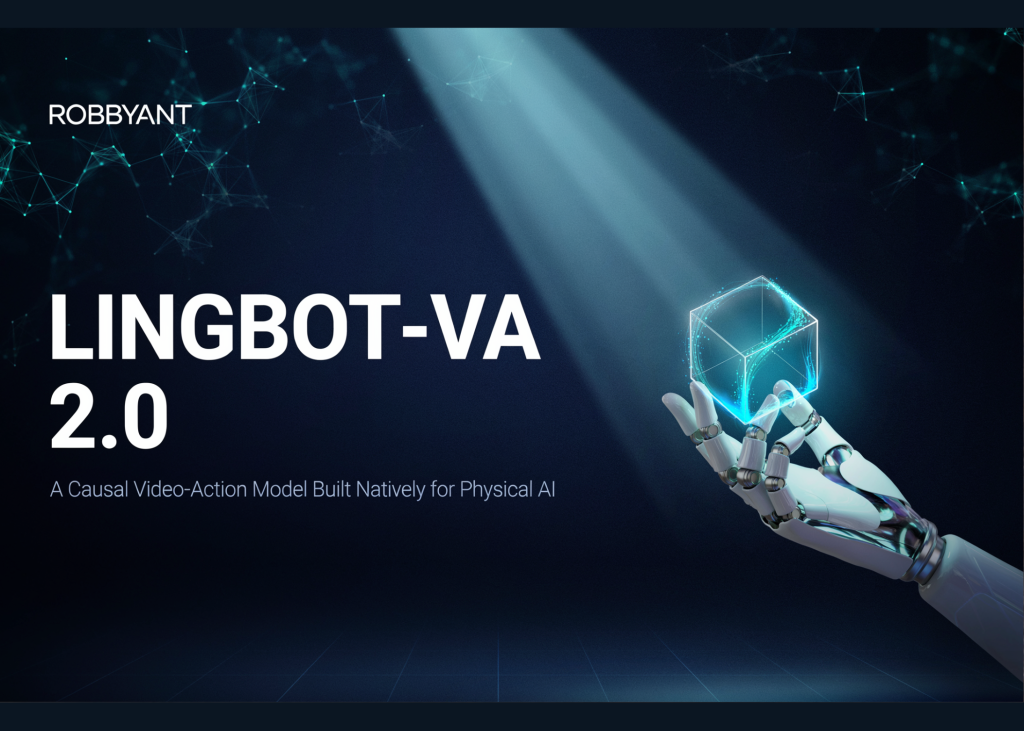
Ant Group’s Robbyant has released LingBot-VLA 2.0, a Vision-Language-Action (VLA) foundation model for robots. The release includes a technical report, an Apache-2.0 codebase, and a 6B checkpoint. The research team targets a well-known gap: VLA models often work in labs but stumble in deployment. LingBot-VLA 2.0 advances the prior version along three practical axes. These are generalization, an expanded action space, and predictive dynamics modeling.
What is LingBot-VLA 2.0?
LingBot-VLA 2.0 is a generalist robot policy built on a vision-language backbone. It converts camera images and a language instruction into robot actions. The public model is lingbot-vla-v2-6b, a 6B ‘native depth’ checkpoint. It uses Qwen3-VL-4B-Instruct as the VLM backbone. Two teacher models, LingBot-Depth and DINO-Video, supervise training through distillation.
One inference call takes about 130 ms on an NVIDIA GeForce RTX 4090D. That measurement uses 10 denoising steps. The action expert uses a Mixture-of-Experts (MoE) design for scaling.
Data pipeline: 60,000 hours across 20 configurations