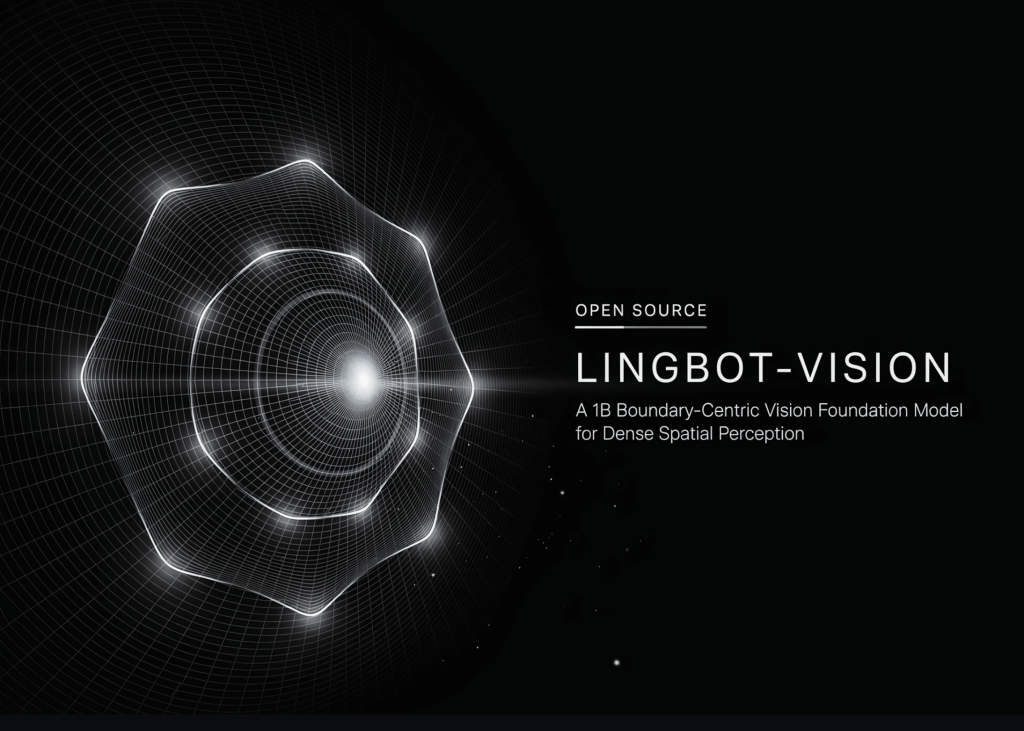
Robbyant, the embodied-AI company within Ant Group, has open-sourced LingBot-Vision, a family of self-supervised Vision Transformers built for dense spatial perception. The weights ship under Apache-2.0 on Hugging Face in four sizes — ViT-giant, ViT-large, ViT-base, and ViT-small — together with a technical report and inference code.
Most vision foundation models are trained for semantic invariance: they learn to answer what is in an image while discarding exactly the fine-grained spatial structure — object boundaries, contours, depth discontinuities — that robots and other physically embodied systems depend on. LingBot-Vision inverts that priority. It treats boundaries as a native pretraining signal rather than a downstream output, and the payoff is a 1B-parameter backbone that matches or surpasses models up to 7× larger on dense spatial tasks, including the 7B DINOv3.
What is LingBot-Vision?
LingBot-Vision is a self-supervised pretrained encoder for spatially structured downstream tasks. The flagship ViT-g/16 has roughly 1.1B parameters and is trained with a new objective called masked boundary modeling on a curated corpus of about 161M images — selected from a 2B web pool — with no human labels, no external edge detectors, and no pretrained backbone to bootstrap from. The training is also notably economical: the corpus is an order of magnitude smaller than DINOv3’s LVD-1689M, and the model consumes less than a third of DINOv3’s training samples.