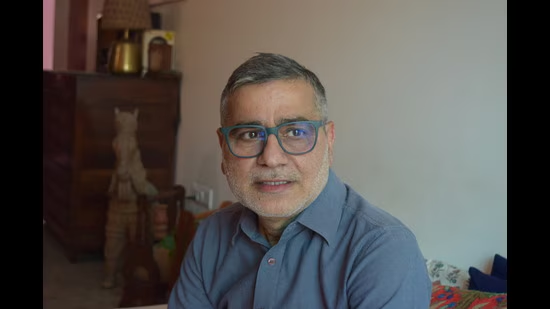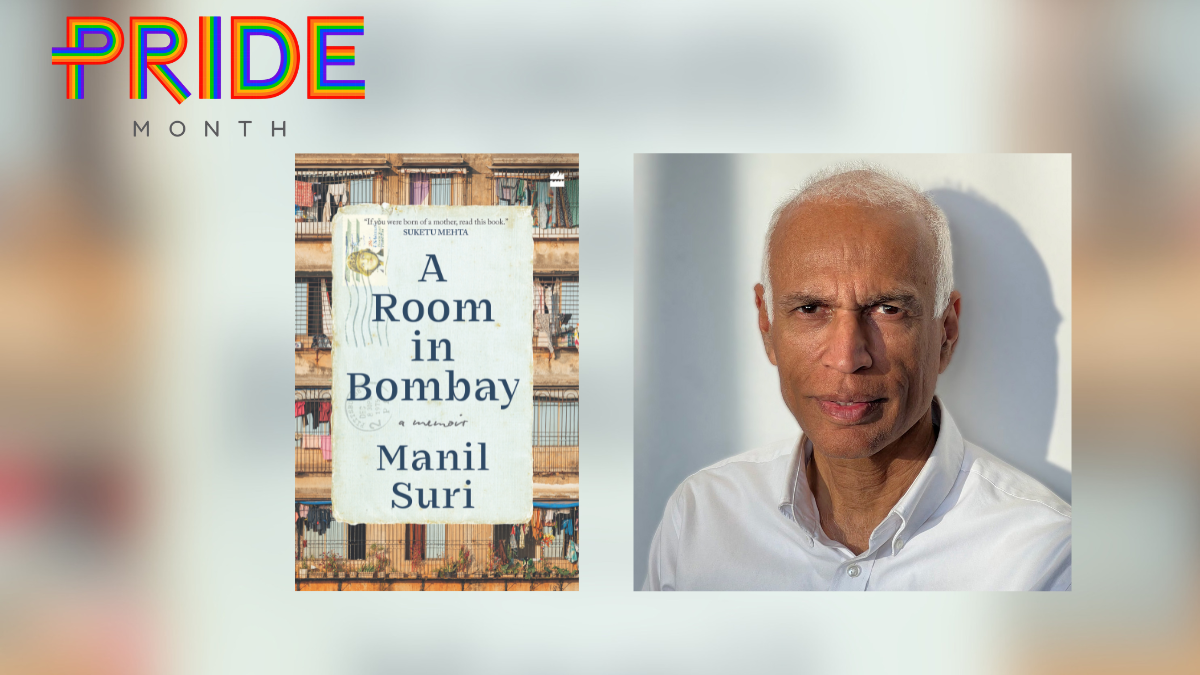
While he has demonstrated creating numbers out of nothing (an empty set), for A Room in Bombay: A Memoir (HarperCollins India), novelist and mathematics professor, Manil Suri, did have a concrete set: the 2,711 letters he exchanged with his mother between 1979, the time he moved to the U.S., and 2010, shortly before her “psychiatric hospitalisation”. “Someday, maybe you will write a book about them,” his mother had said to him.“It had seemed more like a responsibility than an opportunity,” Suri notes in the book. His mother, Prem, was able to read the first chapter before her condition deteriorated. “She was still halfway lucid,” Suri says during an interview over email.The book’s overriding theme is entrapment, symbolised by the room in Bombay’s Razia Mansion where Suri’s parents moved after living separately for 11 years. When Suri was born in 1959, he became the centre of their universe.The hold the room hadAt 20, Suri decided to leave for the U.S. “Of course, you can’t keep living here,” Prem had said when Suri expressed an interest in pursuing further studies. She was at the airport, determined not to miss even the “last glimpse” of her son’s Pittsburgh-bound plane.Yet the room, and the hold it continued to exert over his parents, kept drawing him back to Bombay. Reflecting on moving away but never truly escaping either the room or his family, Suri says, “Whether one is talking about a room or marriage or a closet, each of these can either be a prison or a refuge — or both. One can feel trapped and confined within it, but one can also find reassurance and safety within its familiar boundaries.”Prem decided to stay at Razia Mansion despite the harassment she and her family faced there, amid attempts by neighbours to take over the flat given rising real estate prices. According to Suri, this was because his mother was deeply attached to “South Bombay, in the lively, bustling, constantly stimulating Kemps Corner area”. He says more than the room, it was the locality she really didn’t want to let go of.“It wasn’t just her, but several of the other people in the flat as well, who felt the same way,” he says. “She was also determined to get any money that was coming to her in return for relinquishing her rights to the room. Rather than a sense of failure, I think she would have been overcome with wistfulness and nostalgia if forced to let go.”The balancing actThe estranged couple doted on their only child, but had little affection for each other. “By trusting so much to my judgment, they engendered in me a sense of responsibility, rather than turning me into a spoiled monstrosity,” Suri writes in the book.But did that burden ever become overwhelming? Suri admits that it did. He says he was still a child, and that this formed part of his moulding — a formative experience that shaped his personality.Between the two, it was Prem who asserted her love for him strongly. Did that colour his judgment regarding his father? “Indeed, my mother influenced how I viewed my father,” he says. “There is a section in the book which describes the time he came to visit me in the U.S. without Prem, and ‘I was able to see my father for who he was, without refraction through the prism of my mother’s resentments.’ But it was a balancing act — I tried to be as fair as I could to both my parents, and keep them both happy as much as possible. My mother was conscious about this as well, and tried her best not to consciously undermine the relationship I had with my father.”World beyond the roomBesides the familial dynamics, the memoir offers only limited glimpses of Bombay in the 1970s, when Section 377 of the erstwhile Indian Penal Code, criminalising consensual same-sex relations, prevailed. Given the risk of extortion — where queer people could be threatened with being outed unless they paid up — how did people forge romantic connections? Suri notes that the idea of extortion or harassment never entered his mind. “My friends weren’t worried, either. Sadly, the people who were in danger were invariably from the less well-off strata of society,” he explains.In the age of dating apps and instant hook-ups, what many queer people increasingly share today is a sense that building steady partnerships has become more difficult. Suri feels it has “become harder to find a monogamous partner” for people like his younger gay friend, who “lamented” that “with sex so readily procurable, it’s become very difficult to find a partner interested in building life together”.For Suri, things did fall into place in that regard. He has been in a 36-year-long monogamous relationship with his partner, Larry. He says, there were a few rough patches, which the couple got over with, thanks to “copious amounts of black humour.”Thinking of the time when he needed medical support for his mother, Suri says mental healthcare in India has always been given less attention than it deserves. Though 16 years have passed since he negotiated with the Indian healthcare system, he can’t forget the “shock over learning that there were only two hospitals with psychiatric wards for the whole of Bombay”. The only “lifesaver” was the Dignity Foundation. The real trap, in a sense, is systemic; it was the case then and remains so now.The interviewer is a Delhi-based queer writer and culture critic.
Interview | Manil Suri on his new book A Room in Bombay: A Memoir
Join Manil Suri as he discusses his memoir, "A Room in Bombay," exploring family dynamics, love, and the complexities of identity.
907 words~4 min read