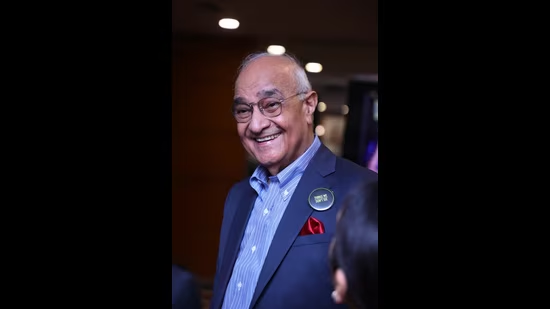
Your memoir, Things We Don’t See, begins very differently from a conventional corporate autobiography.Author LC Singh (Courtesy the subject)Yes, that was deliberate. I wasn’t interested in writing a chronology of achievements. What interested me more was the movement of experience, learning, perception.The title itself came from childhood. My mother used to speak about intuitions and unseen things. I remember questioning my father about what she had said: “There are things we don’t see.” That sentence stayed with me all my life.Your book is surprisingly philosophical – stars, mortality, fear, nautankis – the first mention of any business-related concept appears more than halfway in.I grew up in a village without electricity. There was no pollution, almost no traffic. At night the sky was clear. I would lie there in summer looking at stars for hours wondering: they will remain long after I am gone, so what happens when I die? Does anything continue?Music and theatre always enchanted me. Once, in the middle of the night, I ran barefoot through fields eager to watch a forbidden nautanki performance. The next morning, I saw the fields clearly – they were full of sharp spikes and thorns. Somehow those thorns did not touch me.Yet, you eventually became a chemical engineer, joined the corporate world, and later founded Nihilent.The artistic and intuitive side came naturally. The analytical side developed later because I was pushed very hard academically by my family.In 1970, BHU did not offer campus placements. I arrived in Bombay with nothing and lived in a slum in Kanjur Marg because I simply couldn’t afford anything else. I briefly joined the State Bank of India, which was considered a dream job then, and later left to work in Iran to provide a better life for my family.When political turmoil began there, I came back and decided to try becoming a film writer. I spent my days walking from studio to studio trying to sell film scripts. One producer finally told me kindly: “You can write, but this industry is not the right place for you. Go back to the corporate world.”One of the memorable passages in the memoir is your encounter in Karachi while escaping Iran to return home to India – without a Pakistan visa.Yes, I had been warned that I could be arrested. Initially, the official dealing with me was stiff and suspicious; understandably so. Then he noticed some Begum Akhtar LPs I was carrying, and his behaviour changed completely. We spoke to each other in that Hindi-Urdu mix and the atmosphere transformed. He became warm, conversational, even protective. I stayed overnight in a hotel and left for Bombay by Indian Airlines.Reading that section, I felt the episode almost became a metaphor for the title of the book itself.Exactly. That is precisely what I mean by Things We Don’t See.Behind all the labels – nation, religion, politics, propaganda – human beings remain human beings. What we usually respond to is conditioning. When those layers fall away, something much more basic and human emerges.I felt impressed that you wrote about the phase in which your wife faced anxiety challenges because it’s so useful for others in similar situations, in an environment where we are trained to hide and pretend that nothing is wrong.My wife came from a large landlord family – they had 1800 acres of land. She grew up in extraordinary comfort and suddenly found herself first in my humble village home and then in Bombay slums. She never complained – but the strain must have accumulated. After the children were born, she went through a difficult psychological phase. Thankfully, it lasted only a few months.You also describe moments that sound almost mystical – intuitions, premonitions, moments of spiritual awakening.Those experiences did happen, but usually when the mind was completely quiet.My younger daughter was born after months of anxiety and medical complications. One day in the hospital, feeling deeply peaceful after all that stress, I looked at a switchboard and had an inexplicable feeling that something was wrong. I called loudly for help and people came running. It burst into flames in front of us and we were all shocked.I don’t claim to understand such things. I simply describe them as they occurred.Looking back now, what do you consider your life’s greatest successes – and failures?Honestly, I don’t think in those terms anymore.If I had to use the word at all, I would say awareness is the real success.To remain aware – of people, animals, plants, situations, emotions, silence.To drop accumulated labels and interact with people without hierarchy.In fact, that is one reason I became interested in photography.The moment you pick up a camera, the world changes.Suddenly every object begins staring back at you. Trees, faces, light, walls, animals – everything begins communicating differently.Life is not linear. You can be on top one day and brought down the next. So don’t become arrogant during success, and don’t collapse during difficult times either.I increasingly feel that empathy – karuna – is the essential human quality. Most emotions are reactions to fear. Empathy is different. It connects us.Your other book, The Collapse of Illusions, seems to emerge from these reflections.Very much so.I became deeply interested in systems theory, entropy, cybernetics, quantum theory – trying to understand why human beings behave the way they do.Religion interested me less than understanding.Even karma, to me, can be understood through systems. Every action disturbs a system. Entropy in any living system is never zero. If disturbance exceeds a threshold, the system reacts.Your memoir suggests that attentiveness shaped your relationship with fear itself.Possibly.There have been situations where, looking back, I should probably have been far more afraid than I was. Once I unknowingly walked through a group of about 75 wild baboons. I later learnt they can be extremely dangerous. But because I carried no fear, nothing happened. When I told people at the camp where I was staying, they were horrified.Another time, near Lake Malawi, I sat for nearly an hour very close to a group of hippopotamuses because I found them beautiful and peaceful. I did not know that hippos are among the deadliest animals in Africa. Nor did I know that behind me was marshland containing large pythons. Eventually, a search party came looking for me and I was sternly reprimanded for sitting there!Again, I had remained completely relaxed because I did not perceive danger.Which perhaps brings us back again to the title – Things We Don’t See.Yes, perhaps everything returns there eventually.Saaz Aggarwal is the author of Sindh: Stories from a Vanished Homeland and Losing Home Finding Home.
LC Singh: “Life is not linear. So don’t become arrogant during success”
The memoir "Things We Don’t See" explores personal growth, philosophical insights, and human connections beyond societal labels and fears.
1,093 words~5 min read