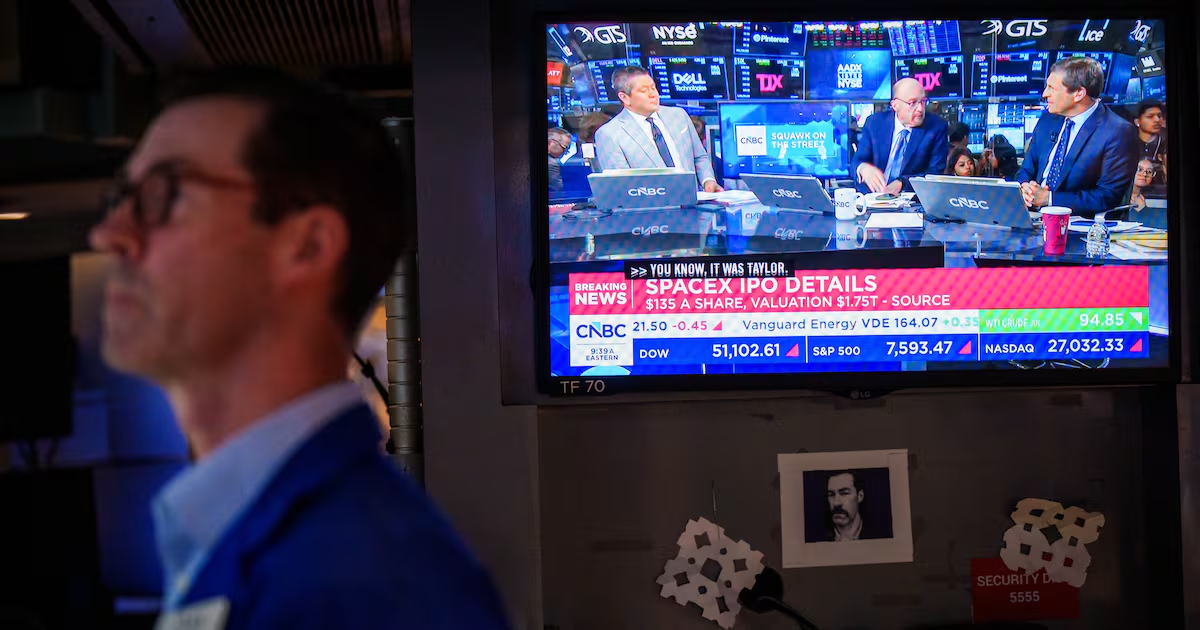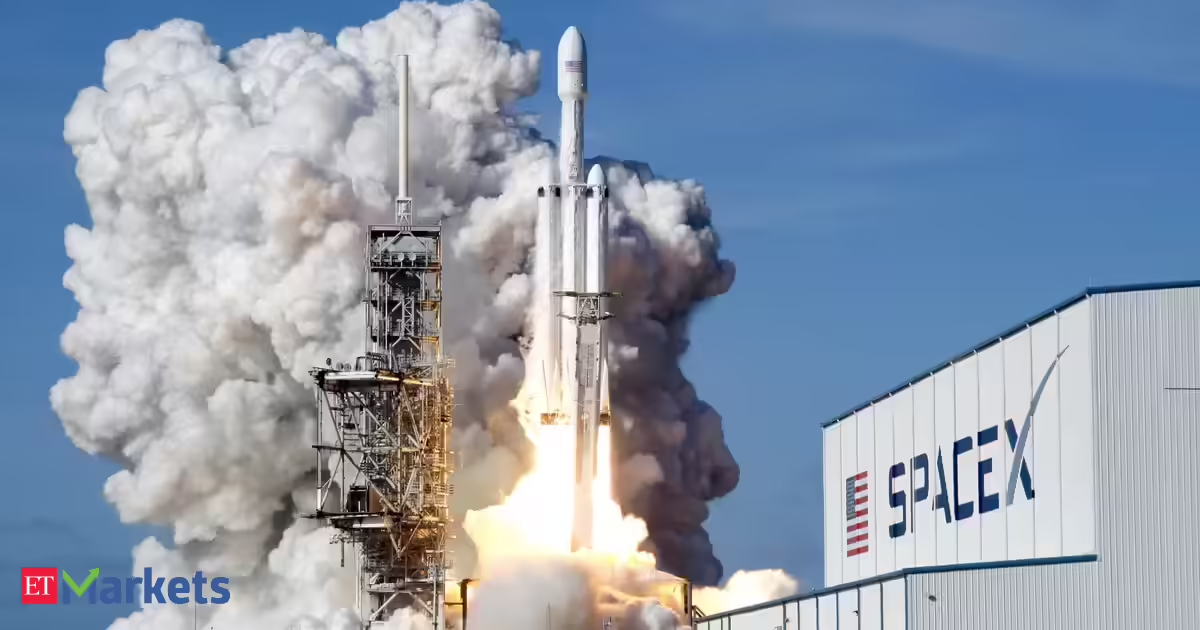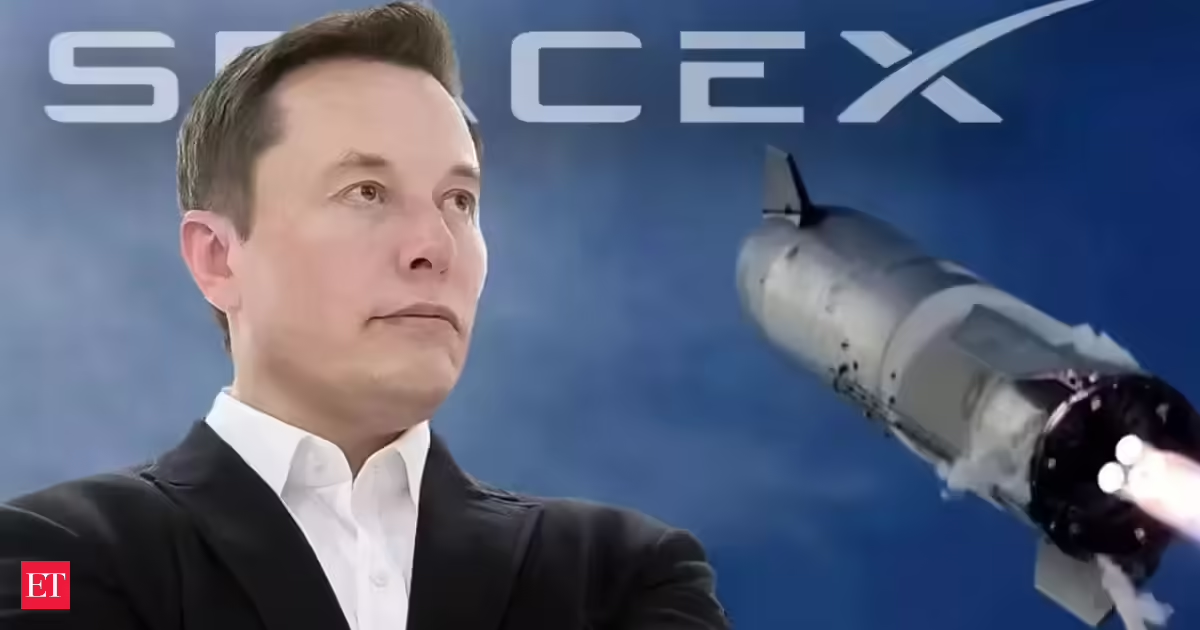
As Elon Musk's SpaceX prepares to debut at a valuation of nearly $1.75 trillion, investors are also confronting a question: Does the biggest IPO in history signal that the technology rally is nearing its peak?SpaceX is set to raise about $75 billion, eclipsing Saudi Aramco's record $26 billion listing in 2019. Investor demand has reportedly reached nearly $150 billion, even though the company remains loss-making and generated revenue of $18.67 billion in 2025.The offering comes at a time when artificial intelligence-linked stocks have driven Wall Street to fresh highs, with capital pouring into semiconductor makers, cloud companies, AI infrastructure firms and technology funds.Analysts say the timing looks familiar. "Historically, after the listing of such large market-cap companies, the probability of a short-term top cannot be ruled out," said Sunny Agrawal, Head of Fundamental Research at SBI Securities.He noted that investors have already been shifting money from other asset classes into equities."We are already seeing rotation of capital from other asset classes like gold, silver, bitcoin and AI trades, and it is making its way into new IPO issuances," Agrawal said.The argument echoes patterns seen in previous market cycles, where highly anticipated listings often arrived when investor enthusiasm was already running at extreme levels.Technology valuations certainly leave little room for error. According to Ventura's Head of Research Vinit Bolinjkar, the Nasdaq-100 currently trades at about 35.7 times earnings, significantly above its historical median of around 24.5 times.The broader market is also flashing warning signals. "The S&P 500's Shiller CAPE has touched its second-highest level in 155 years of data. The only higher reading was during the dot-com peak," Bolinjkar said.Such metrics naturally raise questions about whether investors have become too optimistic. Yet several analysts caution against drawing direct comparisons with the technology bubble of the late 1990s.Back then, many companies came to market with little revenue, no profits and untested business models. Today's leaders are fundamentally different."Unlike the dot-com era, where venture capital-funded, unprofitable companies were rushed to market, today's AI rally is being funded by highly profitable technology companies," Bolinjkar said.The world's largest technology firms continue to generate enormous cash flows while investing heavily in artificial intelligence infrastructure. Big Tech companies are expected to spend roughly $655 billion on capital expenditure in 2026, up about 60% from a year earlier. Companies such as Nvidia, Microsoft, Amazon, Alphabet and Meta are deploying vast sums to build AI data centres and computing capacity."Earnings are real," Bolinjkar said. "Nvidia, despite its massive rally, still trades at a reasonable forward multiple."Bubbles are typically characterised by excessive speculation detached from business performance. The current AI boom, while expensive, is supported by strong revenue growth and profitability among market leaders.In that context, some analysts view SpaceX less as a warning sign and more as a reflection of investors' willingness to pay a premium for scarce growth assets."SpaceX's $1.75 trillion IPO is more a reflection of the scarcity premium on quality growth assets than a bubble trigger in itself," Bolinjkar said.He nevertheless warned that risks are building. "If the AI capex cycle disappoints on returns, or if the Federal Reserve turns more hawkish, a correction is possible. I wouldn't call this a definitive market top, but it is certainly a market that offers limited margin of safety."Others believe investors are reading too much into a single transaction. Niteen Dongare, Director and CEO of Anand Rathi International Ventures IFSC, said elevated valuations in AI and semiconductor stocks indicate strong investor interest in a specific theme rather than evidence that the entire market has become overheated."SpaceX with such a high valuation is just one datapoint showing strong investor interest and not necessarily proof that the US market has reached its top," he said.Dongare pointed out that broader market conditions, including liquidity, earnings growth, IPO activity and retail participation, need to be considered before calling a market peak.The same view is shared by Ishan Tanna, Senior Associate at Ashika Capital. "The SpaceX IPO reflects peak optimism, but not necessarily a market peak," Tanna said. "It tells us investors remain willing to fund ambitious growth stories at extraordinary valuations."Tanna argues that such landmark IPOs are often better indicators of market sentiment than reliable predictors of when a bull market will end.Some of the largest IPOs have indeed arrived close to market peaks. Others have listed years before rallies eventually ran out of steam. Market tops are usually identified only in hindsight.For now, SpaceX appears to embody both sides of the debate. On one hand, it is a company operating in industries with enormous long-term potential, including satellite internet, commercial space launches and artificial intelligence infrastructure.On the other, investors are being asked to pay one of the richest valuations ever assigned to a newly listed company. Whether the IPO ultimately marks the peak of AI-driven optimism or simply another chapter in a continuing technology boom may depend less on SpaceX itself and more on whether the massive investments currently flowing into artificial intelligence generate the returns investors expect.(Disclaimer: Recommendations, suggestions, views and opinions given by the experts are their own. These do not represent the views of Economic Times)
Signs of worry: Is SpaceX's $75 billion IPO ringing the bell of market top?
SpaceX's upcoming IPO at a staggering valuation is sparking debate. Investors wonder if this massive listing signals the peak of the current technology boom. While some see it as a warning sign, others believe it reflects strong investor appetite for growth assets. The market's future performance may depend on AI investments delivering expected returns.
847 words~4 min read