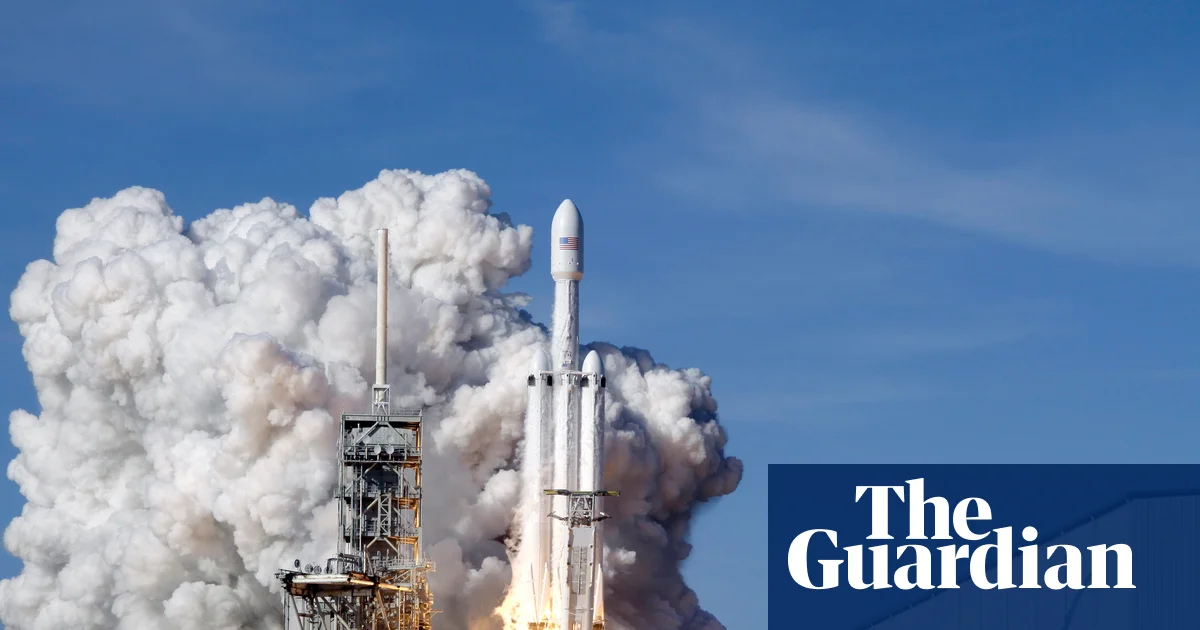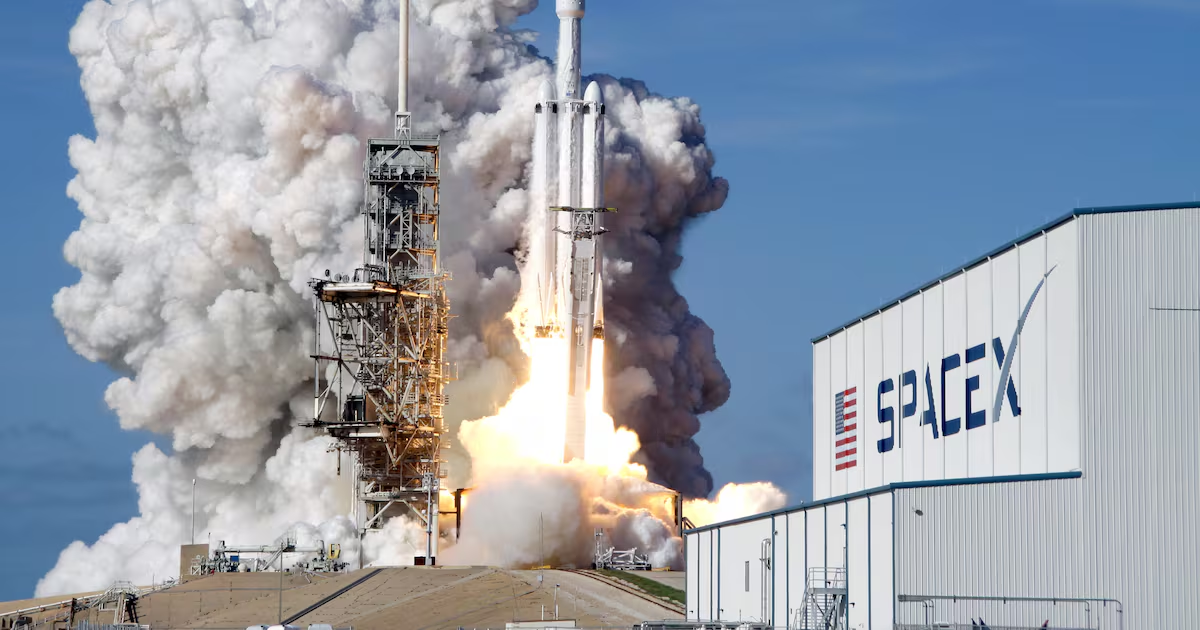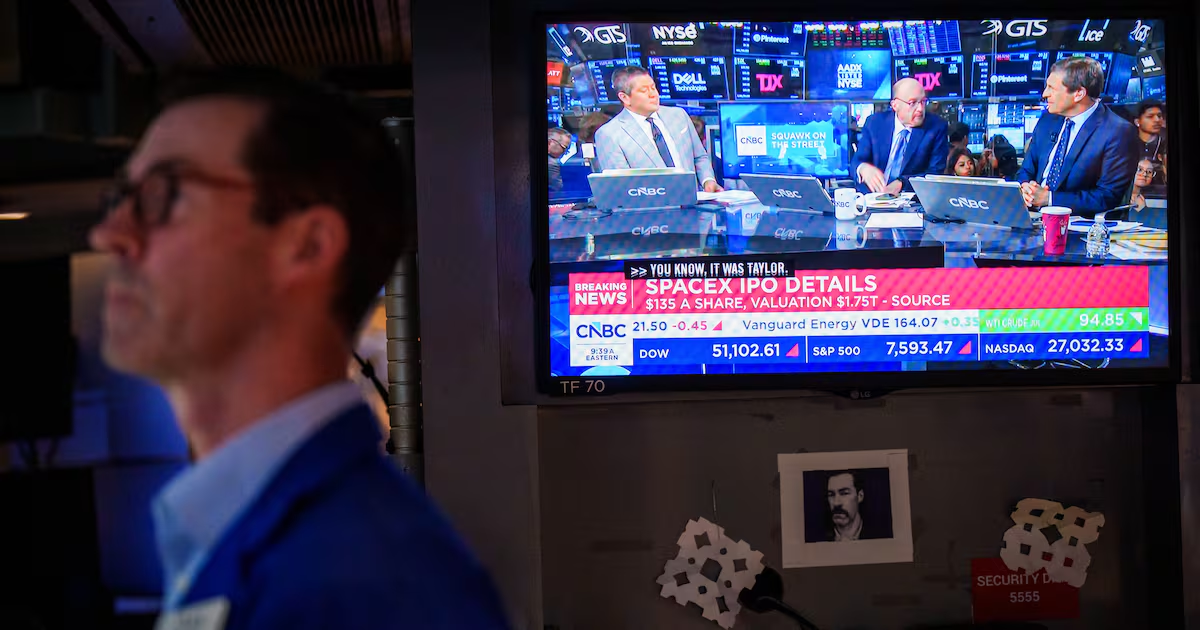
Are we watching the final chapter of a tech feeding frenzy which has driven the US stock market relentlessly higher? Or the start of a new phase in the AI-driven rise which has already sent US markets to new highs? On Friday there will be a new marker as Elon Musk’s Space X floats on the market, the biggest IPO in history which has a target valuation on the company of an eye-watering $1.75 trillion. That is $1.75 thousand billion. The company plans to raise around $75 billion in the float – selling roughly 4 per cent of its stock. Mega floats from Anthropic and OpenAI are due to follow, along with big fundraising from Alphabet and Meta as all the AI players – including the most profitable ones – seek to raise more cash for seemingly endless investment. It will be a big test of the US market and its confidence in the future of AI. And while Irish investors can choose whether or not to buy these shares directly, the investments of pension funds and many other vehicles such as exchange traded funds are going to have a rising chunk of AI in their portfolios, even if no one is quite sure who will actually make money in this new era. Big flotations to allow companies – and their owners – to raise cash from investors, including the retail sector, can be a sign of a market at or near its peak. So is floating companies like SpaceX which are not making a profit and may not do so for some years.Hype and hope collide in the marketing of the SpaceX float. With revenues of $18.7 billion in 2025 and net losses of almost $5 billion, there is a lot of “hope value” behind the flotation price being sought by Musk, which is more that 90 times annual revenues. And a much-quoted analysis by US financial services firm Morningstar argues that a reasonable valuation would be less than half the figure sought. Key to the float is an attempt to attract in retail investors, who are thus exposed to the risk of a flotation which has valuations which are off-the-charts and require the company – and its AI arm in particular – to grow exponentially. ‘No profit and crap governance’ – is Elon Musk’s SpaceX actually worth $1.75 trillion? Listen | 41:54First up on this week’s episode of Inside Business is Elon Musk's company SpaceX and its plan to raise $75 billion through what will likely be the biggest initial public offering (IPO) in history this Friday.The company values itself at $1.75tn, but some analysts feel it is worth far less.Could it prove to be a risky bet for the retail investor given SpaceX's lack of profit? And there are question marks over governance given Musk's almost untouchable status within the company.To get some insight on all this, host Cliff Taylor was joined in studio by Aidan Donnelly, head of Global Equities at Davy.Plus, European Central Bank President Christine Lagarde is expected to announce a 0.25% rise in the ECB's interest rate, this will bring it up to 2.25%.It will be the first interest rate hike since 2023, following Russia’s invasion of Ukraine and the impact that had on energy prices.So, what does this week’s increase mean for Irish mortgage holders and those looking to buy?And is this the beginning of a cycle of increases designed to control rising inflation?Cliff was joined in studio by Senior Mortgage Advisor at Irish Mortgage Brokers, Michael Dowling.Produced by John Casey with JJ Vernon on sound.SpaceX, of course, as befits a Musk operation, is unique. Its core business has been Starlink, a global internet provider for consumers, business and many airlines. This is where most of its revenue comes from and is the only profitable division. Then there is the original space launch service, for satellites, supplies and astronauts to the International Space Station and so on – and, if Musk is to believed, in time trips to Mars. And finally are Musk’s AI interests, merged into SpaceX, including the Grok platform, X – formerly Twitter – and data centre infrastructure, which requires major investment. SpaceX generates cash, but it’s all being diverted into investment, mainly relating to the next generation of rocket and of course AI including massive spending on data centres and research.Elon Musk has a big business. It has managed to almost corner the market in delivering “payloads” such as satellites into orbit, based on reusable infrastructure. It has invested significantly in a new “Starship” rocket which, if successful, would take this to another level and widen its advantage over competitors. Its Starlink business is growing and its ability to deliver internet access to more remote areas is a notable advantage. It is investing tens of billions in its AI play and it remains to be seen if and when this plays out. It is here that Morningstar and other analysts are most sceptical of the forecasts made in the prospectus for the IPO, particularly given the lead other companies such as Anthropic have in developing and commercialising AI models and the uncertain return from the massive investment being made. Goldman Sachs calculates that the company’s AI revenues would need to grow a hundredfold from $3.2 billion annual to $322 billion by 2030 to meet its targets. According to Morningstar, adding all the bits together and taking a realistic view of its prospects still leaves the SpaceX valuation well short of what Musk is looking for. As an investor you can, of course, choose to bet on the world’s richest man – because that is what those putting money into the IPO are effectively doing. Morning Star reckons a reasonable value would be around $780 billion, less than half what is being sought. It advises private investors who want to take a punt on Musk to sit on the sidelines for now, reckoning that they will be able to buy in at a lower level in time.This does not mean the IPO will fall flat. It will most probably get away successfully. It has the backing of most of the big US investment banks and, as Aidan Donnelly, head of global equities at Davy, explained on The Irish Times Inside Business podcast this week, is the first giant IPO in a number of years, which has left a pent-up demand from investors in an era when share buy-backs from major companies have been more common.Goldman Sachs has estimated that the net supply of US stocks will be flat this year, having declined each year since 2003, and is set to rise next year as the SpaceX float is due to be followed by Anthropic and OpenAI, as well as fund-raisings by other players investing in AI. How this plays into market valuations will be interesting to watch as stock shortage has been a theme in recent years, alongside, of course, the massive surge in big tech valuations based on AI and the more recent rise in the price of stocks benefiting from the resulting investment, such as chip manufacturers. With the investment banks on board and encouraging their retail clients and a certain amount of institutional buying all but guaranteed by the inclusion of the stock – after 15 days – in the Nasdaq index, it could get initial support provided the market generally does not hit a wobble. This role of passive funds which control large parts of the US market will be vital, though Donnelly points out that SpaceX will not be admitted to the S&P500 index for at least a year, as it resisted pressure to change its rules to allow it to enter. This will limit buying from funds who are obliged to match key stock indices – or generally do so. So will the small “free float” of shares – the amount which is trading on the market – which will be around 4 per cent of the total. So while big funds will be pulled in, the float depends to a large extent on the “punter”. They may feel they are buying into something which has enormous longer-term prospects – but they are being asked to subscribe at prices well above existing investors in a hugely risky enterprise in a frothy stock market. Musk retains voting control through his holding of a special class of shares – so-called B shares – and is also protected from investor legal actions. Thus, says Donnelly, big investors have no way to challenge the way the company is being run or to take legal action against it, as would normally be the case. It further underlines that those investing in SpaceX are throwing in their lot with Musk.The real test of Space X may comes in the months ahead. Lock-in periods for those who have already invested in the company are phased out on a tiered basis – starting after it has reported its first quarterly results as a public company and mostly ending after six moths. More stock is likely to come on the market as some of these investors look to cash in. Musk and some early investors who stand to see massive valuations on their holdings have a one year lock in.So as well as the initial test in getting the stock “away” at an acceptable price – which could be higher or lower than the putative $1.75 billion valuation – SpaceX will face further key periods in the months ahead. And of course the wider context for investors is a US market which is already high on the hope value of AI with historically high valuations and uncertainty about which companies will make profits from the technology to justify this massive level of investment. Irish investors – apart perhaps from a few high rollers – would not have access to the IPO but can buy in the secondary market. Many will also see SpaceX holdings in investment of pension funds they hold over time. As the seventh biggest company in the world if it attains its float price, the company will feature in many portfolios. Its value will depend on two things: The underlying strength of the US market – already trading at high valuations and the performance of SpaceX. On both fronts, investors will be taking a very big risk. It looks certain – particularly with the small amount of shares trading on the market – to be a bumpy ride.
Investors in SpaceX will need to strap in for a bumpy ride
Hype and hope collide in the biggest IPO in history
1,739 words~8 min read