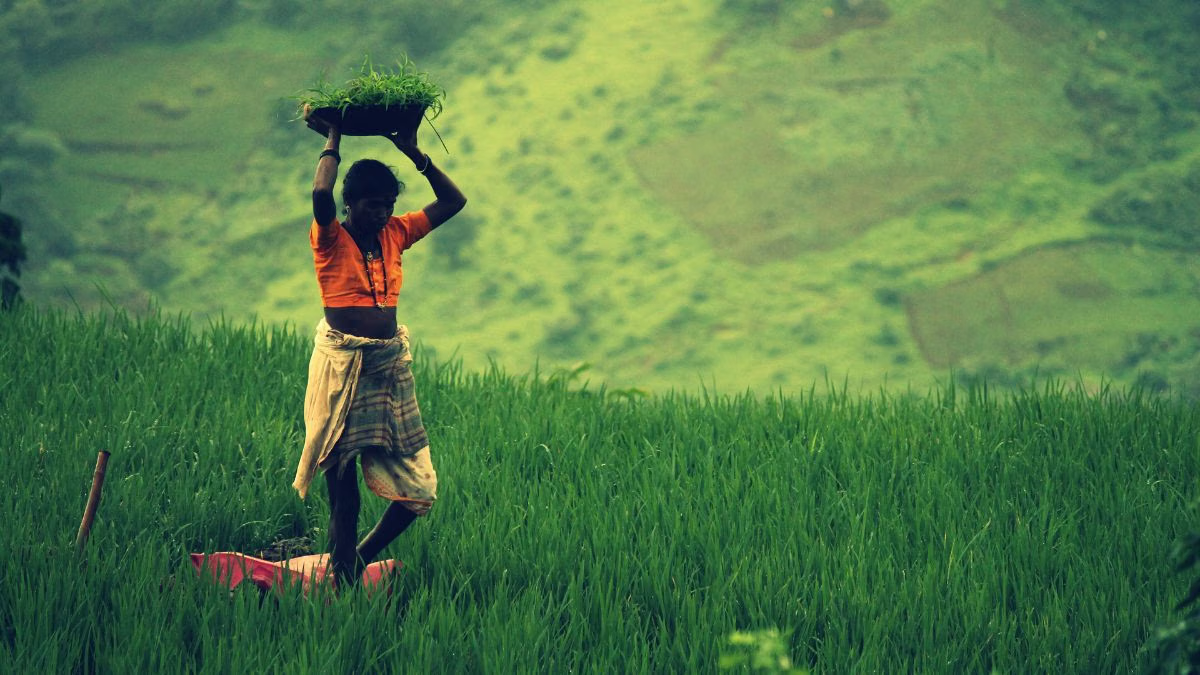
These memories are in stark contrast to the idyllic tone of medieval inscriptions, which praise the courtly patrons of rainwater tanks, and describe prosperous surrounding farms, orchards, and temples. The designers and beneficiaries of medieval water systems were not the same as the people whose hands had built the tanks and canals — in much the same way as the people signing off on data centres today are not the ones whose water is being taken away. Lords and labourers
Thousands of tanks were built over nearly a thousand years (c. 8th to 18th century CE). Village landscapes were frequently criss-crossed by tank channels and streams. Inscriptions recording these tanks are, on first encounter, idyllic. Take, for example, a gift made by the 12th-century Brahmin merchant Kammata Chatti-Setti. He was a trader in horses, elephants and pearls, who boasted of kings as clients. In the village of Banavur, near the town of Arasikere (literally “Queen’s Tank”), he enlarged two tanks. Other inscriptions recorded by historians GS Dikshit, GR Kuppuswamy and SK Mohan describe the environs as “filled with clusters of groves, with well-filled channels, with large tanks like seas, surrounded with growing crops, with crowds of people and splendid temples.” Chatti-Setti also built a large tank near the capital city of Dvarasamudra (present-day Halebidu, in Karnataka), which was home to several vast reservoirs holding the waters of the Yagache river, bearing annual harvests of sugarcane and rice. In this, he was part of a larger trend among the court elite of the Hoysalas in South Karnataka. Sanskrit eulogies praise Hoysala kings themselves as sponsoring agraharas (Brahmin settlements) without count, “multitudes of charitable tanks,” and temples that pierced the sky. Several highly-placed court officials are recorded commissioning tanks, each surrounded by valuable agricultural land in which they held a stake. Brahmins and merchants (sometimes the same individual could be both), Jain and Hindu, male and female members of the royal family and aristocracy, mathas, and temples were all involved in financing and benefiting from the expansion of tank agriculture. However, the inscriptions of this time have little to say about who actually built the tanks. How many hands were needed to move and pack all the earth? Hundreds, thousands? And how were they paid? This information was, apparently, not recorded in stone but probably on more transient materials, like palm-leaf.In comparison, another class is much better represented in the 13th-century inscriptions. The historian Kesavan Veluthat, in his paper “Landed Magnates as State Agents: The Gavundas under the Hoysalas”, describes Gavundas — urodeya in Kannada — as the landed proprietor class of the medieval countryside. A single village could have many Gavundas, who owned land in multiple villages, yielding various returns in gold and crops. The Hoysala state hired many of its functionaries from this class, and Gavundas are mentioned in several tank donative inscriptions as maintaining and patronising tanks. In return, they received a share of the profits from the irrigated lands below the tank.About a century later, under the Vijayanagara empire, Gavundas remained the village’s landed elite, the state’s local agents, and the chief beneficiaries of tank-building grants. Dikshit et al. provide several examples. One Bhattara Bachiyappa excavated six tanks named after his king, his father, his mother, a female relative, himself, and a male relative. The lands below the sluices were granted to the tank-builder in perpetuity as kattukodige — two parts in ten of the rice fields, rent-free, for as long as the sun and moon endured. Local Nayakas, military leaders like Bengaluru’s famous Kempe Gowda, built both forts and tanks to control the local water supply. Engineers and Brahmins belonged to the same class: when the bund of the Arali dam on the Palar broke, Dikshit et al write that the priests of the Katariyanahalli temple granted land to a group of Brahmins on the condition that they pay for repairs. The Brahmins kept three of four parts of the rice fields below the bund in exchange.The city of Vijayanagara itself saw massive hydrological interventions that extended rice cultivation into altogether drier and more arid zones in northern Karnataka. Bunds extending several miles, built by small armies of labourers, altered the course of entire rivers and gathered mountainous amounts of water. Chains of small tanks, tracing out relief contours, captured runoff. A 16th-century inscription describes one of these monumental artificial lakes, “with eddying waterducts/sluices”. It is also at pains to enumerate for us the qualities of a good reservoir. It begins with “a king endowed with righteousness, rich, happy and desirous of acquiring the permanent wealth of fame, and a Brahmana learned in hydrology…”. Its 12th and final quality, ranked after the physical properties of the landscape, the availability of quarried stone, etc is “a gang of men skilled in the art of its construction.” Later, the inscription is more boastful of these teeming hands. It tells us that the lake, named Anamtaraja, was built by “one thousand labourers working at the tank and the dam every day, and a hundred carts were employed for the masonry work of the sluice and wall.” This small army completed the work in two years, and the inscription says no expense was spared in money or grain. The Portuguese traveller Domingo Paes witnessed one of these enormous tanks being built in the 1500s. Sacrifice and Idyll