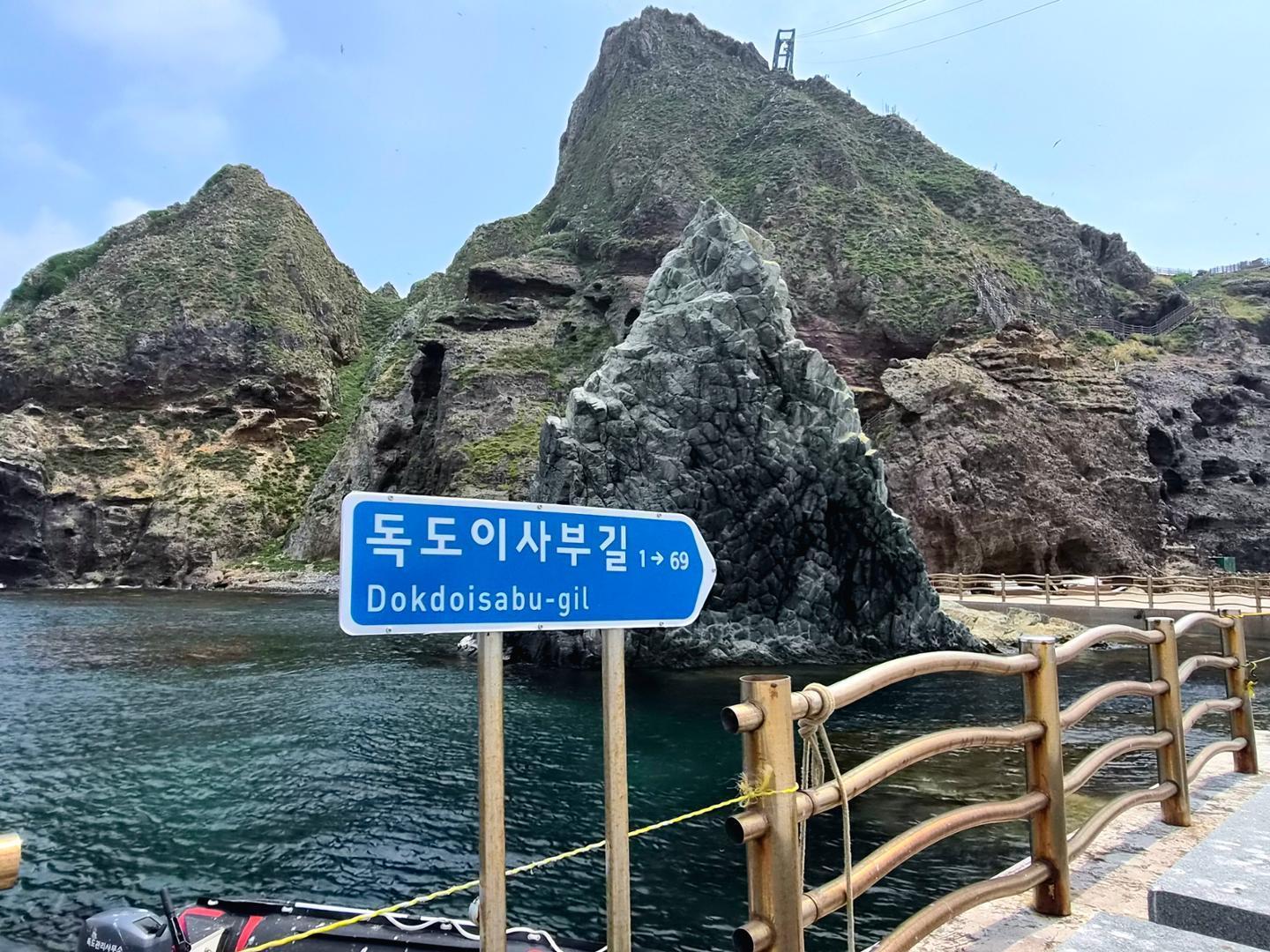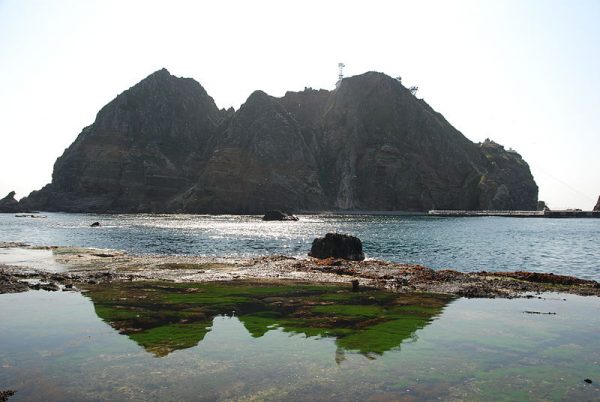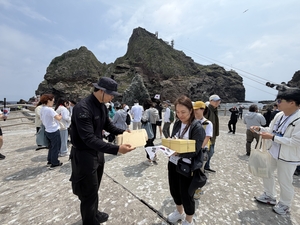
Dokdo Guardian Schools seek to help students explain Korea’s sovereignty through hands-on, digital learning A Dokdo Guardian School teacher (right) gives a Dokdo Coast Guard (left) a care package and letters of gratitude written by students during the teachers' visit to the islets on June 5. (Northeast Asian History Foundation) A boat carrying 32 teachers cut across the waters toward Dokdo last week, its passengers bringing more than luggage: handwritten letters from students, care packages for the Coast Guard and stories from classrooms where Dokdo is being taught through Minecraft maps, computer games and student-led projects.As the teachers disembarked, Dokdo Coast Guard officers greeted them with salutes. In return, the teachers handed over children’s carefully written letters of gratitude and gifts.The symbolic exchange sits at the center of a broader question: how are students today learning to understand and protect Dokdo?Dokdo is Korea’s easternmost territory, a pair of volcanic islets about 87 kilometers off the coast of Ulleungdo, a larger island home to some 9,000 people.Despite South Korea’s effective control of Dokdo, Japan continues to assert sovereignty over the islets, seeking to frame them as disputed territory.What are Dokdo Guardian Schools? Dokdo Guardian School teachers, Northeast Asian History Foundation officials and Dokdo Coast Guards pose for a photo on June 5 during the teachers' visit to Korea's easternmost territory. (Northeast Asian History Foundation) The 32 teachers who visited Dokdo on June 5 were from schools across the country designated as Dokdo Guardian Schools.The Northeast Asian History Foundation operates 120 Dokdo Guardian Schools nationwide across all grade levels to promote hands-on Dokdo education.The program supports schools across the country in running Dokdo-related clubs, curriculum-linked classes, field experiences and study trips.Launched in 2008 with support for 19 schools, the program expanded rapidly after the Education Ministry established its basic plan for Dokdo education in 2011. Over 1,700 schools have taken part in the program so far.The annual budget, which stood at 19 million won ($12,500) at the time of the program’s launch, grew almost tenfold to 160 million won in 2021.Engaging students in virtual spaces A screen capture of the Minecraft map of Dokdo created by Docheok Elementary School teacher Kim Ji-hwan to use in his class about Dokdo. (Kim Ji-hwan) Kim Ji-hwan, a teacher at Docheok Elementary School in Gwangju, Gyeonggi Province, said he built a replica of Dokdo in Minecraft, using the familiar game platform to recreate volcanic eruptions and explain how the islets were formed.He then allowed students to build museums and other facilities on Dokdo, using the activity to spark conversations about the islets’ geography, history and infrastructure.“The purpose is to get students to actually do something in the Minecraft space,” Kim said. “If you look at other content previously used in Dokdo education, there isn’t much that allows students to take the lead and actively participate.”Kim is currently coding the game so the map better reflects Dokdo’s biodiversity.“I am trying to recreate the ecological balance on the map to better teach students and make it more realistic,” Kim said.Fusing student interests with Dokdo educationAt Dankook University Software High School, students apply skills learned in class to develop a Dokdo-themed game.“We are a high school specializing in software development, so students tend to have less foundation in the humanities,” said Min Sae-yeon, a teacher at the school. “That is why I thought about a way to incorporate Dokdo and humanities education into software development.”The game traces the history of the islets. Students have so far spent seven class periods developing the game and are aiming to launch it on the PC game platform Steam by November.Using digital devices to learn about Dokdo Hongdae University Elementary School teacher Lim Hyun-seo (first right) poses with his students after his classes were recognized by the Education Ministry in 2024. (Lim Hyun-seo) “We have one device per student,” said Lim Hyun-seo, a sixth-grade teacher at Hongik University Elementary School. “Using their Chromebooks, I have students watch footage of Dokdo and try to locate where the islets are.”The devices are part of the Seoul Metropolitan Office of Education’s “Digital Buddy” initiative.Launched in 2022, the initiative provides each student with a smart device for educational use. The Seoul education office supports the purchase, distribution, maintenance and repair of the devices.Lim said students also use Padlet, an online collaborative platform, to explore the value of Dokdo, including its abundant natural resources and biodiversity.They also use artificial intelligence tools to create Dokdo-related drawings and writing, with some entering their work in writing contests and winning awards.Lim’s classes were recognized by the Education Ministry as an exemplary case in 2024.“Going forward, one of the key tasks will be to develop more experiential Dokdo education content using AI and other digital technologies,” said Jung Eun-jung, head of education and training at the Northeast Asian History Foundation.“Knowing Dokdo is not just about saying, ‘It is our territory.’ It is about building the ability to explain why it is Korean territory.”
Students learn about Dokdo through Minecraft, games, AI
A boat carrying 32 teachers cut across the waters toward Dokdo last week, its passengers bringing more than luggage: handwritten letters from students, care pac
822 words~4 min read