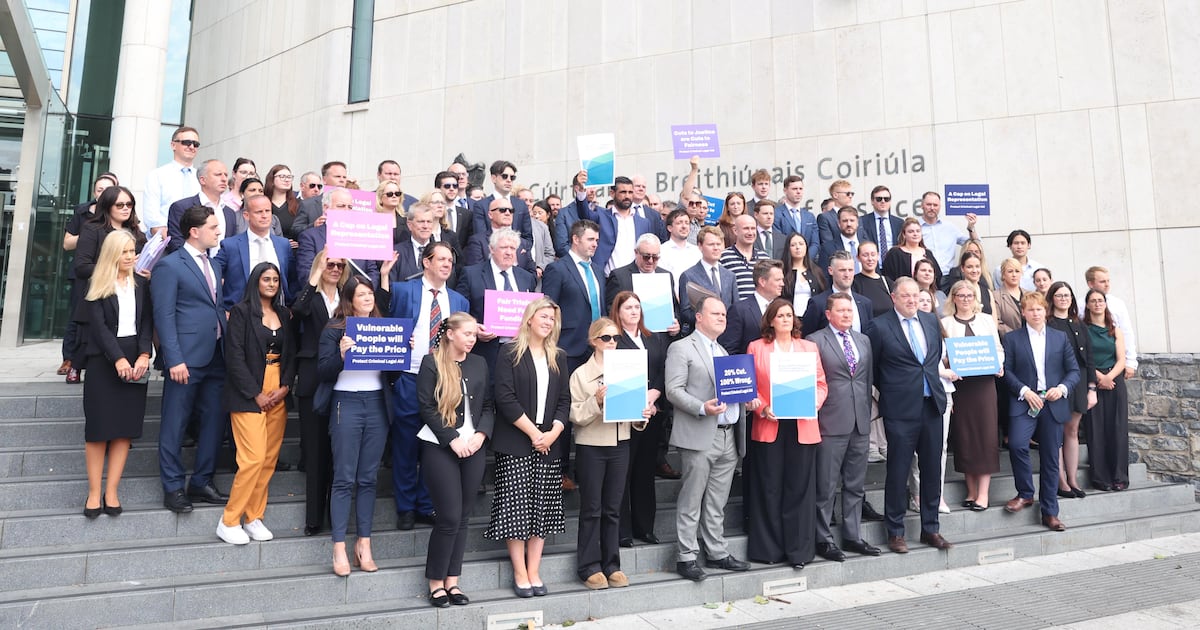
Criminal law solicitors have been urged by some colleagues to withdraw their services for emergency court sittings if a controversial new legal aid payments plan goes ahead.The calls were made at a packed meeting in Dublin on Tuesday of more than 150 solicitors to discuss the new “one flat fee” payment model for District Court criminal legal aid work, to be introduced by the Department of Justice on July 1st. As a result of the meeting, which ran for almost two hours in the Law Society headquarters, there were no instructing solicitors present for some cases in a number of courts around the country, including in Dublin, Trim, Wexford and Mayo. That led to some court hearings, including at Cloverhill District Court in Dublin, being adjourned to 2pm.The meeting heard calls for action, included for withdrawal of services for emergency court sittings in Dublin and around the country, including night sittings and sittings on Saturdays and bank holidays.Solicitors presented “a united front” and actions are expected “sooner rather than later”, one source said.In a statement, the Law Society said more than 150 solicitors attended the “information” meeting to address their concerns around “mounting access to justice challenges” with the proposed changes to the criminal legal aid system. Officials from the department were invited to the meeting but did not attend.The meeting was convened by the society’s criminal law committee and follows the publication of a Law Society Gazette survey of more than 200 criminal law solicitors, which found deep concern about the plan to replace the current appearance-based system with a flat-fee model for District Court criminal cases.In the survey, a large majority said the proposed changes would make it harder for defendants, particularly vulnerable defendants, to secure representation and would lead to delays in trials.The findings send “a clear message” that criminal law solicitors “do not believe the proposed model is fair, workable or sustainable”, the society said.Solicitor Shane McCarthy, chair of the committee, said the level of engagement by solicitors over the department’s proposals showed their concerns “are serious, widely shared and cannot be dismissed”. The message from solicitors is the proposals would lead to them no longer taking on District Court legal aid work, “with inevitable consequences for defendants, the courts and the wider justice system”, he said. “Solicitors welcome real reform, but these proposals are a cost-cutting measure dressed up as reform,” he said. The department must address the concerns “before pressing ahead with changes that will have lasting and harmful effects”.Solicitor Amanda Connolly, vice-chair of the criminal law committee, said there was a lot of anger and “a feeling of palpable frustration” among solicitors at the meeting.Solicitors are angry about the department’s approach and “the lack of understanding and appreciation of the job we actually do and our very important role in the criminal justice system”, she said.“The services we provide for the most vulnerable in society are completely undervalued.” The department’s plan involves replacing the current payments system based on appearances with a single flat-fee for representation from the start to the end of a case, with the aim of reducing delays and simplifying representation. The new scheme follows a department review of more than 350,000 District Court cases during 2022 and 2023. The review noted expenditure on criminal legal aid in the District Court rose from €19 million in 2015 to €37 million in 2024.A core proposal is for a €455 “one accused, one fee” payment for an individual accused, irrespective of the number of appearances. Solicitors are currently paid €239.38 per accused for their first appearance, and €59.86 for each subsequent appearance.The plan also proposes a €100 flat fee for a District Court case referred to the Circuit Court, involving an average nine court appearances.
Solicitors consider withdrawal of services over new criminal legal aid payments
Some courts delayed as 150 solicitors meet over Department of Justice proposals
623 words~3 min read