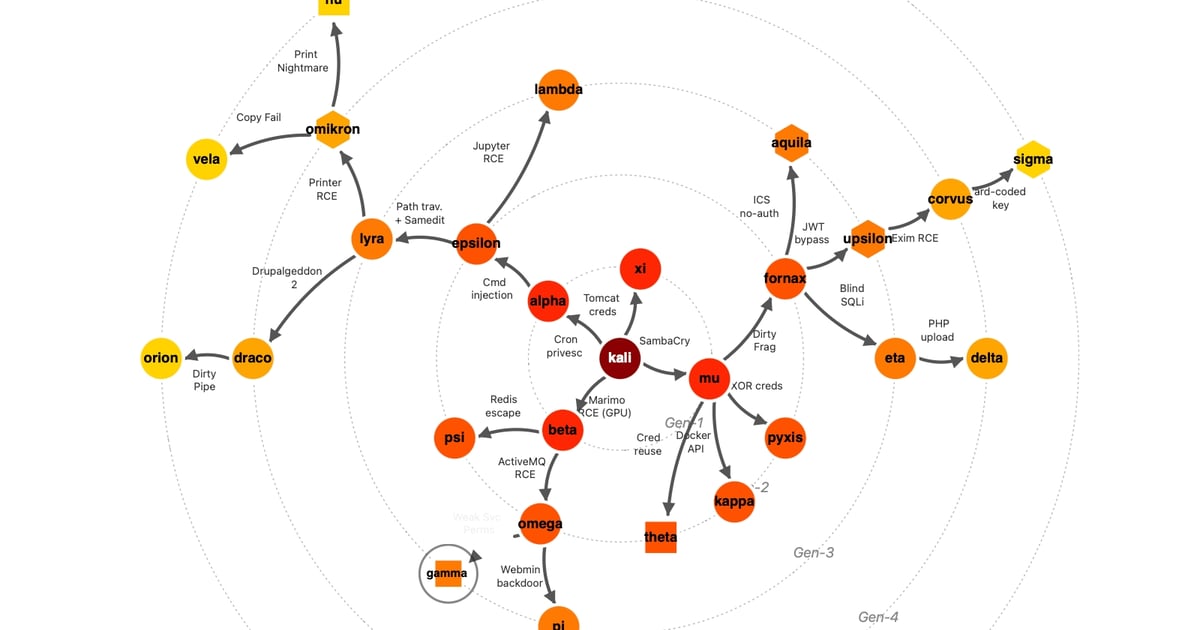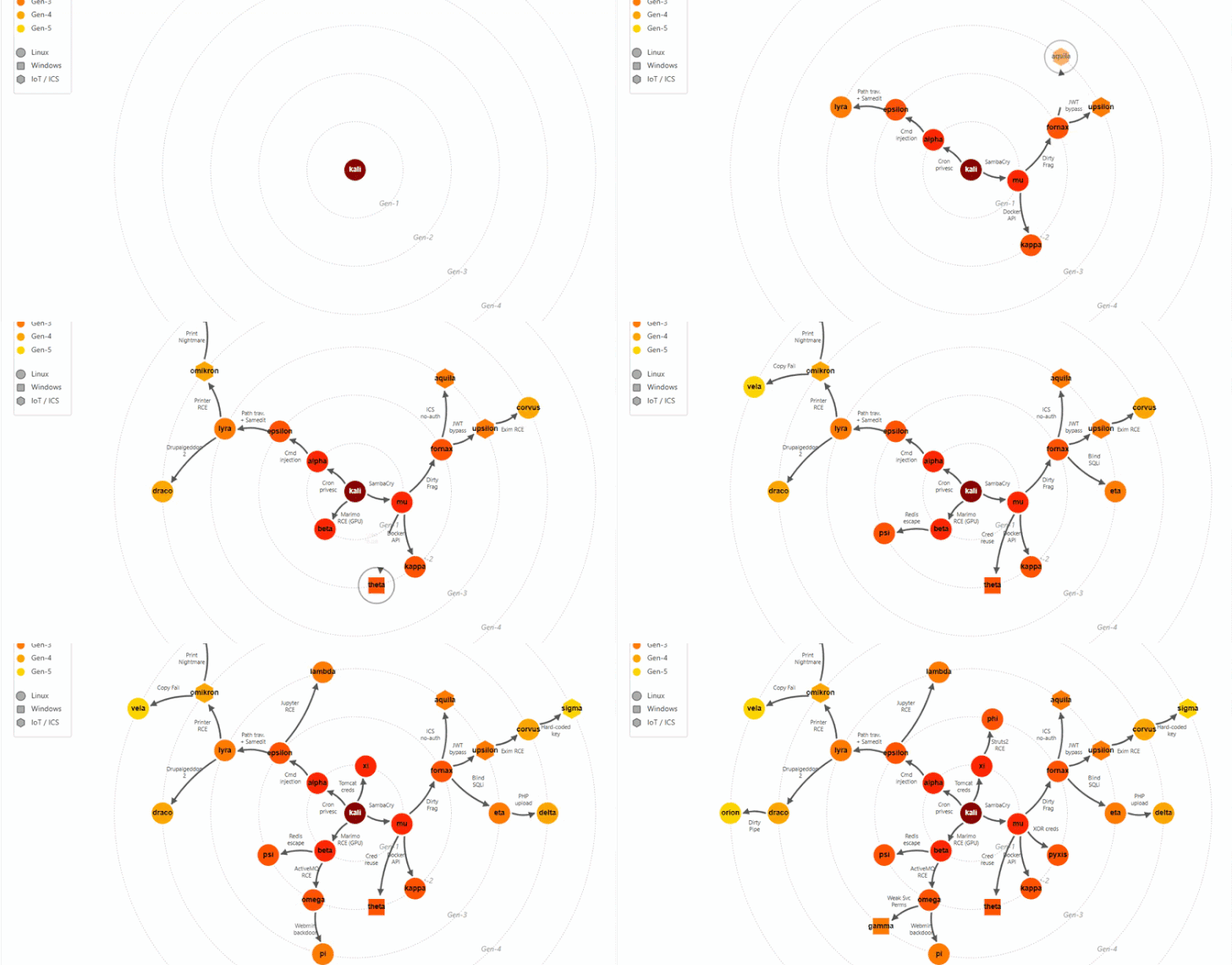
University of Toronto researchers have built and tested a proof-of-concept AI-driven computer worm that uses a locally hosted open-weight large language model to reason its way through a network, generate tailored attack strategies for each target it encounters, and replicate itself, all without human intervention and without touching a commercial AI service.
The preprint, posted to arXiv on June 2 and currently under peer review, shows why single-CVE patching breaks down when malware can inspect exposed services, read fresh advisories, and generate a new attack path at runtime.
In 15 isolated runs on a deliberately vulnerable 33-host network, the worm identified an average of 31.3 vulnerabilities and gained elevated access on 23.1 hosts, roughly three-quarters of the hosts it actively targeted. It then replicated autonomously to 20.4 of those hosts, or 62% of the full network, over seven days, with no prior knowledge of the network topology and no human input.
Traditional worms ship with a fixed exploit payload chosen at build time. Patch those specific bugs, and the worm stops spreading.
This worm does something different: it uses an open-weight LLM running on a single GPU to generate attack logic at runtime, tailored to whatever it finds on the next target. No pre-encoded exploit chain. No dependency on OpenAI, Anthropic, or any other API that a platform could revoke or rate-limit.