RBI: Opting for a cautious approach
| Photo Credit:
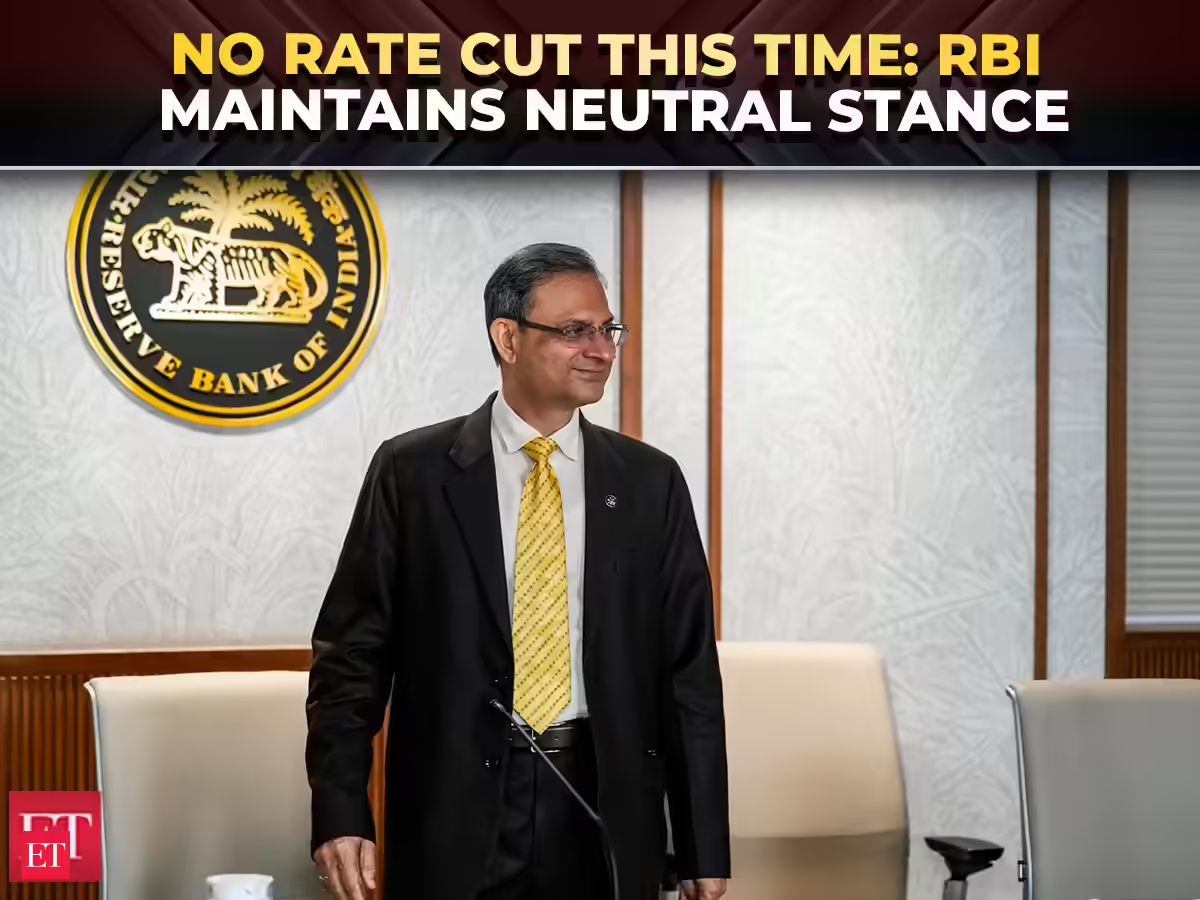
The Reserve Bank of India’s Monetary Policy Committee (MPC) has chosen caution over activism. In its June policy review, the MPC unanimously kept the repo rate unchanged at 5.25 per cent and retained its neutral stance with SDF rate at 5 per cent, MSF and bank rate at 5.5 per cent, even as it lowered its FY2026-27 GDP growth forecast from 6.9 per cent to 6.6 per cent and raised its inflation projection from 4.6 per cent to 5.1 per cent. Nonetheless, the RBI’s decision reflects a sober assessment of the extraordinary uncertainties confronting the economy.The central bank is acutely aware that the current inflationary pressures are largely imported and supply-driven. Crude oil prices remain roughly 30 per cent above their pre-conflict levels as the West Asia crisis continues to threaten energy supplies and key shipping routes. Disruptions to global trade corridors have increased the risks to the availability and cost of several critical goods. At the same time, global economic conditions are becoming less supportive.Rising uncertainty is generating greater risk aversion among households and businesses alike. Investment decisions are being postponed, discretionary consumption is softening, and foreign portfolio investors continue to pull money out of emerging markets.A slowing global economy could further weaken India’s exports and moderate remittance growth, both important pillars of external demand. Financial market spill-overs are also tightening domestic liquidity conditions and increasing volatility across asset markets.Economic threatsThe RBI, therefore, finds itself confronting a situation in which supply shocks are threatening growth as much as inflation. If these disruptions persist, they may eventually transform into a broader demand shock.However, against this backdrop, the central bank’s decision to preserve policy flexibility appears sensible. There are several reasons why the RBI is holding on to its monetary “dry powder”.First, inflation, while rising, remains within the RBI’s tolerance band. More importantly, the recent surge in wholesale price inflation suggests that cost pressures are building upstream, but the pass-through to consumer prices remains limited. The evidence so far does not indicate a generalised inflation spiral.Second, the RBI has actively used the foreign exchange market to contain excessive currency volatility. While the rupee has depreciated amid higher oil prices and capital outflows, the adjustment has been relatively orderly. The objective has not been to prevent depreciation altogether but to avoid destabilizing swings that could aggravate inflation expectations and financial stress. By intervening judiciously and now introducing new measures to boost capital inflows, the RBI has allowed the exchange rate to reflect economic fundamentals while limiting disorderly market conditions while supporting the rupee.Policy rates decisionsThird, a premature rate hike could do more harm than good. Monetary tightening cannot produce more oil, reopen disrupted shipping routes, or lower global fertilizer prices. What it can do is further suppress domestic investment and consumption at a time when external demand is already weakening.Equally, an immediate rate cut would risk sending the wrong signal amid rising inflation expectations and pressure on the rupee. The RBI is therefore choosing patience. It is effectively waiting for greater clarity on several crucial variables: whether the West Asia conflict de-escalates, whether the southwest monsoon remains normal and keeps food prices under control, whether remittance inflows remain resilient, and whether global commodity markets stabilize in the coming months.This is not complacency. The MPC’s revised forecasts clearly indicate that policymakers recognize the inflationary risks ahead. If the current pressures intensify and the spectre of broader inflation begins to emerge, the RBI has made it clear that it stands ready to administer the necessary bitter medicine.For now, however, prudence demands restraint. Like many major central banks confronting an uncertain global environment, the RBI has chosen a wait-and-watch approach. With growth risks rising, inflation pressures still evolving, and geopolitical uncertainties dominating the outlook, preserving policy flexibility may be the wisest course available.The writer is a Professor at Madras School of EconomicsPublished on June 9, 2026