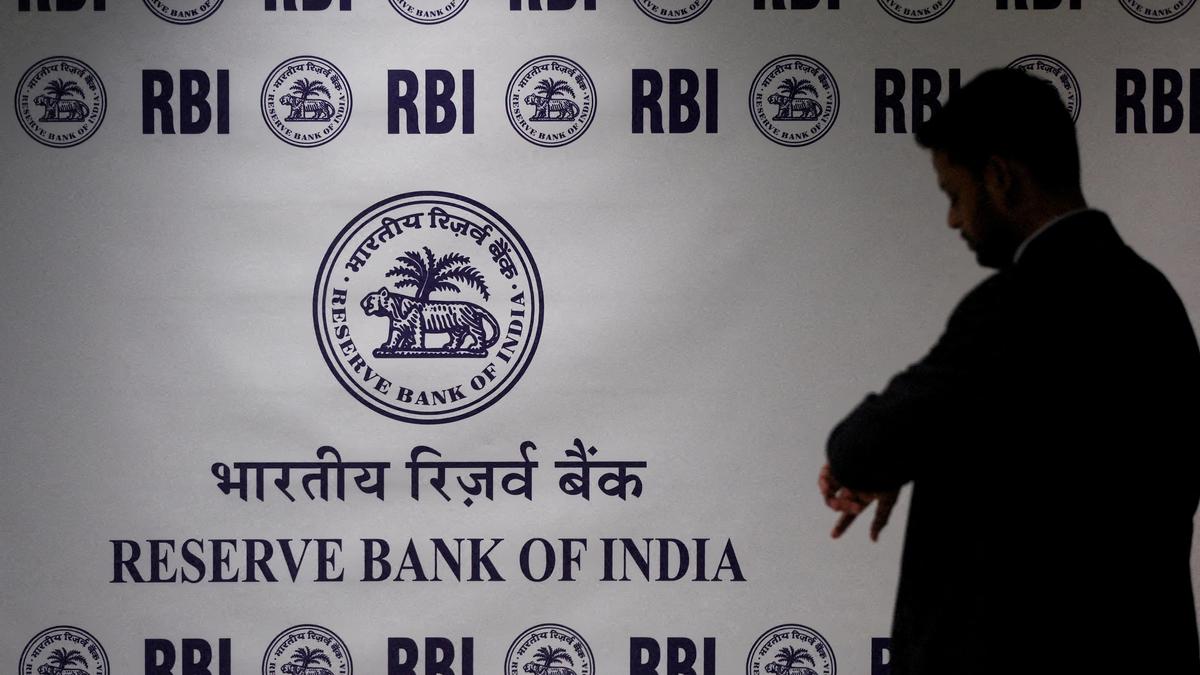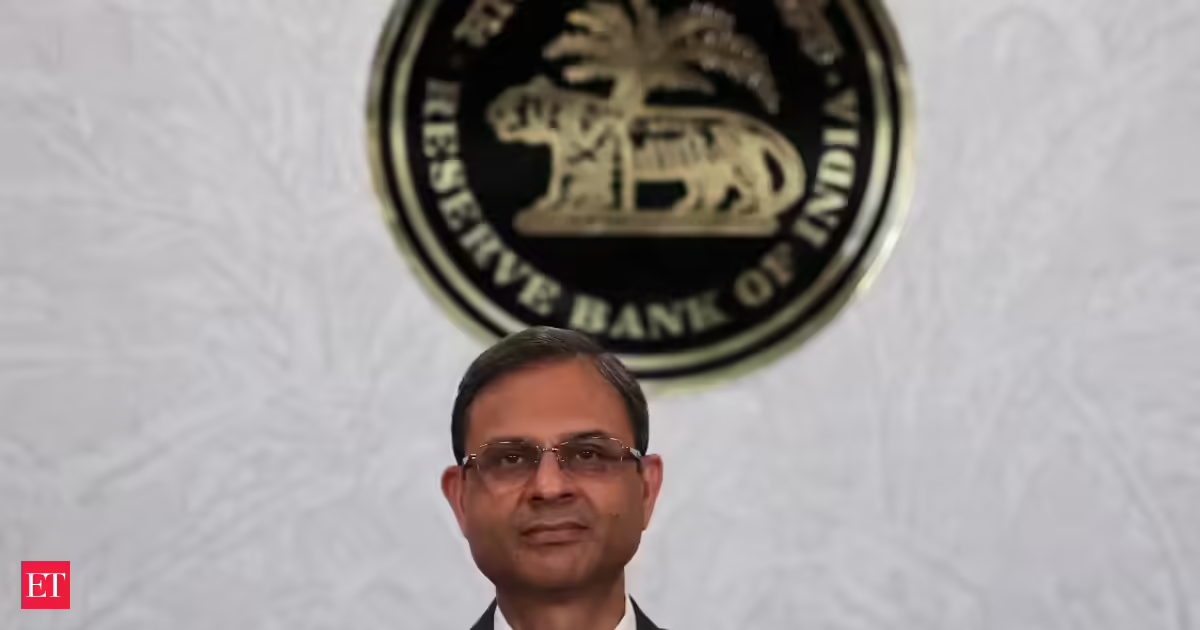
FILE PHOTO: man stands in front of the Reserve Bank of India (RBI) logo inside its headquarters in Mumbai, India, February 6, 2026. REUTERS/Francis Mascarenhas//File Photo
| Photo Credit:
All six members of the rate-setting Monetary Policy Committee (MPC) preferred a cautious “wait and watch” approach over immediate policy action amid rising inflation risks, slowing growth and powerful external shock emanating from the West Asia conflict, going by the minutes of their meeting released by the RBI on Friday.At the MPC meeting held during June 3 to 5, the members voted unanimously to keep the policy repo rate unchanged at 5.25 per cent and also decided to continue with the neutral stance.Inflation targetRBI Governor Sanjay Malhotra observed that while headline inflation continues to remain within the target, CPI inflation for 2026-27 is now projected to be above target at 5.1 per cent.“The increasing inflation trajectory for 2026-27 with its peak of 5.9 per cent in Q3 (October-December) – close to the upper tolerance level of 6 per cent – may suggest the need for monetary policy action. However, I would prefer to wait and watch...We should remain watchful and wary about the generalisation of inflation in the coming months.”“There is high uncertainty in the assumptions made for projections of both inflation and growth on account of several reasons – the duration of the conflict and the disruption in supply chains, the intensity and geographical spread of monsoon and their impact on energy, food and other commodity prices,” he said.Emphasising on the need to be watchful of the inflation trajectory, Malhotra cautioned that going forward, revision in retail prices of petrol and diesel in May would lead to higher fuel inflation in the coming months.“While the near-term outlook for food prices remains favourable on account of a good rabi crop and adequate stocks, risks have amplified, especially from a below normal monsoon as predicted by the IMD and likely El Niño conditions.“Average crude prices have increased sharply from what were assumed in April; WPI for April is elevated; consequently, cost pressures from higher energy and other input prices could also feed into core inflation,” the Governor said.Therefore, the MPC would continue to be data dependent and remain vigilant about inflation getting generalised, which can unhinge inflation expectations.Poonam Gupta, Deputy Governor, RBI, observed that the MPC ought to wait a bit more for global and weather related uncertainties to play out over the coming months, before taking a call on whether and when to reverse the policy cycle.“This is for two reasons. First, at the current juncture, with growth projected to decelerate and inflation yet to become entrenched, I do not see a case for policy tightening to rein in inflation or inflationary expectations. If anything, it could make the economic pain of the ongoing supply shock sharper,” she said.Second, once the West Asia conflict is resolved, the outlook, both for India as well as globally, could improve rapidly warranting a fresh look at the inflation-growth dynamics. Therefore, it would be prudent to adopt a wait and watch approach rather than make an early or preemptive policy pivot, Gupta said.Indranil Bhattacharyya, Executive Director, RBI, opined that while demand-pull inflation may call for pre-emptive action to effectively anchor inflation expectations, cost-push inflation induced by supply shocks warrants greater caution – gradualism – in policy making.“In view of these factors, I feel it is prudent to wait for greater clarity to emerge from the data before deciding on any policy action,” he said.Ram Singh, Director, Delhi School of Economics, said that as long as the West Asia conflict persists and the impact of El Niño remains unquantified, it makes sense for the MPC to retain all the flexibility needed to respond to evolving inflation and growth trajectories.“A “neutral” stance provides the MPC with maximum operational flexibility without being constrained by previous commitments. If external shocks worsen or the second-round price effects spread widely, the neutral stance allows us to adjust policy to protect macroeconomic stability,” he said.Saugata Bhattacharya, Mumbai-based Economist, said given the multiple overlapping geo-economic shocks clouding the future, he believes that risk management is now the most sensible approach to monetary policy responses.“The chances of a policy mistake remain heightened given the two-way risks on the inflation-growth outlook. However, given the MPC forecasts on growth and inflation, and factoring in the elevated and rising inflation expectations, we must now closely monitor second order input cost transmission getting embedded in retail inflation.“This will depend on the intensity and duration of the energy shock. Despite my concerns, I must cautiously note that, as of early June ’26, I do not see material signals of economic overheating. Hence, the policy repo rate is currently appropriate and a status quo at the June ’26 review is likely to have the lowest economic cost,” he said.Nagesh Kumar, Director and Chief Executive, Institute for Studies in Industrial Development, New Delhi, said notwithstanding the factors that make the Indian economy better equipped to withstand the current shock than the previous ones, the economic outlook has been adversely affected.Growth projectionThe growth projection for 2026-27 at 6.6 per cent is 100 basis points lower than the 2025-26 growth rate of 7.6 per cent (the second advance estimates). The CPI headline inflation is projected at 5.1 per cent for 2026-27, representing a 300-basis point increase over the very benign rate of 2.1 per cent for 2025-26. These projections are obviously subject to a lot of uncertainties surrounding the duration of the West Asia conflict.Kumar observed that in the highly uncertain current economic environment, prudence requires waiting for greater clarity to emerge on the impact before any monetary policy response.Published on June 19, 2026