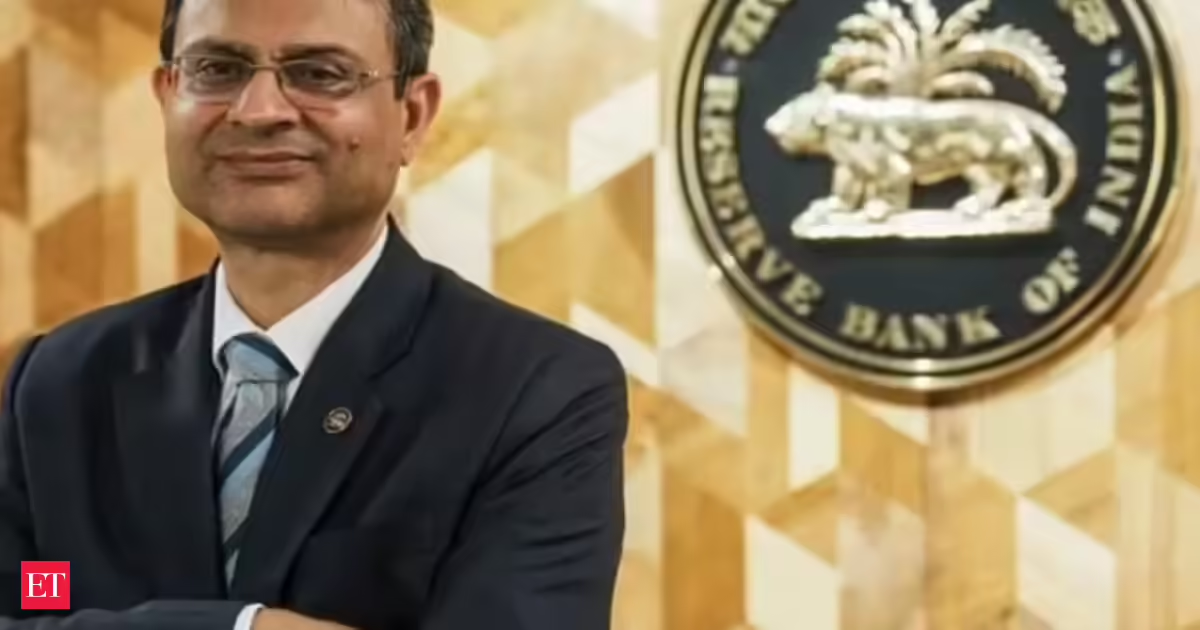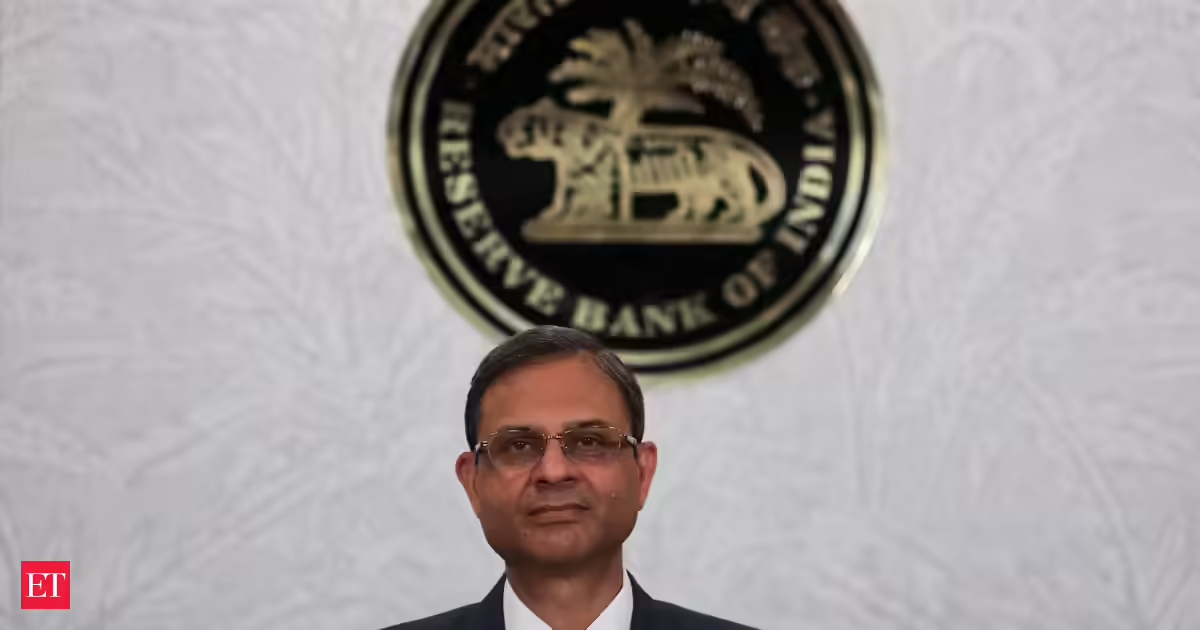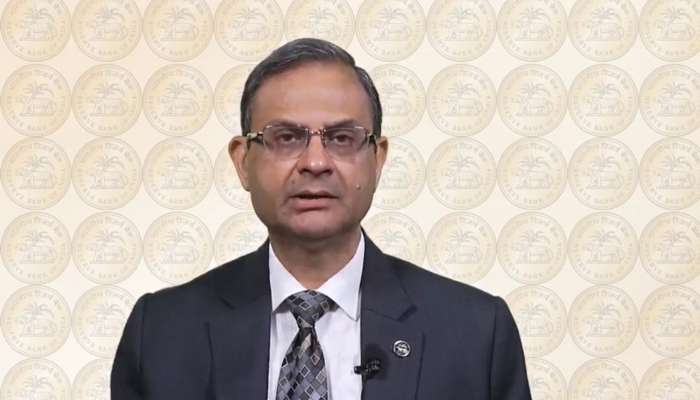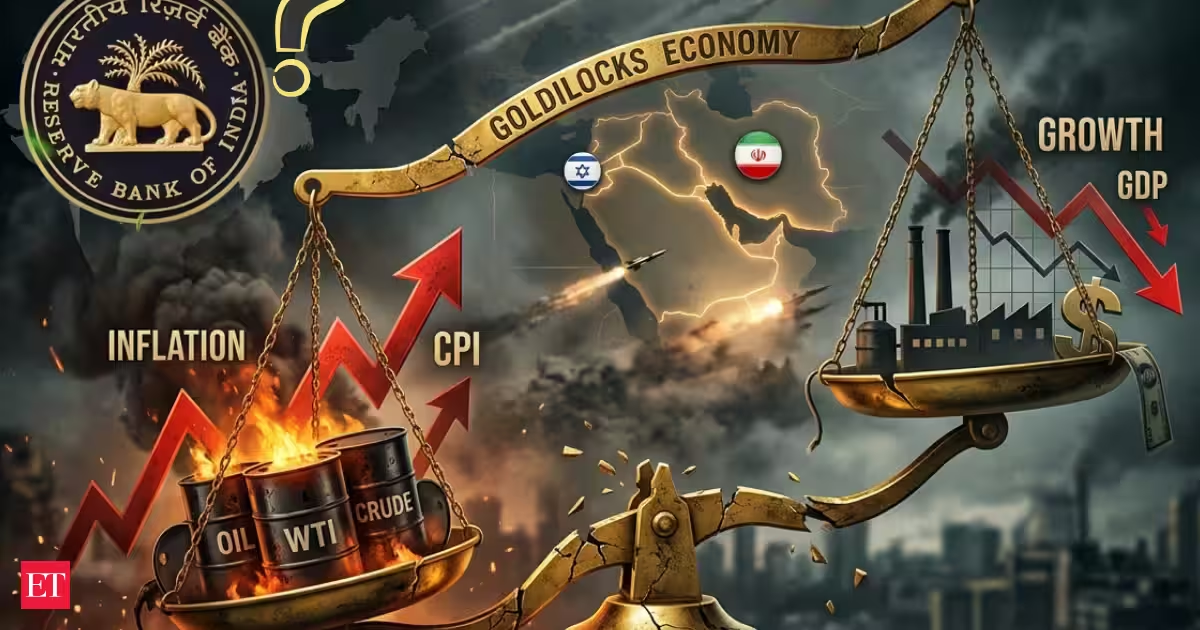
The Monetary Policy Committee (MPC) of the Reserve Bank of India maintained status quo on monetary policy rate and stance – they continue to be 5.25% and neutral – on Friday even as it reduced its growth forecast and increased its inflation forecast for the year, recognising the challenges ahead.RBI announced a slew of measures to attract more foreign capital in the economy. (Representational Photo/PTI)RBI also announced a slew of measures to attract more foreign capital in the economy. Analysts see its actions as a rightful reiteration of “principle of separability” in India’s Inflation targeting framework, where interest rates tackle growth-inflation balance and other measures are deployed to address external sector challenges.The Indian economy is expected to grow at 6.6% in 2026-27 with an inflation of 5.1% according to MPC’s projections released on Friday. The latest growth and inflation projections entail a 30 basis point downward revision in growth and 50 basis point upward revision in inflation from the April forecasts. One basis point is one hundredth of a percentage point. Next year’s projected GDP growth is 110 basis point less than the 7.7% growth in 2025-26, as per the provisional growth numbers for last year released on Friday.The primary reason for the adverse movement in the growth-inflation balance is the disruption from the ongoing war in West Asia. “As the West Asia conflict prolongs without any meaningful resolution in sight, risks to both inflation and growth have increased”, the MPC resolution notes.MPC’s quarterly projections suggest that the economic headwinds from the war will continue to matter for the entire year and not just the immediate period. Quarterly growth projections now stand at 6.6%, 6.3%, 6.5% and 6.8% for June, September, December and March quarters instead of April projections of 6.8%, 6.7%, 7% and 7.2%. Inflation is expected to remain at 4.2%, 5.1%, 5.9% and 5.4% in the four quarters instead of 4%, 4.4%, 5.2%, 4.7% in the April projections.The economic situation is expected to become worse before it gets better, as evident in MPC’s assessment that “while the economy has withstood the conflict spillovers with limited impact so far; the strains are increasingly becoming visible”.That MPC would not change interest rates was widely expected by the markets as inflation is expected remain within the 4%-6% target band of RBI. MPC has reiterated that it will “continue to remain data dependent” in the future and watch out for supply shocks, both on account of the ongoing war and a weaker than normal monsoon rainfall. What is giving comfort to MPC is a benign core inflation environment, which it believes will remain at 4.7% in 2026-27 and much lower if precious metals were to be excluded and suggests that “demand pressures remain contained” in the economy.To be sure, what made Friday’s MPC meeting a keenly watched event was not its usual policy rate response to the growth-inflation dynamics under the inflation targeting mandate but the turbulence on the external front which is manifested in a significant depreciation in the rupee and growing capital account pressures on the Indian economy. While the MPC resolution does not say much about this, given its mandate being restricted to inflation targeting, RBI Governor Sanjay Malhotra announced a slew of measures, in tandem with the fiscal arm of the economic policy, to address the challenges.The crux of these announcements is sweetening the terms of trade for foreign investors in debt and equity markets. The measures announced include (via an ordinance amending the income tax act) waiver of capital gains tax on investment in government bonds, allowing greater play to foreign investors in both equity and government bond markets. Governor Sanjay Malhotra said that he expects a “healthy flow of foreign exchange flows” as a response to these measures. He also reiterated that there are no plans to impose any capital controls in the economy.Experts welcomed the measures but see their ability to address the challenge as partial.“The plethora of measures announced at today’s RBI meeting are comprehensive and wide ranging. They address a number of concerns expressed by foreign investors and will likely result in a pickup in capital inflows over the months ahead. This would help address some of the external financing concerns, but will not resolve India’s structural BoP issues. We think India requires roughly $7-8bn per month in capital inflows to balance the BoP. This is still sizeable, and while the measures may add up to $5bn per month of incremental inflows over the next few months, it does not fill the gap entirely”, a research note from Barclays said.“First, as we had indicated, India’s Inflation targeting framework has established a principle of separability over the last decade, with rates and liquidity being used to address inflation while other instruments (sterilized FX intervention and regulatory policy) are used to combat external sector pressures. We had therefore resisted the notion – built into market pricing -- that RBI would hike rates to defend the Rupee. Today’s announcements -- a pause on rates juxtaposed with regulatory easing to attract capital flows -- reinforces that separability and underscores RBI will not use rates to combat Rupee pressures”, JP Morgan Chief India Economist Sajjid Chinoy said in his note, adding that one of the announcements by the governor could be aimed at potentially unlocking a critical source of flow of external funds. “Earlier the government had eliminated all withholding taxes and capital gains taxes on government bonds for foreign portfolio investors. The key will be whether this, in conjunction with the expansion of the FAR route, will be sufficient for India to get included in the Bloomberg Barclays Index, and attract a large quantum of sticky debt inflows”, Chinoy’s note says.To be sure, there could be a rate hike in the near term, according to some analysts. “We now expect a 25bp rate hike in the August meeting (3Q26), followed by another one in the October meeting (4Q), versus our earlier expectation of two hikes over 4Q26 and 1Q27, taking the repo rate to 5.75%,” Pranjul Bhandari Managing Director, HSBC Chief India Economist.
RBI keeps rates steady, takes steps to attract foreign capital
The primary reason for the adverse movement in the growth-inflation balance is the disruption from the ongoing war in West Asia. | India News
1,006 words~5 min read