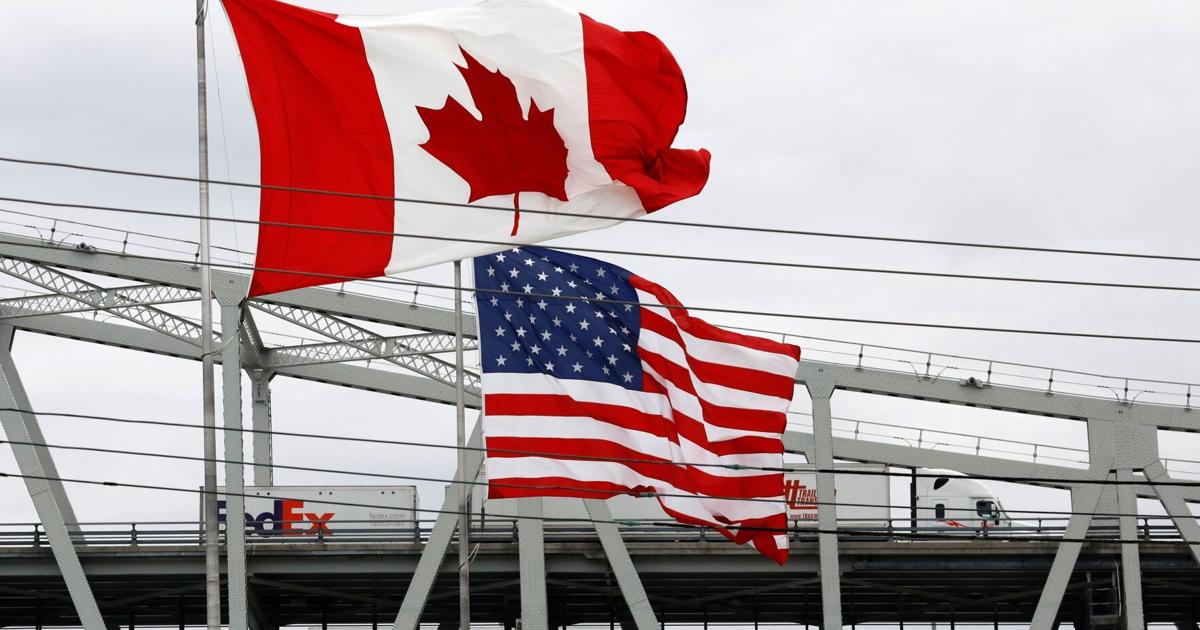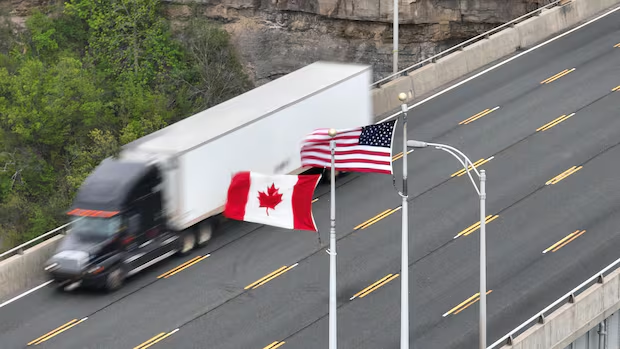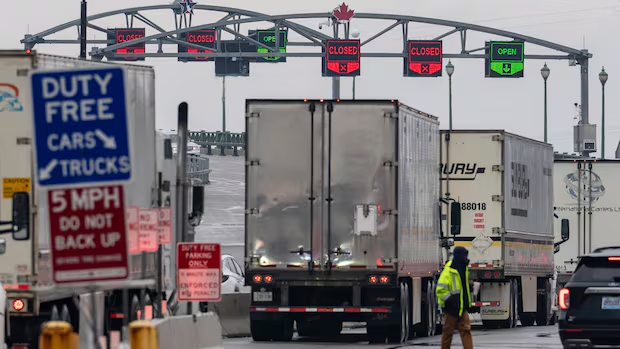
BusinessCanadian businesses that comply with CUSMA were spared in the Trump administration's latest tariffs, but for many of them, it hasn't brought a total sigh of relief as compliance has come with its own set of frustrations. "It's actually quite a nightmare," says the co-owner of a puzzle company in Ottawa.Some small companies find tariffs 'less bitter pill' to swallow than CUSMA compliance, CFIB head saysKevin Maimann · CBC News · Posted: Jun 08, 2026 4:00 AM EDT | Last Updated: 7 hours agoListen to this articleEstimated 7 minutesThe audio version of this article is generated by AI-based technology. Mispronunciations can occur. We are working with our partners to continually review and improve the results.Trucks stop near the Peace Bridge at the U.S.-Canada crossing in Buffalo, N.Y. For some small Canadian businesses, shipping products into the U.S. is a struggle because of costs associated with CUSMA compliance. (Yuki Iwamura/The Associated Press)A sigh of relief might have been expected when Canadian businesses learned the Trump administration's latest tariffs would spare companies that comply with the Canada-U.S.-Mexico Agreement (CUSMA). But after scrambling to become CUSMA-certified in the face of last year's U.S. tariffs, some business owners say compliance has brought its own set of frustrations.Ray Kanani, co-owner of Good Fortune Puzzle Co. in Ottawa, said brokerage fees that shippers are charging to certify CUSMA goods, and other complications around cross-border shipping, have forced his business to restrict where it sends its products."Right now, a made-in-China product has a 10 per cent tariff. So if I'm selling a $50 product, I pay $5," Kanani said. "But if I sell a CUSMA-compliant product, I'm paying $10 to the broker just to certify and have the paperwork that it's CUSMA compliant." Kanani said those costs involve shippers including UPS and FedEx, which are doing more work for cross-border processing. "It's actually quite a nightmare." Trump to hit more than 60 countries, including Canada, with new tariffs over 'forced labour'Carney says latest Trump tariffs 'not a surprise' after U.S. promises new 10% levy on CanadaLast week, the U.S. announced plans to impose new tariffs on over 60 countries that are allowing goods allegedly made by forced labour. The new levies would include 10 per cent on exports from Canada. The tariffs would apply only on goods that don't comply with CUSMA's "rules of origin," a set of standards that determine how many goods should be produced in North America. Last August, Trump hit non-CUSMA-compliant goods exported to the U.S. from Canada with a 35 per cent tariff, sparking a scramble for Canadian companies to comply. Fitch Ratings Inc. said 81 per cent of goods exported to the U.S. from Canada were compliant with CUSMA by mid-August, up from 56 per cent three months earlier. We love our Canadian customers and we love being in Canada. It pains us not to be able to serve the Canadian market because of what's happening.- Ray Kanani, co-owner of Good Fortune Puzzle Co. in OttawaKanani said he and partner Jessica Sue, who work with a Canadian jigsaw puzzle manufacturer to develop artistic puzzles representing Asian cultures, were excited to have an entirely CUSMA-compliant product.But even after completing paperwork to get CUSMA-certified, some products sent to addresses in the U.S. were returned with no explanation. Kanani said they found the most reliable way to reach customers south of the border was through a fulfilment centre in the U.S.Good Fortune Puzzle Co. owners Jessica Sue and Ray Kanani, left to right, are dealing with frustrations around CUSMA certification. (Submitted by Ray Kanani)Kanani said it's too expensive to have major inventory sites in both countries, so he has prioritized the U.S. because it's the bigger market. Ironically, that means Good Fortune now only keeps a small amount of inventory in Canada and has had to stop selling to most customers here."We love our Canadian customers and we love being in Canada. It pains us not to be able to serve the Canadian market because of what's happening," Kanani said, adding he hopes to figure out a solution before the holiday season.CUSMA challenges facing small businessesDan Kelly, president and CEO of the Canadian Federation of Independent Business (CFIB), said he's heard similar concerns from other small businesses about CUSMA complications.Kelly said that for large businesses, the benefits often outweigh the costs of certification, but the reverse can be true for small businesses doing low-volume trade. Some smaller companies find tariffs a "less bitter pill" to swallow than "all of the headaches and costs associated with demonstrating CUSMA compliance," he said, including the sometimes laborious paperwork around getting certified."If you're, let's say, a distributor of nuts and bolts, you might have a thousand products in your inventory. Even as a small business, you're now going to have to have documentation certificates of origin for everything." New trade deal with U.S., Mexico unlikely, says B.C. jobs minister51st state 'a great discussion' for Trump and Carney, says Hoekstra as president trolls ahead of trade talksRuth Hoang, owner of Foxwood Gifts in Windsor, Ont., said the CUSMA certification paperwork was a "huge learning curve," but it hasn't been a significant financial burden in her case. Hoang, who sells to American customers on Etsy, said she ships goods through Stallion, costing an extra $2 per package and adding a few days to the shipping time. Ruth Hoang, who runs Foxwood Gifts in Windsor, Ont., says she's lost most of her U.S. customer base. (Emma Loop/CBC)But she's been hit hard by back-and-forth U.S. trade policies, losing 60 per cent of her U.S. customers after last August's tariff announcement. Hoang suspects many American Etsy customers, not knowing the distinction between CUSMA-certified and non-CUSMA-certified products, have filtered out international shippers out of fear of having to pay tariff costs.Thankfully, she's been able to make up for the loss by shifting to wholesaling in Canadian gift shops."It was a great pivot, especially last year with all this stuff going on." Shippers face 'complex' situationThe U.S. mandates that duties and tariffs be prepaid on all packages entering the country through the international postal network, even if they qualify for duty-free status under CUSMA. CUSMA exemptions can only be claimed when using commercial couriers.Those couriers say they've had to add extra charges because the rush to CUSMA compliance has strained them as well. WATCH | Analysis of CUSMA negotiations:CBC News Network’s Andrew Nichols speaks Sergio Marchi and Stephen Vaughn on CUSMA tradeJune 3|Duration 8:35Get the latest on CBCNews.ca, the CBC News App, and CBC News Network for breaking news and analysis.UPS spokesperson Natasha Amadi said the specific fees levied on products shipped from Canada to the U.S. vary widely."The process is very complex, and UPS has invested in the people and technology to serve customers who ship internationally," Amadi, who is based in Washington, D.C., told CBC News in an email. Getting around tariffsKelsey Irvine, CEO of Northbrook, Ont.-based skin-care company Birch Babe, said her business was planning a major U.S. launch before the 2024 U.S. election, but instead pulled out of the U.S. entirely rather than deal with complications around tariffs and CUSMA. "You're watching the devastating impact that it was happening and all the stress it was causing to so many other small businesses, and so we just stayed the course," Irvine said. That ended up being a blessing, as Birch Babe saw major growth in Canada. Birch Babe CEO Kelsey Irvine, founder Debbie Alger and COO Lindsay Irvine, left to right, are behind the Ontario-based skin-care company, which has found an innovative way to get around CUSMA and tariffs. (Momme Halbe)Irvine said the company meets CUSMA requirements, but has found a creative way to re-enter the U.S. market by developing a medical-grade sunscreen that's approved by the U.S. Food and Drug Administration (FDA). Because some over-the-counter drug products have been exempt from tariffs, she said, this adds a potential "extra layer of protection" amid changing tariff rules."The amount of stress that we would be putting towards trying to figure out this CUSMA thing that's changing every single day, and the logistics behind it, and revising everything, only to have it retracted and changed again — we just put that energy towards ... a really innovative product." A Global Affairs Canada spokesperson contacted by CBC News pointed business owners with CUSMA concerns to Canada’s Trade Commissioner Service CUSMA compliance toolkit, which includes guidance and a dedicated hotline "to help businesses understand rules of origin, certification and border procedures."Global Affairs advises small- and medium-sized businesses to work directly with U.S. importers and direct any refund‑related questions to U.S. Customs and Border Protection. ABOUT THE AUTHORKevin Maimann is a senior writer for CBC News based in Edmonton. He has covered a wide range of topics for publications including VICE, the Toronto Star, Xtra Magazine and the Edmonton Journal. You can reach Kevin by email at kevin.maimann@cbc.ca.
Canadian businesses under CUSMA get U.S. tariff reprieve. But the compliance pains are real | CBC News
Canadian businesses that comply with CUSMA were spared in the Trump administration's latest tariffs, but for many of them, it hasn't brought a total sigh of relief as compliance has come with its own set of frustrations. "It's actually quite a nightmare," says the co-owner of a puzzle company in Ottawa.
1,471 words~7 min read