Heat is something we encounter every day. A steaming cup of coffee gradually cools, a laptop warms up during use, and sunlight heats the Earth's surface. Yet when heat is examined at distances far smaller than the width of a human hair, it can behave in unexpected ways.
Researchers from Carnegie Mellon University, working with collaborators at Stanford University and Purdue University, have now demonstrated a powerful new method for controlling heat at the nanoscale. Their findings, published in Nature, provide strong experimental evidence that heat transfer can be intentionally engineered and significantly enhanced using specially designed metamaterials.
How Heat Moves Across Tiny Gaps
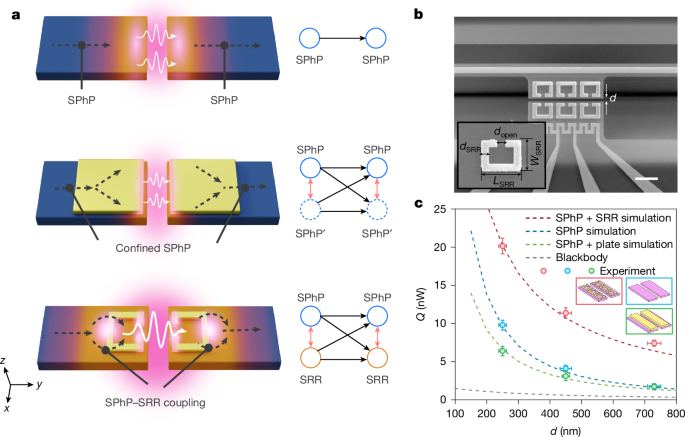
The research centers on a phenomenon known as near-field radiative heat transfer. When two objects are separated by an extremely small distance, only a few hundred nanometers, heat can travel between them much more efficiently than it does under ordinary conditions.
Instead of simply radiating outward, thermal energy can effectively tunnel across the narrow gap through electromagnetic waves. This process allows far more heat to flow from one object to another than would normally be expected.