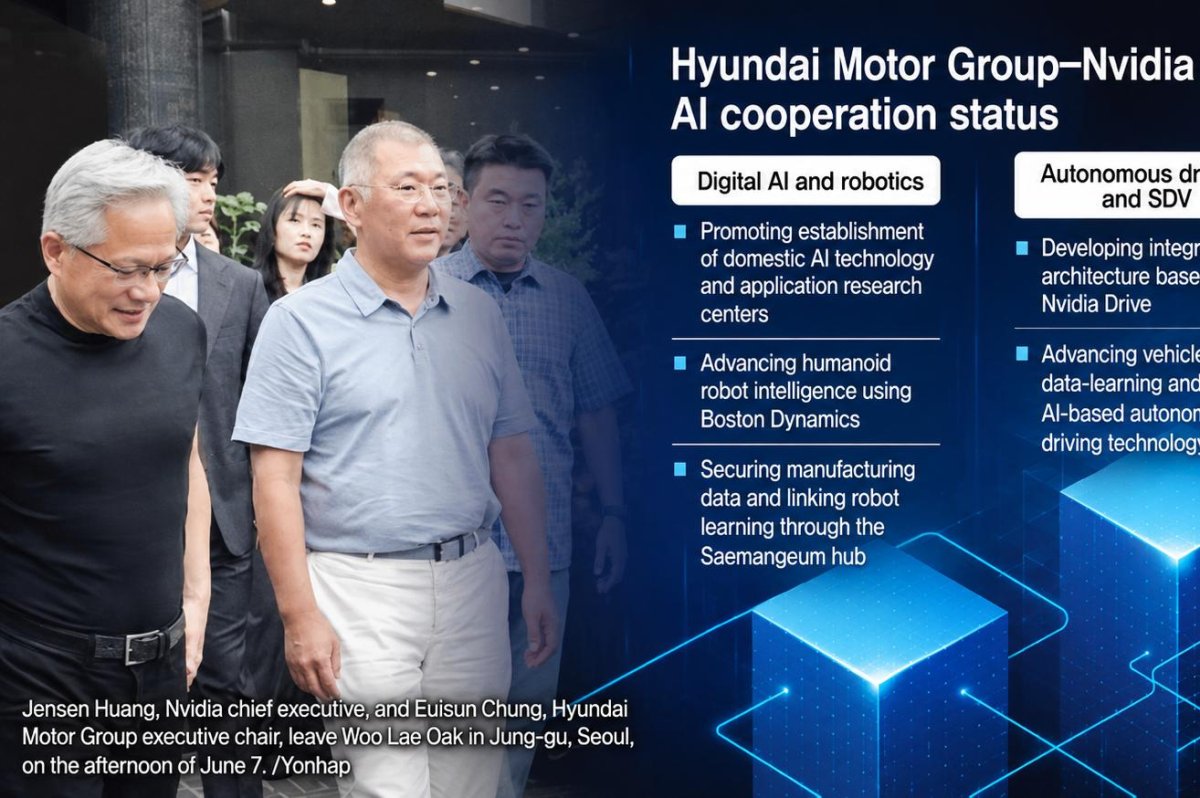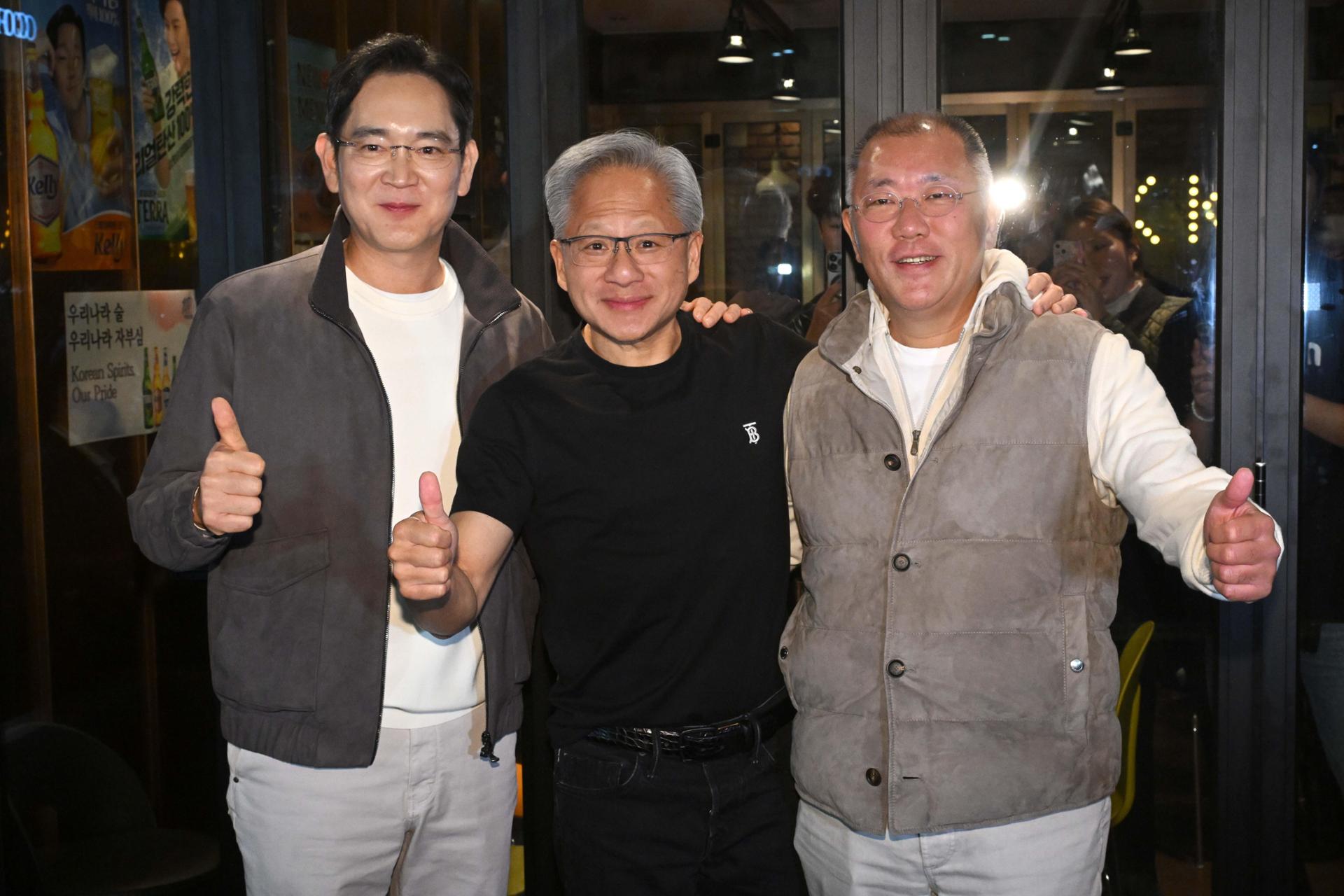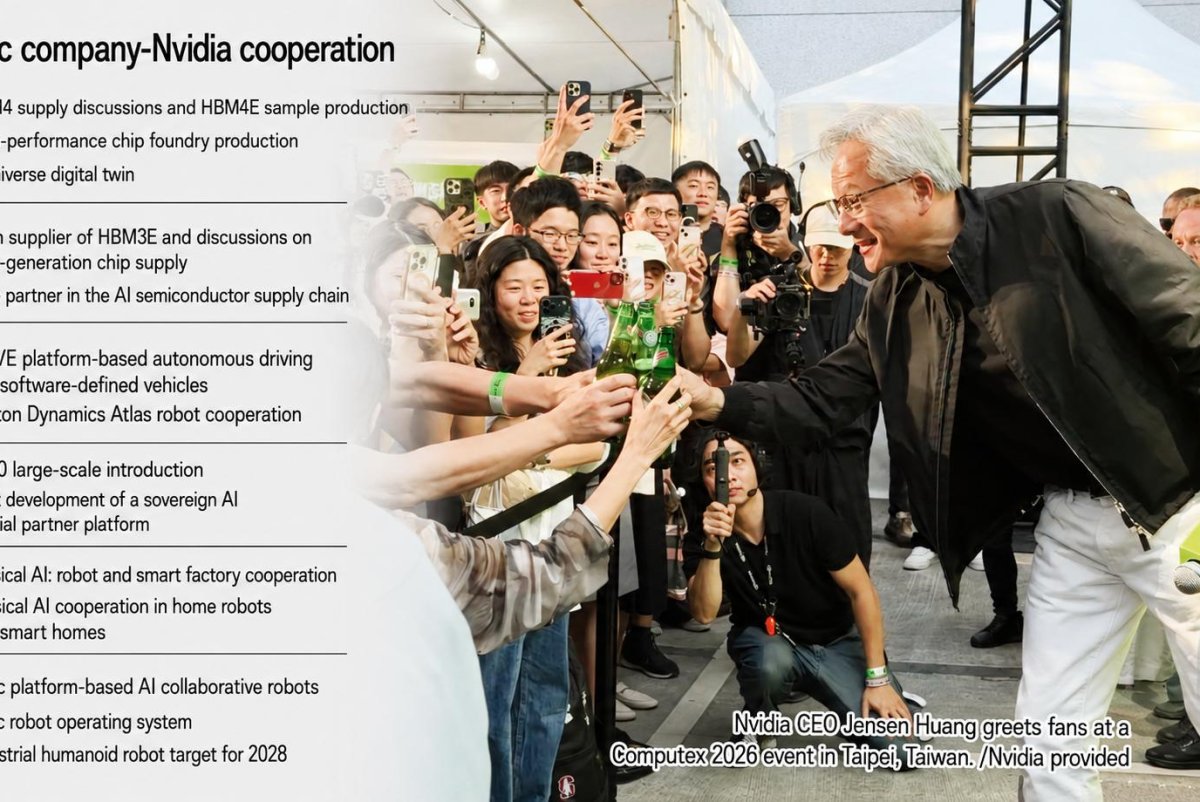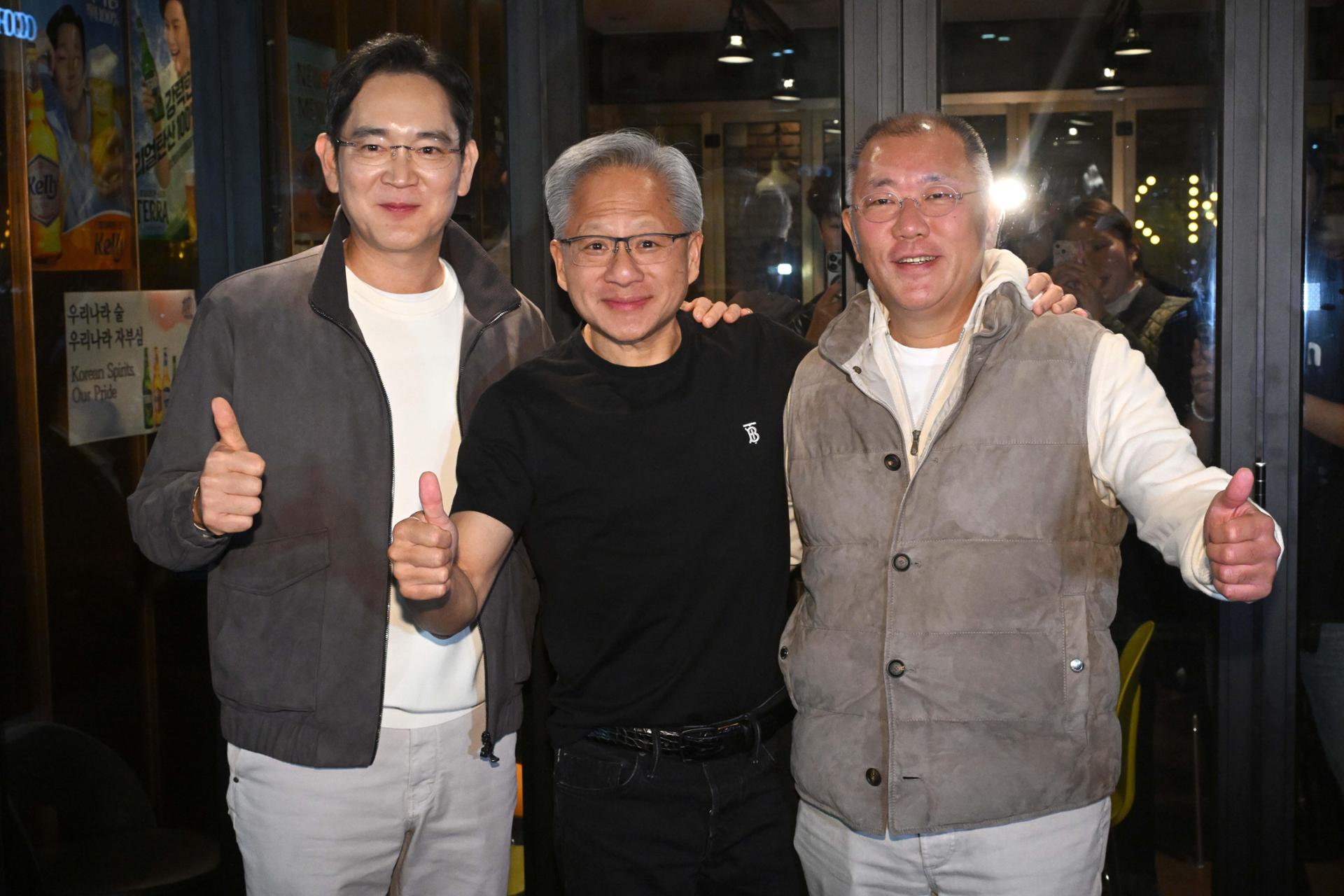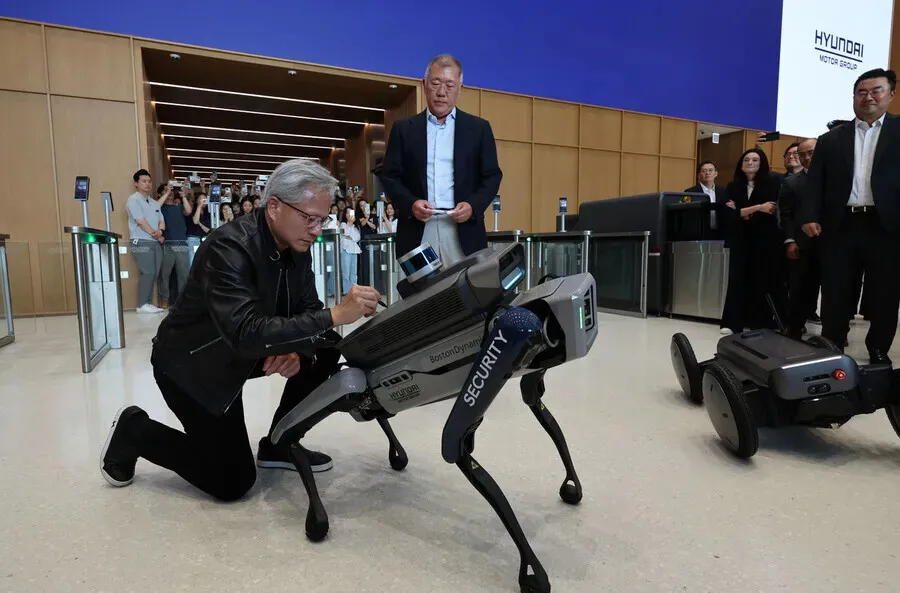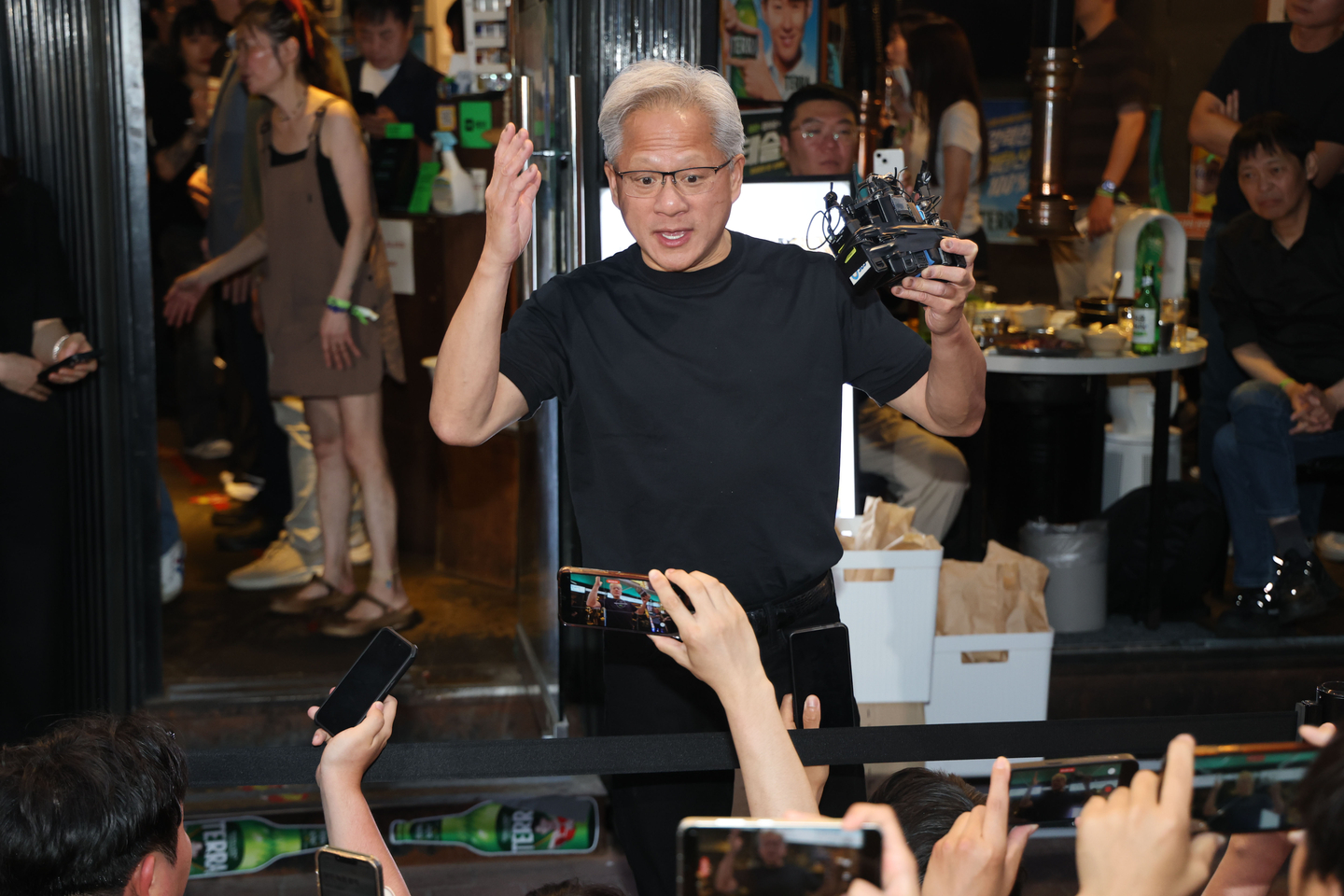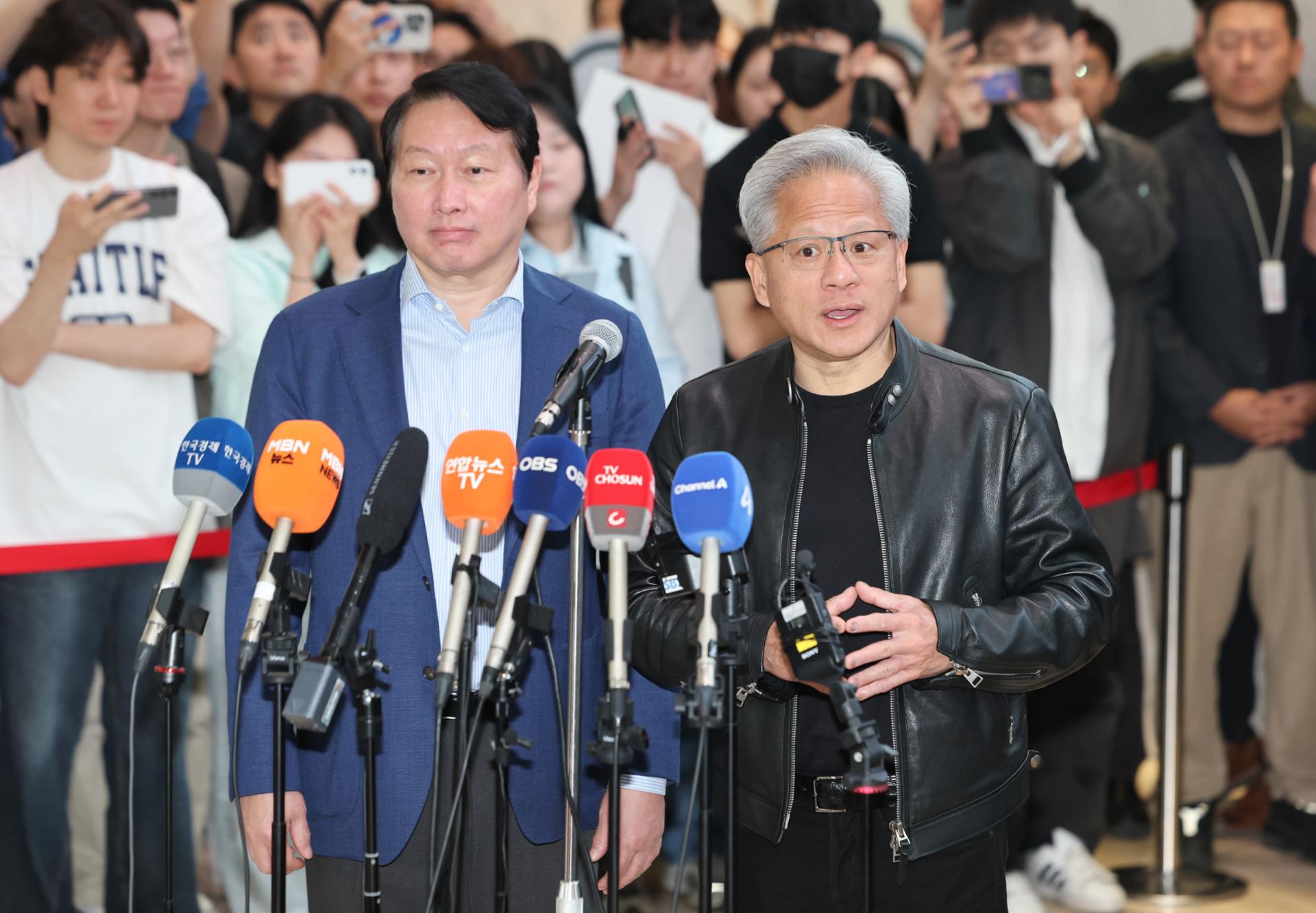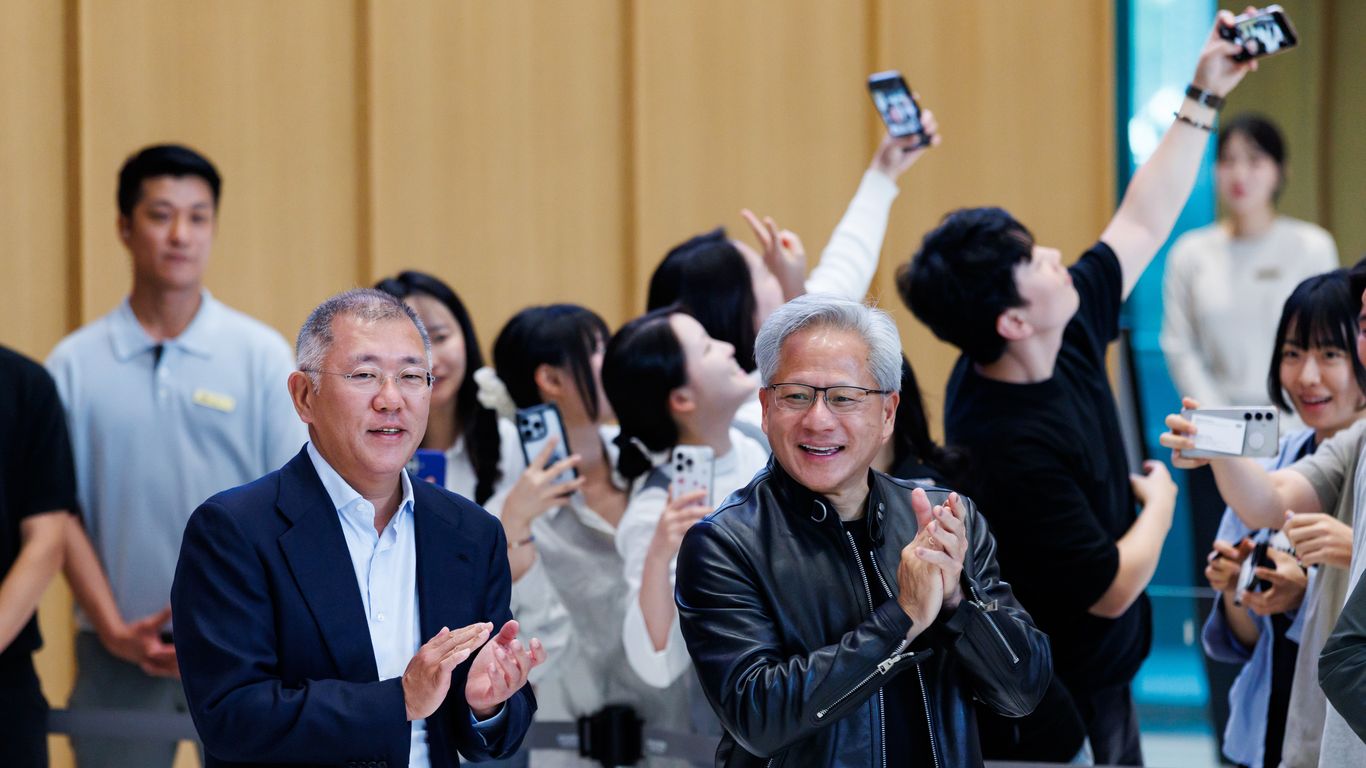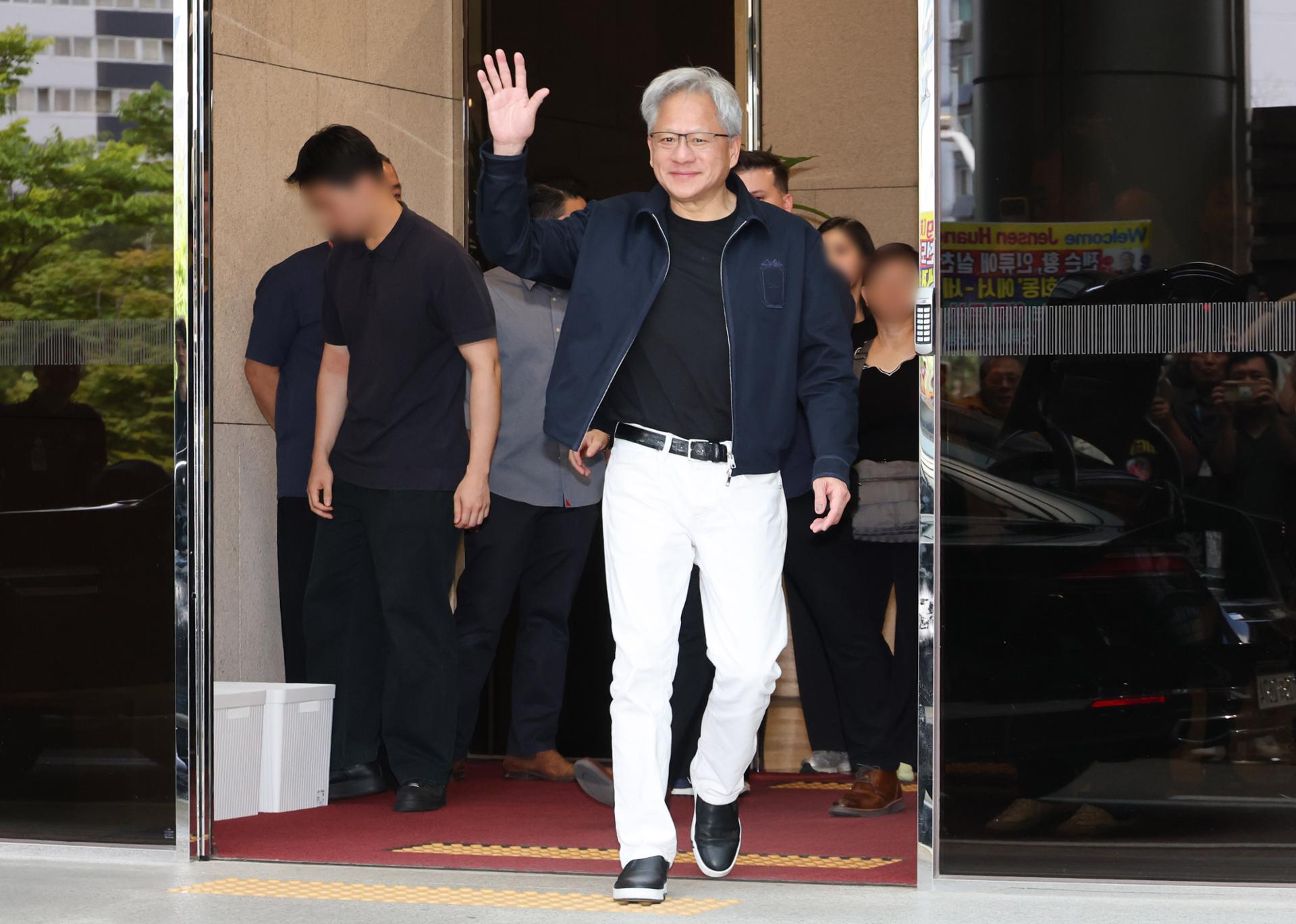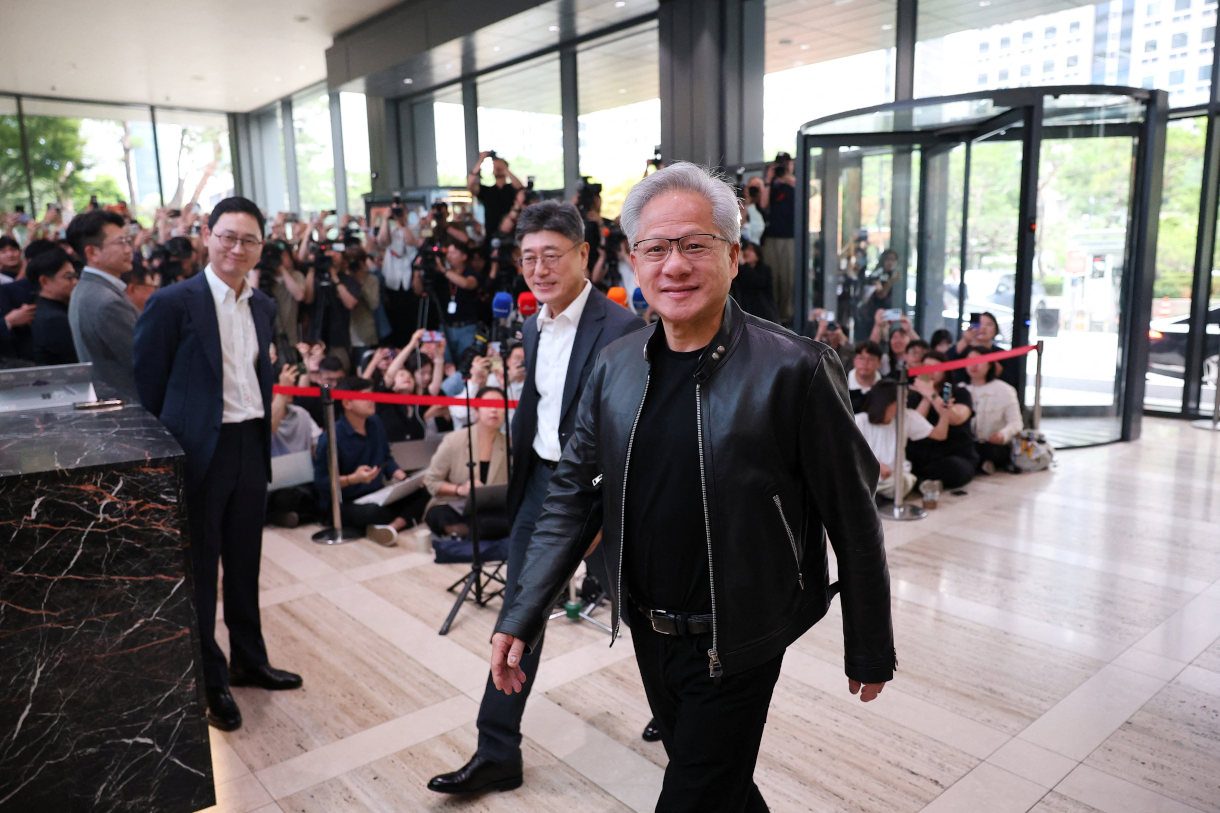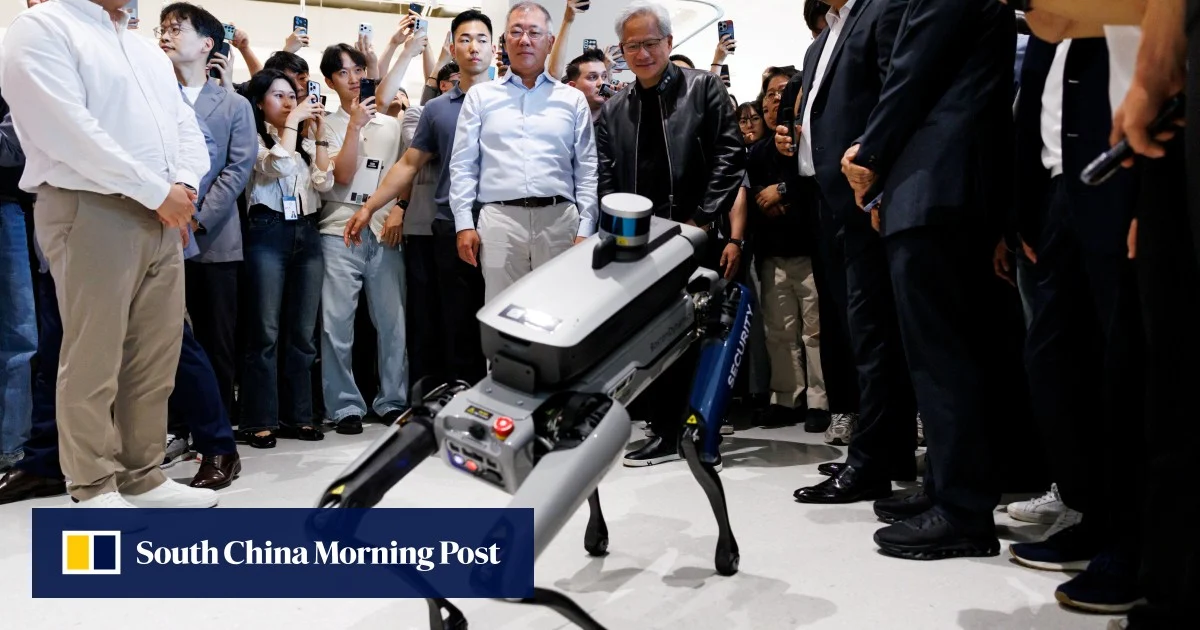
Hyundai Motor Group Executive Chair Chung Euisun (right) and Nvidia CEO Jensen Huang are spotted in front of a restaurant in central Seoul on Sunday. (Yonhap) Hyundai Motor Group Executive Chair Chung Euisun and Nvidia CEO Jensen Huang met in Seoul on Monday, reportedly discussing their collaboration to incorporate physical AI in deep tech sectors spanning autonomous driving, robotics and smart factories.According to Hyundai Motor, Huang toured the newly renovated lobby of the company’s Seoul headquarters in Yangjae, Gangnam, around 2 p.m. with Chung, where the automaker has deployed three service robots: DAL-e Gardener for watering plants, DAL-e Delivery for in-building beverage delivery and Spot, a quadruped security robot developed by Boston Dynamics, Hyundai’s US-based robotics subsidiary.It was the second meeting between the two industry leaders during Huang's five-day business trip to Seoul. On Sunday, Chung and Huang reportedly dined together at a restaurant in central Seoul.Under Hyundai’s robot-friendly workplace initiative, the robots are equipped with autonomous navigation technology, enabling them to move throughout the building, use dedicated elevators and recharge with minimal human intervention. Chung mentioned that the company plans to utilize the robots at its headquarters before mass commercialization, so the building also serves as a real-world proving ground for its physical AI technologies.Industry sources say that as Huang was scheduled to inspect Hyundai’s robots, the two companies would have explored how to apply their physical AI partnership in real-world settings.For autonomous driving, Hyundai is seeking to combine Nvidia’s Drive Hyperion platform — a ready-to-use self-driving system package — with its own SDV architecture to deploy Level 2 and higher autonomous driving technologies in vehicle models, while continuing efforts to develop in-house AI systems.Boston Dynamics is developing its Atlas humanoid robot using Nvidia’s next-generation robotics platforms, such as Jetson Thor, and AI models to perform more autonomous factory tasks. The company also uses the chipmaker’s Omniverse digital twin platform to extensively train the robot in virtual environments before deploying it in industrial operations.The two are also supporting Korea’s physical AI initiative. Together with the Science Ministry, they agreed to invest roughly $3 billion to establish an Nvidia AI Technology Center and a Hyundai Motor Group Physical AI Application Center in Korea.Hyundai and Nvidia’s strategic ties date back to 2015, when they signed a technology agreement to develop an intelligent connected car system powered by the Nvidia Drive platform. Five years later, they announced plans to expand the platform's use in infotainment systems across Hyundai and Kia vehicles.Momentum has accelerated since January 2025, when the two agreed to apply accelerated computing, generative AI and industrial digitalization technologies across robotics, autonomous driving, smart factories and software-defined vehicles. Later that year, Hyundai unveiled plans to build an AI factory powered by 50,000 Nvidia Blackwell GPUs to train, validate and deploy AI models for in-vehicle AI, autonomous driving, smart manufacturing and robotics.
Hyundai, Nvidia chiefs discuss deeper ties in physical AI
Hyundai Motor Group Executive Chair Chung Euisun and Nvidia CEO Jensen Huang met in Seoul on Monday, reportedly discussing their collaboration to incorporate ph
471 words~2 min read