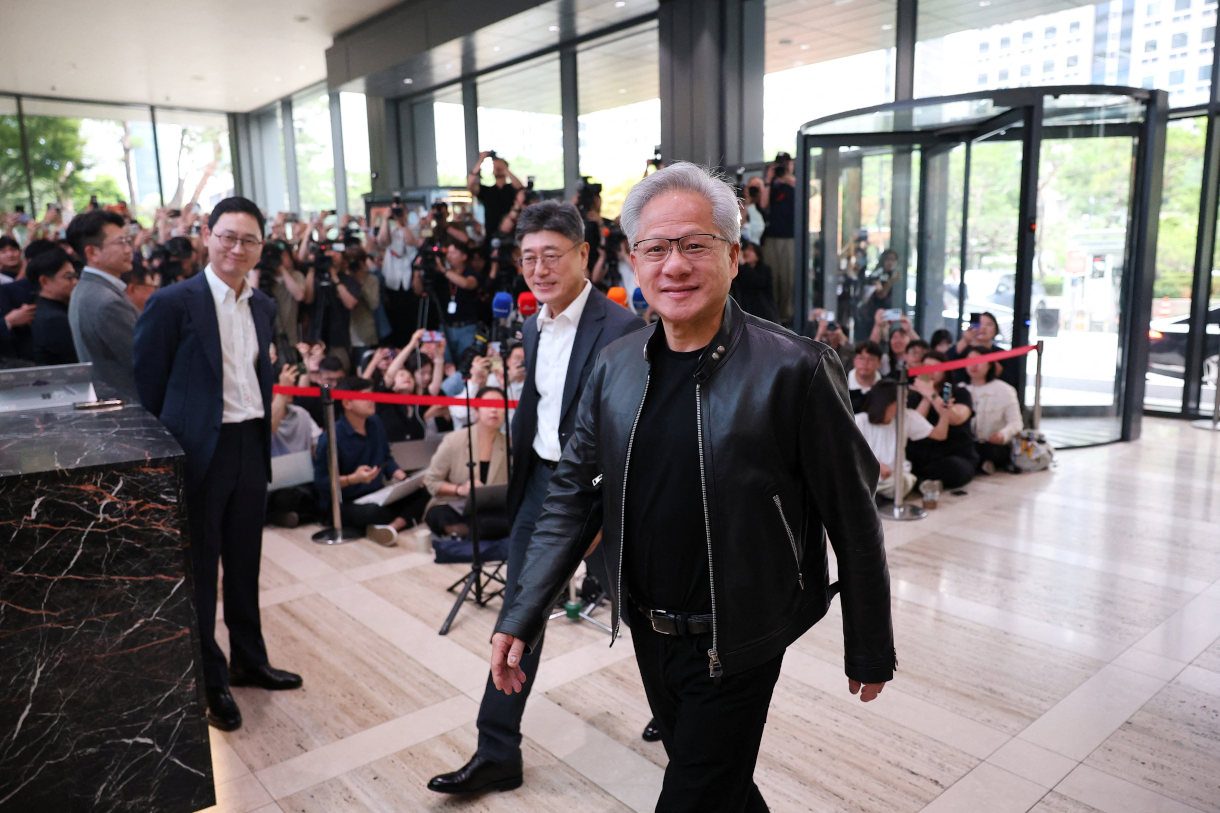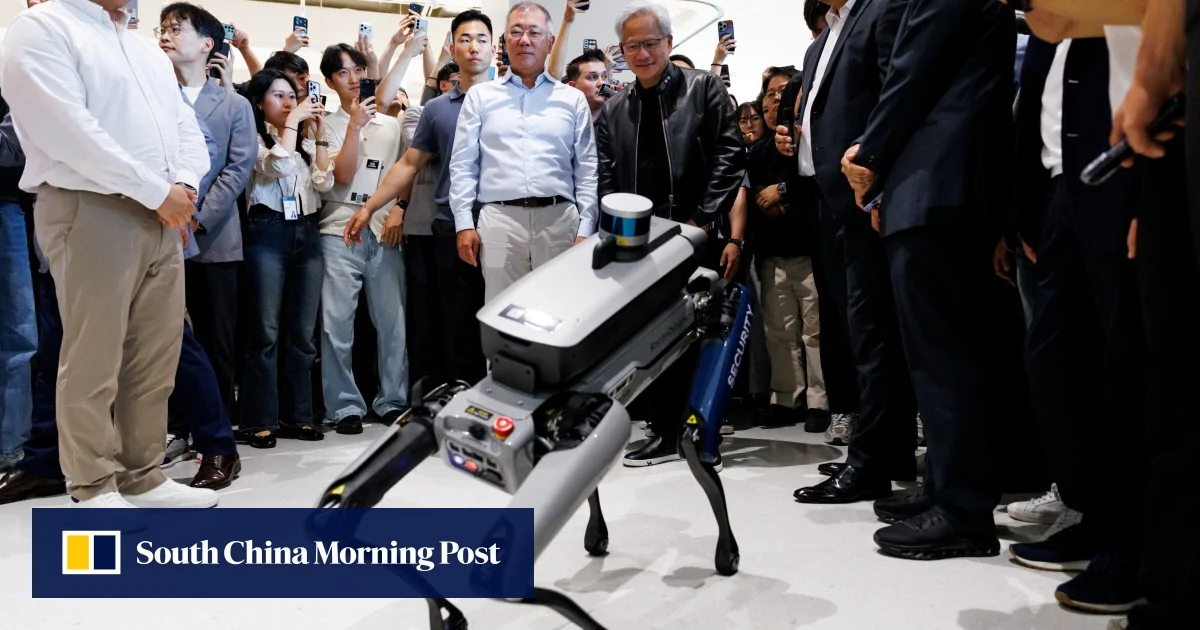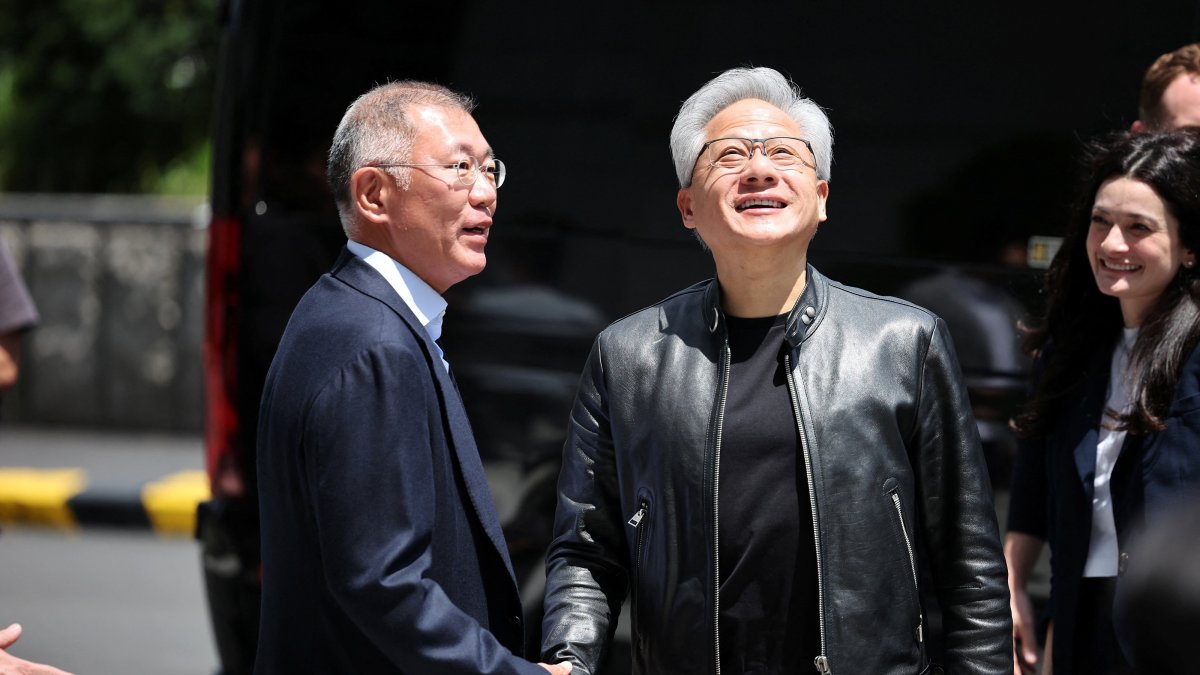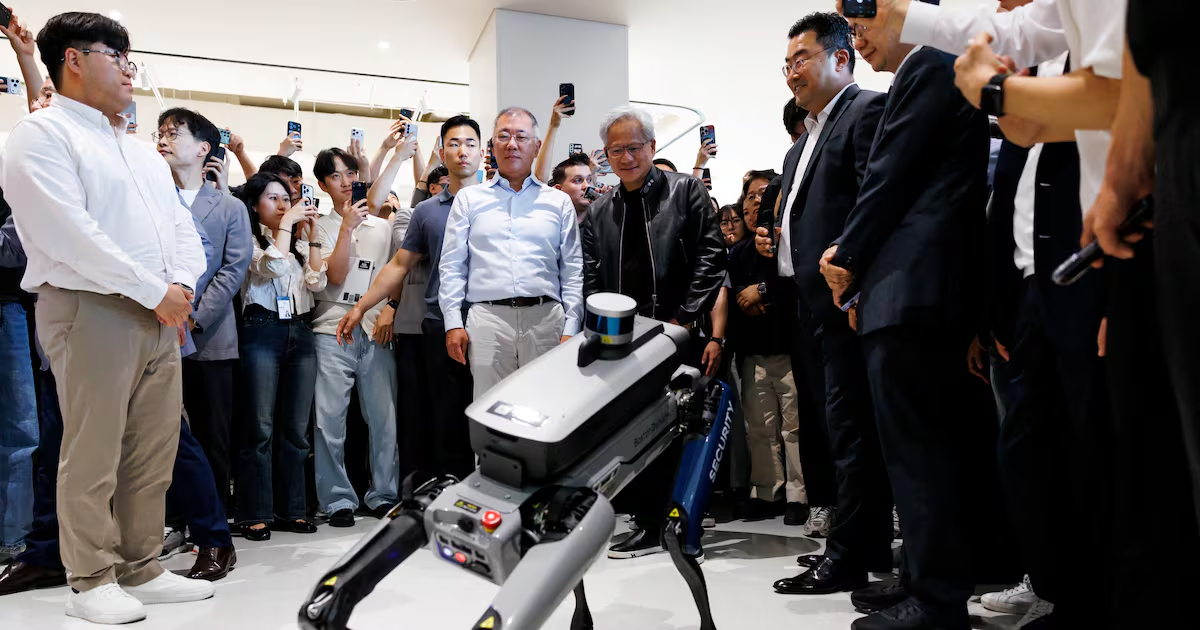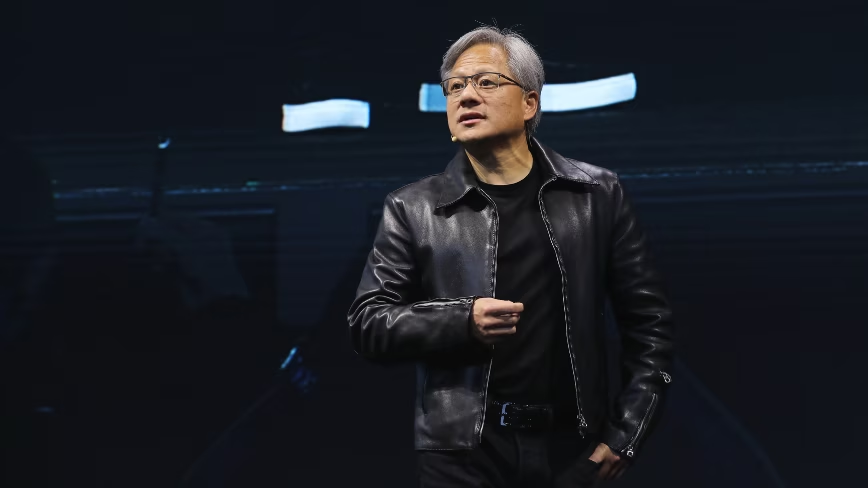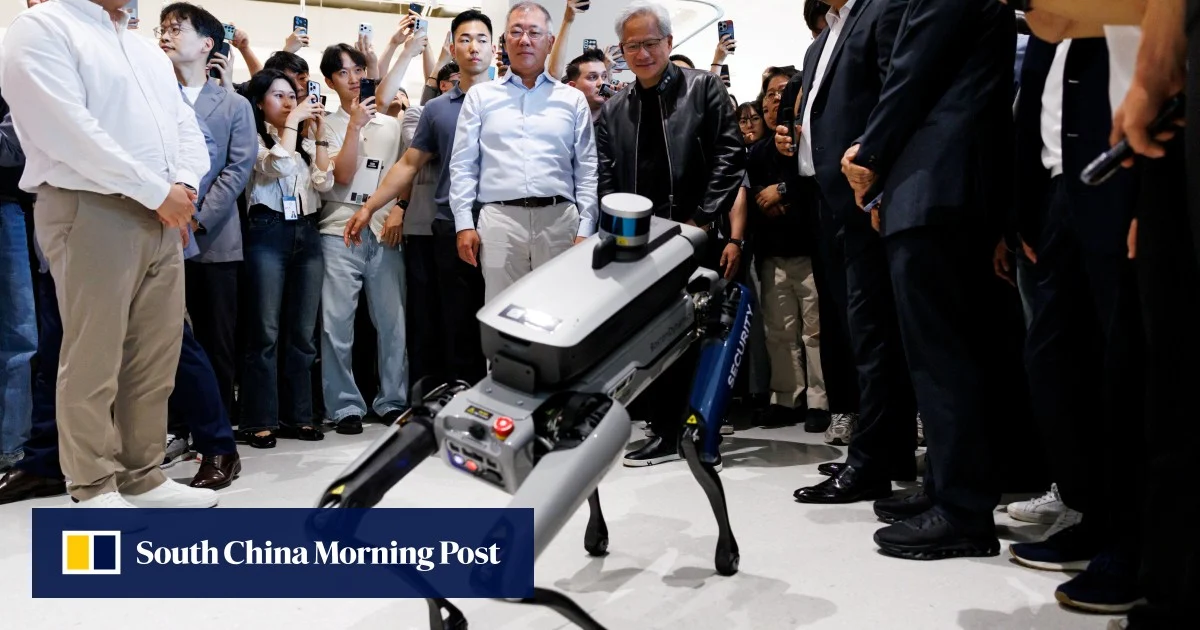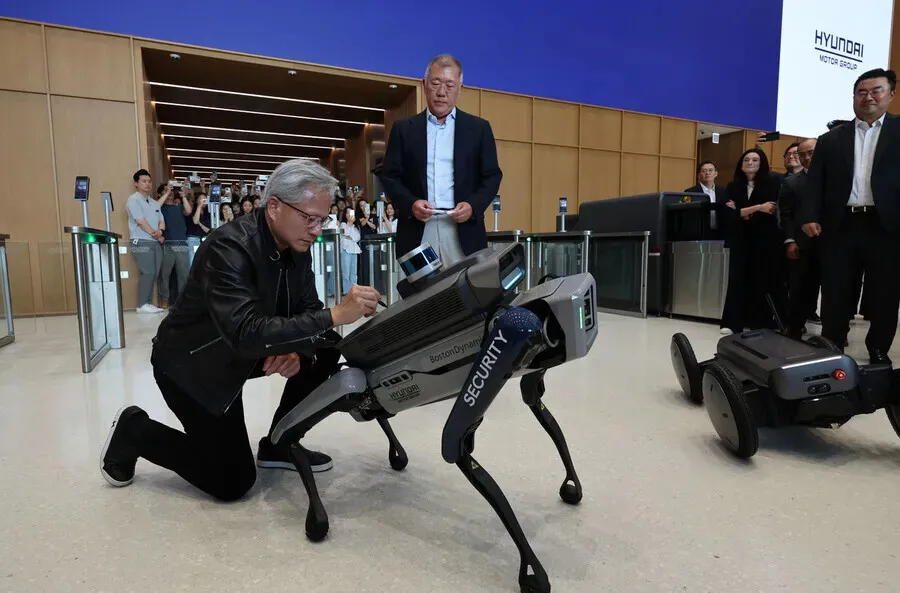
Nvidia CEO Jensen Huang signs a security robot dog after a meeting with Chung Eui-sun, the executive chairman of the Hyundai Motor Group, at Hyundai Motor’s headquarters in Seoul’s Seocho District on June 8, 2026. (pool photo)
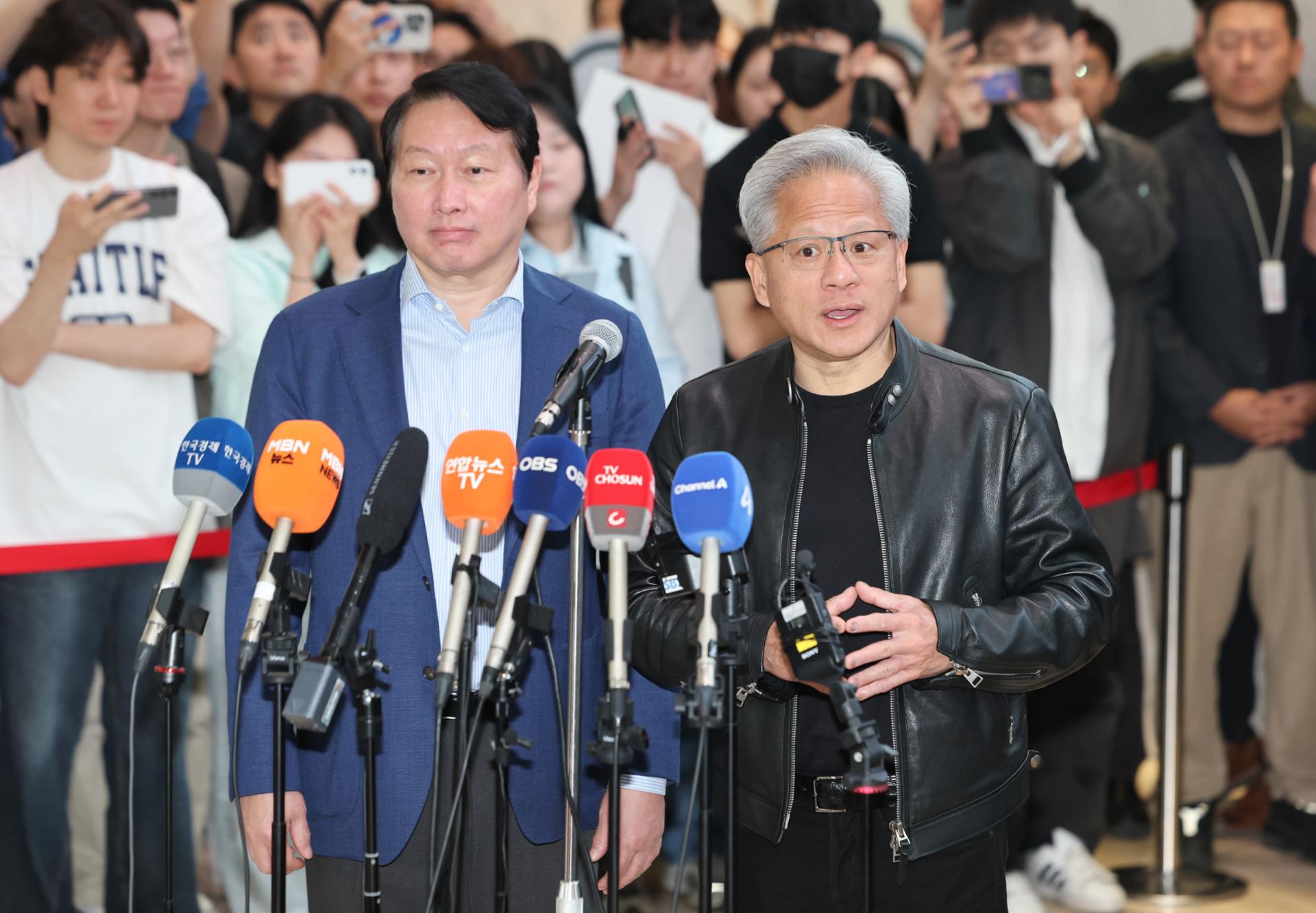
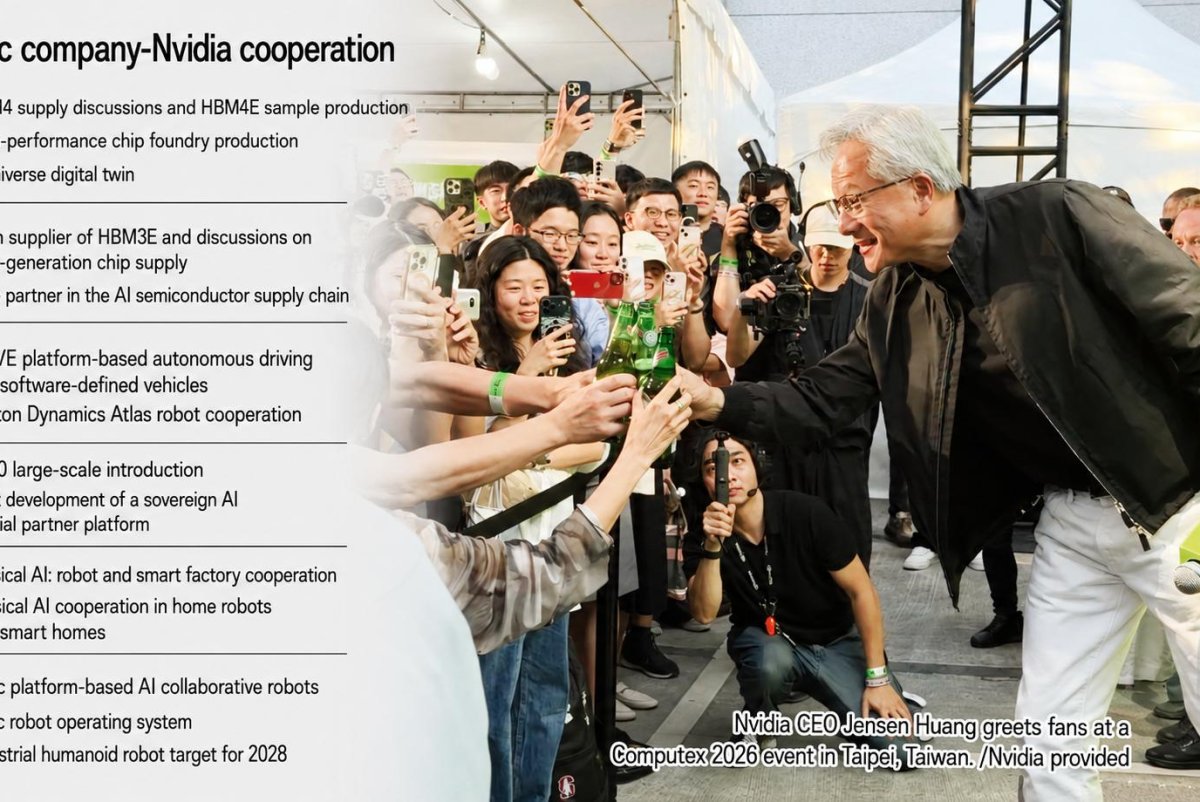
Major Korean conglomerates and corporations like Samsung, SK, Hyundai Motor, LG and Naver have formed a veritable alliance for artificial intelligence infrastructure with the US-based semiconductor giant Nvidia to accelerate the build-out of AI data centers in Korea.The coalition’s strategy is to ride Nvidia’s momentum as the global leader of the AI market and the broader wave of AI transformation for mid- to long-term growth. While in Seoul on Monday, Nvidia CEO Jensen Huang held successive meetings with SK Group Chairman Chey Tae-won, LG Group Chairman Koo Kwang-mo, Hyundai Motor Group Chairman Chung Eui-sun, Naver Chairman Lee Hae-jin and Samsung Electronics Vice Chairman Jun Young-hyun to discuss ways their companies can collaborate.While Huang’s meetings with major Korean executives over the weekend were casual gatherings for dinner and drinks, discussions with business bigwigs on the last day before his departure from Korea explored concrete plans for cooperation.Companies used Huang’s visit as an opportunity to announce their AI business strategies using Nvidia’s AI chips and software platforms.SK Telecom and Naver unveiled plans to build AI-specialized data centers dubbed “AI factories” by Huang to stress their roles as hubs powered by AI that create intelligence. Such facilities are considered foundational infrastructure for applying AI to manufacturing and other sectors.SK Telecom plans to build an AI data center in Korea next year equipped with Nvidia’s latest chips. Naver has agreed to jointly build a gigawatt-scale AI infrastructure four times bigger than the country’s largest data center to create a massive AI plant targeting Asia, the Middle East and Europe.LG and Hyundai Motor have joined forces with Nvidia to focus on physical AI industries such as robotics. LG Group will collaborate in the development of robots, components and related platforms, as well as raise cooperation in thermal and power management for data centers, two sectors that LG Electronics and LG Energy Solution are strong in. Huang also called Hyundai Motor’s robotics, AI and hydrogen cluster under development in Saemangeum, a massive estuarine tidal flat and land reclamation project on the Yellow Sea coast in North Jeolla Province, “AI Valley.” He also discussed with the conglomerate’s Chung cooperation in autonomous mobility, industrial robots and future manufacturing systems integrating AI.A partnership between Korean companies and Nvidia could deliver major gains for both sides. Beyond just procuring memory chips, Nvidia has strengthened its presence in the Korean market, which holds manufacturing data, a key growth driver in AI. Domestic corporations also stand to greatly benefit by using Nvidia’s high-powered chips and platforms to gain faster access to the AI market, a key sector of future growth.“We’re in the beginning of the AI revolution,” Huang said at a news briefing held at SK headquarters in downtown Seoul, noting that the global infrastructure for artificial intelligence must be built over the next 10 years and beyond. “We’re at the beginning of the AI infrastructure build-out, and the future is quite bright,” he said, implying that the partnerships Nvidia formed with Korean companies during his visit could accelerate the AI revolution as the first step toward a boom in related sectors.Memory companies such as Samsung Electronics and SK Hynix, which already have close ties with Nvidia, pledged to further strengthen their cooperation. SK Hynix will jointly develop next-generation AI memory with Nvidia including high-bandwidth memory. Huang on Monday also spoke to Samsung Electronics Vice Chairman Jun Young-hyun, with both sides agreeing to firm up their partnership in semiconductors. Naver will also join the Nemotron Coalition, a Nvidia-led global collaboration of AI labs and developers to build, train and advance open, frontier-level foundation models to build leading open-source models to compete with closed-source AI systems such as OpenAI and Anthropic.By Park Jong-o, staff reporter; Sun Dam-eun, staff reporter; Yu Ha-yeong, staff reporterPlease direct questions or comments to [english@hani.co.kr]