Choi Ji-won
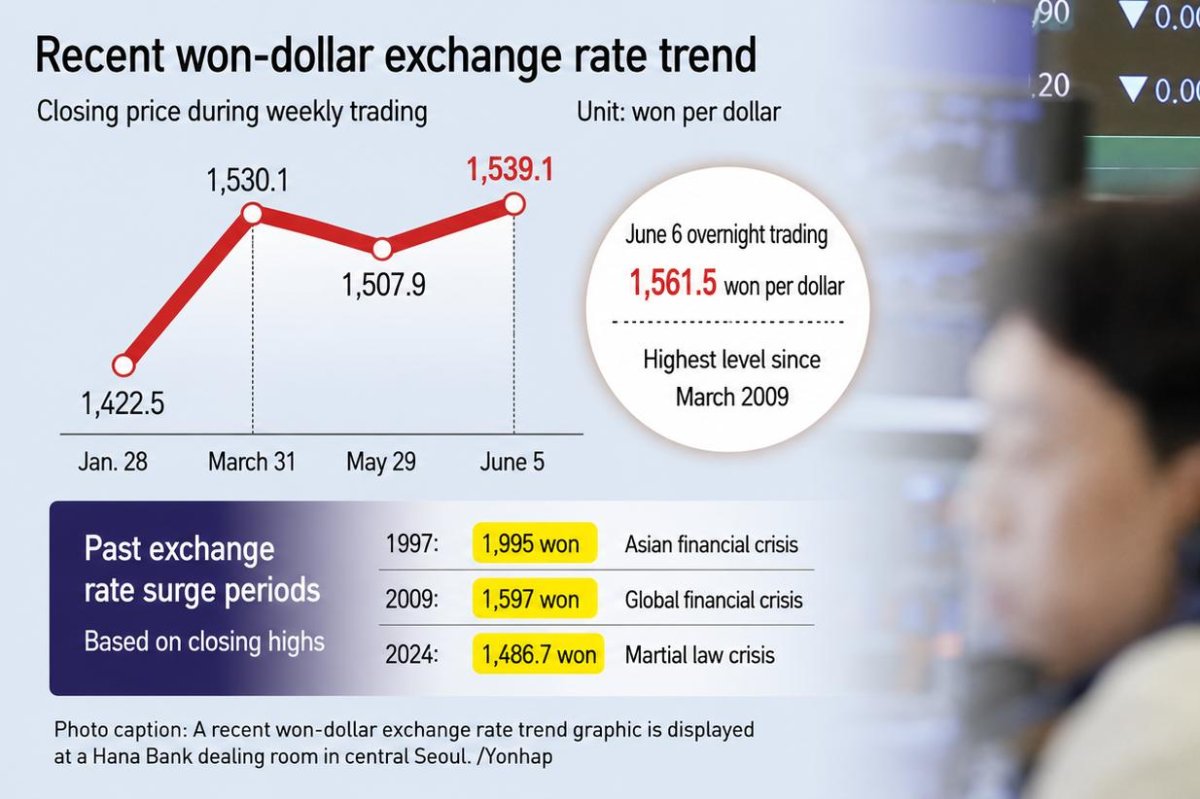
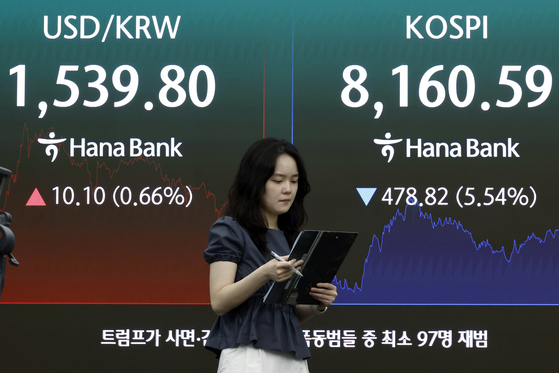
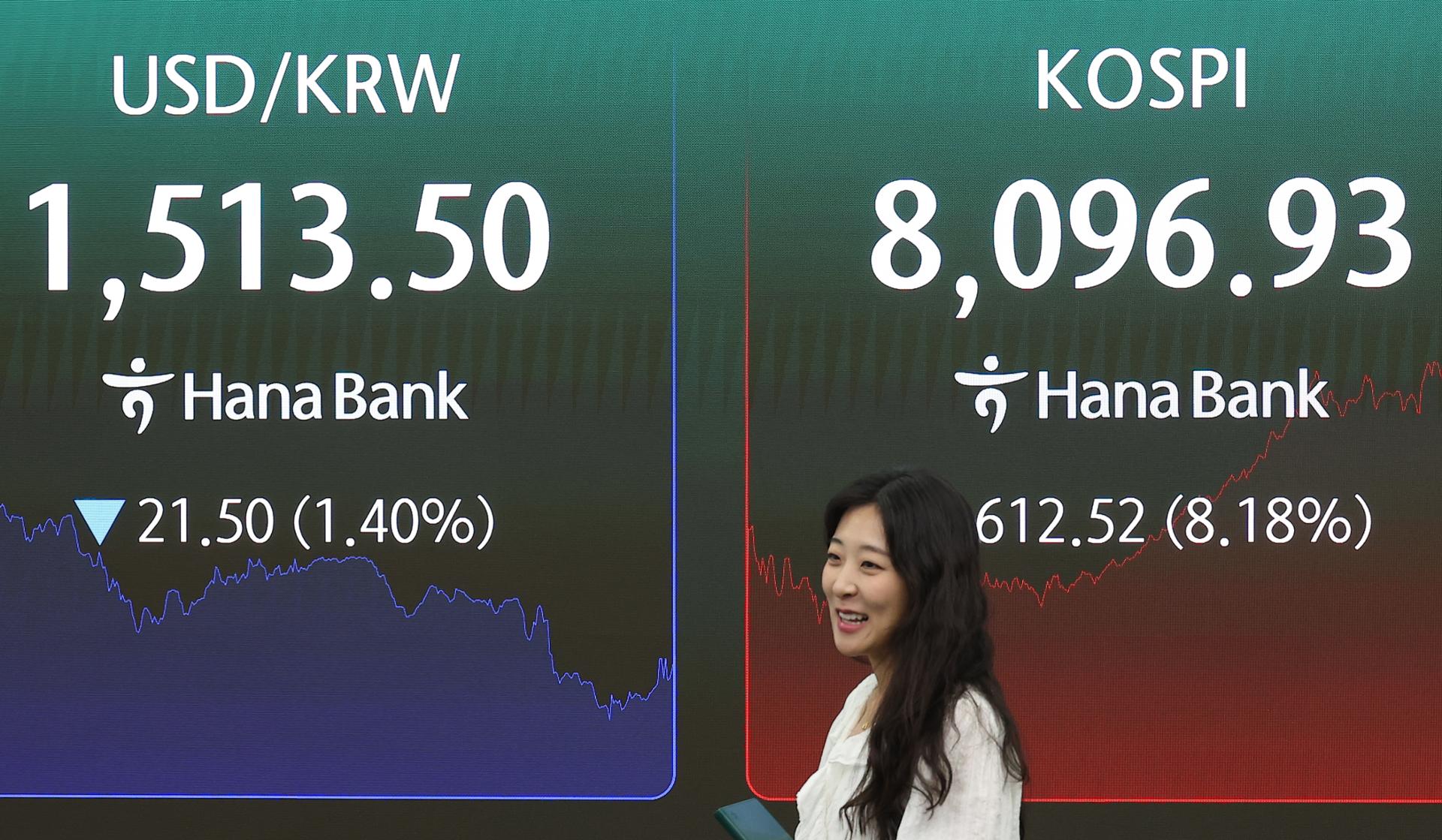
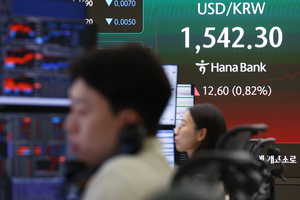
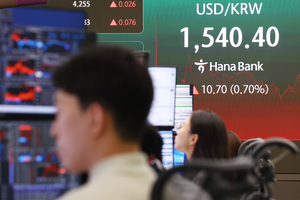
Currency breaches 1,560 per dollar for first time since 2009 as capital outflows outweigh strong exports, authorities' warnings A display at a Hana Bank dealing room in Seoul shows the Korean won trading at 1,540.40 against the US dollar on Friday afternoon. (Yonhap) The Korean won briefly breached the 1,560-per-dollar level in overnight trading Friday, falling to its weakest point since the global financial crisis as foreign selling and broad-based dollar strength overwhelmed Korea's solid export fundamentals.The won closed at 1,559 per dollar in Seoul's overnight market at 2 a.m. Saturday after touching 1,561.5 during the session, its weakest level since March 2009.The slide accelerated after the dollar-won rate ended Friday's regular session at 1,539.1, up 9.4 won from a day earlier. Stronger-than-expected US jobs data boosted expectations that the Federal Reserve could resume interest-rate hikes later this year, sending the dollar higher against major currencies.Financial authorities issued verbal warnings for a second consecutive day against excessive one-way bets on the currency market, but the won continued to weaken in after-hours trading, suggesting the intervention had had little immediate impact.Foreign selling pressures wonThe currency slide came as foreign investors continued cutting exposure to Korean equities. The Kospi plunged 5.54 percent Friday to 8,160.59, while foreigners net sold 3.5 trillion won ($2.26 billion), extending their selling streak to 20 sessions and bringing cumulative net sales to about 70 trillion won.Market participants say the move reflects more than broad dollar strength or higher oil prices, with foreign stock profit-taking and related dollar buying emerging as sharper drivers."The won's depreciation appears excessive even after taking into account heightened geopolitical risks and strong US economic data," said Chun Kyu-yeon, an economist at Hana Securities. The won has posted the sharpest decline among major currencies since the Iran war broke out and is now significantly undervalued by real effective exchange rate measures, he added.Moon Jung-hiu, a senior economist at KB Kookmin Bank specializing in foreign exchange, said foreign investors' profit-taking in Korean equities appears to be the biggest factor. "Exporters are still selling dollars from sectors such as semiconductors and shipbuilding, but foreign dollar buying appears to be coming in more strongly," he said.While the flows cannot be directly equated, as the investors selling shares and those buying dollars may differ, Moon said the timing suggests equity rebalancing and custody-related dollar demand are moving together.Hana Securities said foreign investors have net sold nearly 120 trillion won on the main Kospi market this year, but the market value of their holdings has more than doubled to 2,918 trillion won as the rally outpaced their sales, leaving room for further rebalancing pressure. A Hana Bank employee holds up US dollar bills at the bank's headquarters in central Seoul on Thursay. (Yonhap) No crisis, but 1,600 in viewThe latest level has revived comparisons with past crises, but Korea's external buffers are much stronger than during earlier episodes. Foreign exchange reserves stood at $426.99 billion at the end of May, down $880 million from a month earlier but safely above levels seen during the 1997 Asian financial crisis or the 2008 global financial crisis.Exports also remain a major buffer. Korea's outbound shipments surged 53.2 percent from a year earlier in May to a record $87.75 billion, powered by a 169.4 percent jump in semiconductor exports. The country posted a record monthly trade surplus of $26.95 billion, suggesting that the won's weakness is not being driven by a collapse in Korea's ability to earn dollars.Still, market watchers see the reserve picture as more complicated than the headline figure suggests.According to Moon, Korea appears to have ample dollars on paper when foreign reserves, corporate and household foreign-currency deposits and net external assets are counted together. But whether that liquidity would be enough to absorb potential outflows is less clear."The problem is that much of that money is tied up," Moon said. "Foreign reserves are mostly held in bonds, and net external assets are largely invested overseas. If a crisis actually comes, the amount of short-term dollar liquidity that can be mobilized immediately may not be as large as the headline figures suggest."For now, experts still see little chance of a quick retreat, with capital outflows and dollar demand likely to keep the won under pressure.Moon did not rule out a move to 1,600 at the current pace, seeing little room for the won to retreat below 1,500 for now. He saw the currency stabilizing to around 1,500 to 1,520 if stock market volatility eases, while a return toward 1,440 would likely require an end to the war and lower oil prices."The market is in a period of heightened volatility, with excessive concentration in semiconductors and related sectors, so it is hard to say the won will not reach 1,600," Moon said."But even if it does, that alone would not signal that Korea is heading into another crisis."