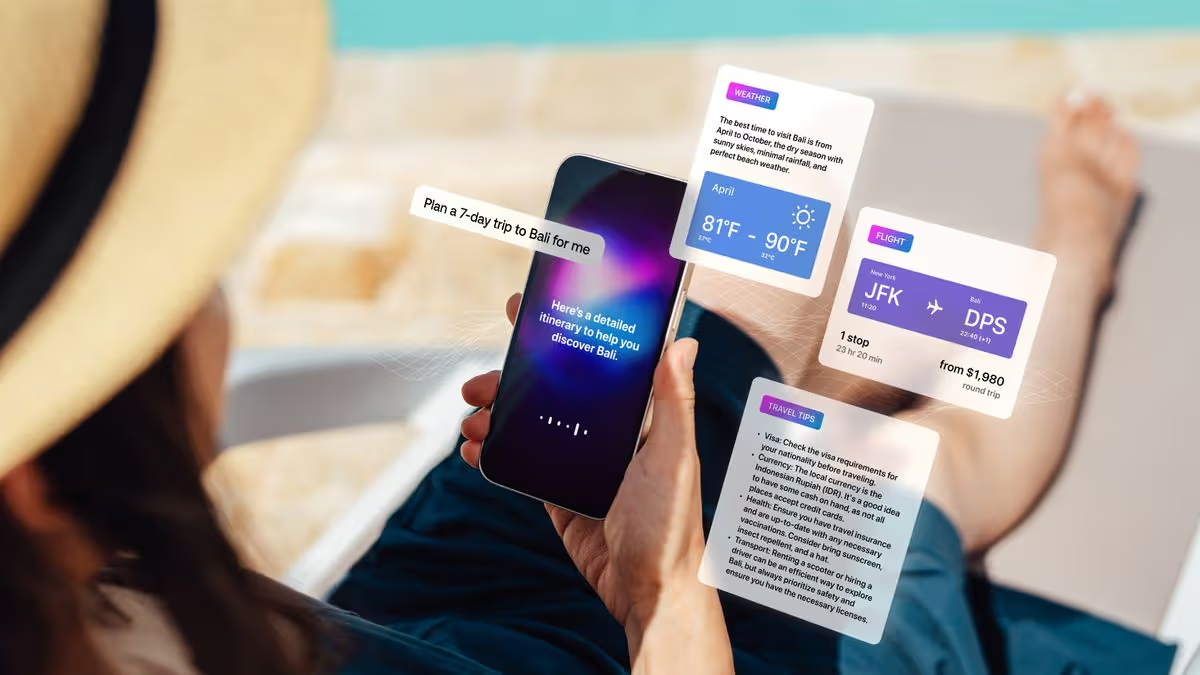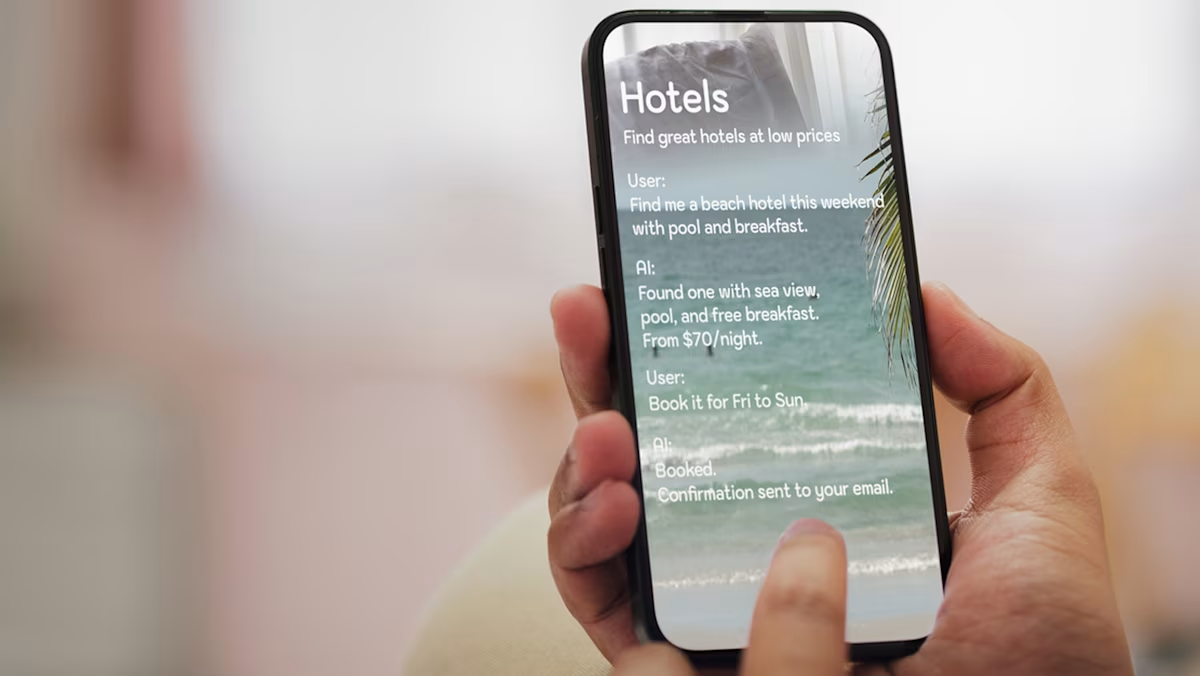
With artificial intelligence (AI) reshaping our lives in good, bad and existential ways, its impact on our holidays is unlikely to get top billing in many of the most doom-laden or upbeat discussions about the grave new world we’re racing towards.But it’s clear that before our robot overlords take our jobs, seize control and issue kill commands, or see themselves deployed as the amoral executors of the capricious whims of tech bro billionaires, the era-defining technology is targeting travel and promising to make holiday planning easier and cheaper. It seems likely that sooner rather than later, travellers relying on guide books, newspapers, radio, television, word of mouth or even personal experiences when deciding where to go next may seem whimsically quaint.We may be on the cusp of handing our travel planning to energy-sapping AI engines with access to virtually all the world’s information, but we’re not there yet, and the know-it-all bots are not as reliable as they like to think they are. We asked ChatGPT to plan a weekend in Dublin for two adults and two children aged eight and 10, travelling from London on Friday, June 5th, and leaving on Monday, June 8th. Less than 45 seconds later it was back to say it had it all worked out. Sort of. “The main London airports with affordable options to Dublin are Gatwick, Luton, and Stansted,” our AI wannabe travel agent started earnestly, if obviously. “By early June, you can find good-value returns on budget airlines if you book soon.”It suggested an early-morning Ryanair flight from Stansted with a Monday return, and told us the total cost would be less than £200 (€231) .[ Hobby holidays: Nine places to engage with your passions, from hiking to horseridingOpens in new window ]The Maldron in Smithfield was recommended as the best place to stay, with the online oracle promising a room with a double bed and two singles for €510 in total. A stroll through St Stephen's Green was included in the AI itinerary. Photo: Nick Bradshaw/The Irish Times The itinerary included a stroll through St Stephen’s Green, Trinity, Dublinia, Dublin Zoo and Howth, while dining options included Avoca, Gallagher’s Boxty House, Beshoff’s in Howth and Ely Wine Bar. As itineraries go it was grand, but what intrigued us more than the activities were the suspiciously low prices. For three nights in the Maldron on these dates,the best deal we could find was €1,036, or twice what the AI bot told us. The restaurant prices seemed out of whack too. When our fantasy family decided to have mains and desserts in Ely along with a fairly sober two pints of Guinness and two soft drinks, they easily wound up spending over €150 rather than the €80 ChatGPT told us to expect.All told, the AI “travel expert” suggested a budget of €1,266 would see our family through a Dublin weekend. It doesn’t take a huge amount of intelligence, artificial or otherwise, to know the figure is optimistic. By our back-of-a-napkin calculation, it barely covered accommodation and one of the 10 meals our made-up family would eat, never mind any of the activities ChatGPT had lined up. Travel isn’t ChatGPT’s core business, so we tried a more dedicated AI system called Airial. Unlike ChatGPT, it linked directly to flights and hotels, suggesting a Ryanair flight from Luton and the Croke Park Hotel as the place to stay. The Epic museum, Dublin Zoo and Trinity College were among the suggested activities, while its chosen restaurants included the Woollen Mills, The Winding Stair, Octopussy’s Seafood Tapas in Howth, Bunsen and Brother Hubbard. The Winding Stair in Dublin. Photograph: Ellius Grace/The New York Times It made some basic errors, telling us to have breakfast in Brother Hubbard on Capel Street – a long schelp from Croke Park – while the Bunsen it recommended was in Dublin 8, even though there are two Bunsens much closer to the Croke Park Hotel.When we asked for a total cost of the trip, it said no. “Airial tracks flight and hotel costs but doesn’t provide detailed budgets for activities, meals, or other expenses. You’ll need to estimate those separately based on the suggestions I provide,” came the decidedly tetchy response.Now, AI is nothing if not literal, so we went back to ChatGPT with a key tweak to our query. “Cast yourself as a travel expert,” we said, before asking the same question as before. Instantly, the accommodation switched to the Staycity Aparthotels on Mark Street, with a more realistic expected cost of between €230-€300 per night. The activities included Temple Bar in the “early evening before nightlife crowds”, and it recommended the zoo, bike rental in the Phoenix Park, Howth and the Viking Splash tour. [ Good to go: Exploring how AI can enhance your travel experienceOpens in new window ]Among its suggestions for food were Elephant & Castle for wings and Pi Pizza and Lemon Jelly Cafe. It suggested we’d need around €2,350 for our three-night jolly in Dublin, which was more realistic.Pi Pizza in Dublin. Photograph: Dara Mac Dónaill/The Irish Times Concerned we were making it too easy for the hive mind, we asked ChatGPT to cast itself as a travel expert again, and arrange a round-the-world trip in 80 days for one person, allowing them to visit as many countries as possible.Almost immediately we had a “high-speed, luxury-backpacker-style Around the World in 80 Days route designed to maximise the number of countries while still giving you time to actually experience each place”.Our virtual travel agent delivered an itinerary that saw us hit 40 countries in exactly 80 days, “using efficient flight corridors, overnight trains, ferries, and open-jaw airline routing”.And, in case you are wondering – as we were – “open jaw routing” sees you fly into one place and out of another. Our Jules Verne holiday – minus the villains, the racing, the gambling and the derring-do – is too detailed to explore here, but ChatGPT sent us through 13 European countries before heading to the United Arab Emirates and on to India and Nepal. [ AI guardrails stripped from Meta and Google models in minutesOpens in new window ]From there it sent us through countries including Thailand, Bali, Indonesia and Japan and down under to Australia and New Zealand, before jetting across to the US and Canada and down to South America, eventually finishing up in Lisbon.Our AI friend explained it had chosen the route because “it follows the globe efficiently and you continuously move eastward” to ease the jet lag. It clustered easy border crossings and balanced “big hitters with rapid entries” to allow us to experience ancient history, beaches, mountains, food capitals, nature and nightlife “without wasting days in transit”.It also suggested the best airlines and rail networks, and presented three budgets from €13,000 for the backpackers to €45,000 for the luxury traveller. It was – in short – astonishingly comprehensive, and all it didn’t do was organise and book the trip for us (but don’t worry, that’s coming too in the form of Agentic AI – more on this below).Most AI bots aggressively search the internet, leaning heavily on positive reviews scraped off travel sites. What’s on the horizon is more profound, suggests Peter Cullen, the chief operations officer with online travel agency Click&Go.Over the last 20 years, travel businesses such as his have relied heavily on Google search engine optimisation (SEO), but the world is shifting to AI optimisation. In times past, sites such as Click&Go would have carried articles on topics such as the top five destinations for families, listing them and explaining their appeal. Attracting the attention of the AI bots requires “a different mindset”, he says. “Now we have to think about how we can use all the data that we have, data that talks not just about destinations for families, but looks at when families travel and where they go and how long they stay, and use everything we have to position us as an authority in family holidays in a different way.”The next step is Agentic AI, which will see a shift from regular search tools listing options to detailed itineraries and actual reservations. Agentic AI will also keep an eye on the best deals and make last-minute switches to better value hotels, or hop on the lowest fares on our behalf.Peter Cullen of Click&Go says his travel business will be incorporating Agentic AI into its systems. Photograph: Bryan O’Brien It’s still in an experimental phase, Cullen says, but “in four years, I think we will have Agentic AI built into our systems. Five years ago nobody really knew what AI really was, and in five years’ time, it will be totally different again. It’s evolving very quickly”. Cullen believes that even as Agentic AI takes over, people will seek human interactions – particularly when it comes to complicated bookings, “where those searching for holidays have very specific needs”. [ What lies ahead for Meta in Ireland?Opens in new window ]He says, ultimately we will develop a greater reliance on AI only if we are happy to share our lives and finances with bots. “If AI knows what you want and the kind of hotel you like to stay in and the experience you like, it can, over time, build up a picture of you,” he says. “At a conference recently I was told that we are not living in an era of change but in a change of era, and that really encapsulates it. It is fundamentally different way of thinking and doing things, and how travel companies react will be fundamental to their survival.”As a big fan of AI for planning holidays, Happiness Omochere-Esho is the kind of person travel agents like Cullen might fear. Her experience has led her to question why anyone would need a travel agent any more.“I’ve just used it to book a trip to Albania, and I’m currently using it to book my honeymoon,” she says. For the trip to Albania she leaned heavily on Claude, starting with a prompt asking how much cash she would need. She had the flights to and from Tirana booked, but wanted to spend one night in the capital and a few days by the coast. She asked for an infographic.“It broke down exactly how much the taxis would cost, how much the daybeds would cost on the beach, how much food would cost at night.”It said she would need $675 (€580) for four days. Happiness Omochere-Esho: 'With AI you can ask it very specific questions suited to you.' Photograph: Dara Mac Dónaill Later this year, Omochere-Esho is visiting southern Africa on her honeymoon and will fly to Cape Town before travelling to Kenya and on to Zanzibar.“I keep putting in different prompts,” she says. “The last prompt I had was to say I have a budget of $10,000, having spent $1,800 on flights and another amount on hotels. I asked: how much would I have to spend every day? And it told me €55 between us to cover food and activities. It recommended saving another €1,000 to bring it up to €80 a day.” There was one hotel in Kenya she was keen to stay in, and Claude said if she wanted to stay within her budget, “it would be best if I just stayed for the last three days of my Kenya trip and stayed somewhere a bit cheaper, that was closer to the safari”, for the rest.She reckons AI “definitely got me deeper” than more traditional Google searches. “I don’t know anything about Zanzibar, so I told it that me and my husband are quite social and want to stay in a place that’s quite lively. It broke down the different parts of Zanzibar and told me which places were quiet, and which places were more lively and had more backpackers and young people and more nightclubs and restaurants and bars.”She says: “A lot of people just care about their time and want answers quickly. If you’re just trying to plan based off of Google or watching YouTube videos or looking at Reddit or TripAdvisor, you have to use your own judgment, but with AI you can ask it very specific questions suited to you. I don’t really see why I would I need to use a travel agent, because I can put in that into AI, and it will tell me sometimes if it’s ridiculous or it’s not doable.”But the use of AI for travel planning is not problem free. Questions are being asked about what it means for privacy, and what happens if a system that knows almost everything about us and has access to our credit cards gets hacked. And then there are AI hallucinations – already such virtual phenomena have seen supposedly advanced computer systems misread online data, causing them to spew out bogus information and make bookings in non-existent places.Michele Neylon: 'AI does work, but you have to double-check things.' Photograph: Brenda Fitzsimons As chief executive and co-founder of web-hosting company Blacknight Solutions, Michele Neylon has witnessed hallucinatory behaviour from AI bots first hand. He has been using AI to plan his overseas trips for some time. “The main problem I’m running into is when it comes to real-time information. All the engines seem to fall flat on their ass,” he says. Neylon was in London recently and wanted to see The Devil Wears Prada 2. “I was trying to find out which cinemas had a decent-sized screen where I could watch it, but AI insisted the film was still only a rumour and had not been made yet. Even when I said it had been made, and copied and pasted links to websites or listings, it kept telling me the websites were based on rumours.”I use it as a helpful friend, but would I trust them 100 per cent to do absolutely everything for me? No way— Michele NeylonNeylon used to live in Milan, so knows the city well. He recently asked ChatGPT a question about how to get from one place to another in the city. “It said it was a 10-minute walk, and I’m going ‘there is no way that is 10 minutes’, but when I pushed back it insisted it was definitely 10 minutes. It is like that logic test with AI where you say, ‘I need to wash my car and the car wash is 100 metres away so should I walk or drive?’ A lot of engines will tell you to walk to the car wash because it’s so close.”Despite his misgivings, he uses AI regularly. “It does work, but you have to double-check things. If I’m going to a football match in Madrid and want to know what part of the city to stay in so I’m close to the Bernabéu, it will recommend places close the Metro line to the stadium. If you know the city well, you’d know this, but if you are not familiar with it, it can really help. And it can also learn things over time about how you like to travel, what you prioritise. “The next thing is to trust it enough to put together a plan for you and buy it for you. I’m not sure how far I would trust AI to do that for now. I use it as a helpful friend, but would I trust them 100 per cent to do absolutely everything for me? No way.” Martha McCready: 'I think at the moment it’s more of an enhancement tool and a feature rather than the core value proposition.' Photograph: Dara Mac Dónaill Martha McCready has leaned heavily on AI in her personal and professional life. She and her brother are developing an app that uses AI to break down the real-time transport options available to commuters and tourists in cities all over the word. “The idea is the app will move with you to every new city you visit and will know the available providers, including trains, buses, bike rental schemes and cars. It basically takes the guesswork out of overseas travel,” she says. When travelling she uses “a multitude of different platforms, and AI is part of that. I think at the moment it’s more of an enhancement tool and a feature rather than the core value proposition”.She reckons things are shifting, however. “We’re living in an era when people and consumers just want convenience. Everyone is so busy that they just want to know where to go and when to be there. “There is also the safety side. When I am travelling there is a charm in rocking into a new city not really knowing what to do or where to go, but then there’s also a safety side where I want to know where I am. [ How one Irish school is teaching children about AIOpens in new window ]“Ultimately I think it is going to be about finding that nice middle ground. That is where AI will have the most value.”As a travel writer and author of multiple editions of the Lonely Planet travel guides, Fionn Davenport maybe has more to fear from the march of AI than most, but he is phlegmatic about what the future holds. “Travel writing is one of those things that everyone thinks they can easily get into, but when AI is used to create content, there are no peaks and troughs in the writing. It all feels like it’s one emotional note.”He suggests the art of good travel writing is less about lists and more about “giving readers a point of view served with clarity and emotional intelligence, and d all the messy unpredictability of travel. That’s more compelling. It says: ‘This is amazing and this is wonderful and this was better than that and I felt a bit uncomfortable here but then this happened, and I loved that.’ That ability to translate the messiness of it all and make people think it sounds like a lot of fun is what makes great travel writing, and AI is a gazillion miles away from being able to do that”.
Can AI plan your holiday? Yes, but double-check what it tells you
AI for travel planning is evolving from regular search tools listing options to detailed itineraries and actual reservations, but it’s not problem free
3,010 words~14 min read