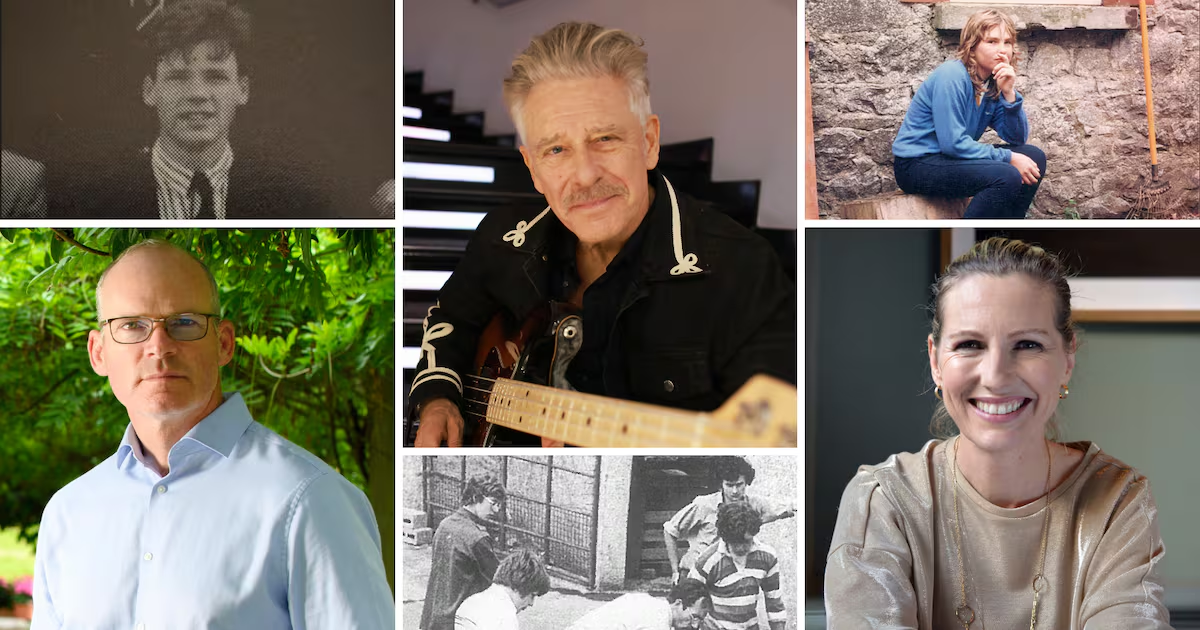
Well-known people who attended boarding schools reflect on their experience and speak frankly about whether or not they would have considered sending their own children to boarding school. Adam ClaytonBass player with U2U2 bassist Adam Clayton: 'I had no real understanding of why I was incarcerated in this antiquated place.' Photograph: Debbie Hickey/Getty Images Adam Clayton was five when his parents moved to Ireland from Africa and after a few years in a local primary school near Howth, he was sent to Castle Park, a private preparatory boarding school for boys in Dalkey, Co Dublin. “My parents thought the boarding school system would be a good idea without understanding the type of child I was. A lot of the other boys there were children of doctors, farmers and clergy – the Irish establishment at the time – and I felt very isolated as an eight-year-old,” Clayton says.He recalls being miserable returning to school after a day at home on Sundays: “I had no real understanding of why I was incarcerated in this antiquated place, with no access to phones, less than one hour from home.” In 1973 at the age of 13, Clayton became a boarder in St Columba’s College in Rathfarnham, south Dublin. “I had a couple of run-ins with the authorities – not over significantly bad behaviour but from breaching the school rules on clothing,” he says. He recounts an incident in which he was denied leave to go into town because he was wearing jeans with embroidered stitching, a cheesecloth embroidered shirt and an Arabic scarf. “I changed my clothes and was allowed to go but then when I got around the corner, I changed back. A teacher saw me in town and I was suspended,” he says.His parents then decided – upon looking at his academic achievements – that he wasn’t going to become a lawyer or a doctor so they didn’t need to continue to pay for his education. “It was time for me to enter the state system,” says Clayton, who then moved to Mount Temple Comprehensive School in Dublin 3 where he went on to meet the other members of U2: The Edge (David Evans), Bono (Paul Hewson) and Larry Mullen jnr. Clayton says now that the more progressive attitude of Mount Temple suited him much better. “There was no school uniform. We were encouraged to be individuals. And we were allowed to rehearse on the school premises on Wednesdays and Saturdays,” he says. When asked if he would consider sending his children to boarding school, he pauses. “I’d say categorically that I wouldn’t send children to boarding school before they are 12 or 13,” he says. “My firm belief is that children are not old enough to be separated from their parents at an earlier age. Being separated from the age of eight was the beginning of a trauma for me. You are thrust into a situation that you don’t know who your allies are.” Adam Clayton (far left) with fellow students helping a staff member to clear an area in the grounds of St Columba's College in 1975 for a future arts and crafts complex. Photograph: St Columba's College While he prefers state education, Clayton believes boarding school can be useful for children of parents who spend a significant amount of time away from home. “Boarding school can give stability to children whose parents are on the move a lot. I’m wary of the elitism that comes with boarding schools but it’s an incredible opportunity and now boarding schools offer control over phone use and screen time.” He says this is a huge benefit. “I think a lot of children, and my own children included, would rather be on their phones than practising music or playing sports.” [ Inside Clongowes Wood: Who sends their child to boarding school in 21st-century Ireland?Opens in new window ]Spending time in nature was something Clayton gained from his boarding school years. “I found myself consoling my wounded soul out in nature, among the trees in the ample woodlands,” says Clayton. And after U2 rented Danesmoate House – next to St Columba’s College – to record the Joshua Tree album in the 1980s, Clayton bought the Georgian country house estate beside his old school. “I realised that I knew the area better than I knew Malahide and I have since re-engaged with the school and met teachers who were students there when I was,” he says.Clayton says St Columba’s College is “a radically different place” now. “The art and music departments are extraordinarily well resourced and the current headmaster brings students from the school to visit students in the boarding school for disadvantaged black children in South Africa where he previously was headmaster.” Domini KempChef and restaurant ownerDomini Kemp: 'The food was really awful and we were permanently frozen' Domini Kemp grew up in the Bahamas before moving to Ireland with her mother and sister shortly after her father died. She spent a year as a boarder at the coeducational Headford School in Co Meath and then became a boarder in Alexandra College in Milltown, Dublin for her secondary school education.“Headford was a culture shock for me. There were 14 girls in a large dormitory. The food was really awful and we were permanently frozen. I was also unbelievably homesick, developing mystery illnesses on Sunday evenings before I had to go back to school,” she says.Domini Kemp as a young girl Domini Kemp in her youth. She has not sent either of her daughters to boarding school She found Alexandra College “less strict and more easy-going” and was happier to be in an urban environment. “We all pretended to be vegetarian to get better food,” she recalls. She hasn’t sent either of her daughters – Lauren (now 28) and Maeve (16) to a boarding school. “I have used boarding school as a threat sometimes during their teenage years but there is no way I’d send them to boarding school – even considering the cost,” she says.[ Inside the only girls’ boarding school taught entirely through IrishOpens in new window ]Kemp does, however, understand how boarding schools fulfil a need for families who live abroad or in a rural part of Ireland. “Boarding school teaches you to get on with people. There is brilliant camaraderie and deep friendships are formed. But, I think parents now want to invest [differently] in their relationships with their children. “I see how some of my friends have a real closeness with my daughters and exposing teenagers to that wider adult community at home is very special.”Simon CoveneyFormer tánaiste, now geopolitical strategy consultant with EYSimon Coveney: 'Boarding school forces you to be independent much earlier.' Photograph: Daragh Mc Sweeney/Provision Simon Coveney attended Clongowes Wood College in Co Kildare for his secondary school education along with four of his brothers. The second eldest of seven children, he says that although there were “ups and downs”, his overall experience of boarding school was good. “It was excellent for creating a rounded person who was resilient, open-minded and confident from a young age,” he says. “Boarding school forces you to be independent much earlier and teaches you how to cope with pecking order, tensions in circles of friends and in sport.”He says that, perhaps ironically, being in boarding school brought him closer to his parents at the time. “I valued more the time I spent with them,” he says. He mentions how he was “a bit rebellious for a time”.A young Simon Coveney at Clongowes Wood College He was expelled temporarily following a transition-year spell of drinking and partying. He was suspended after school authorities caught him under the influence of alcohol. He later left the school to attend a party in Dublin, and was expelled. He was asked back again, however.“I enjoyed sports and clubs but I could have pushed myself harder academically. My style was to challenge norms and push boundaries and boarding school – and my career in politics later – allowed me to do that.”[ Life at Ireland’s biggest boarding school: ‘I have so much more independence’Opens in new window ] The former tánaiste and Fine Gael TD and his wife, Ruth, have three daughters. Two – Beth and Jessica – are in St Angela’s College in Cork city, a non-fee paying day school for girls, and the third, Annalise is in Scoil na nÓg, a coeducational Gaelscoil in Glanmire. “My wife went to St Angela’s and she has strong connections with the school. I like that the students come from diverse backgrounds and different parts of Cork,” he says. Coveney says that if the couple had sons, they might have considered sending them to Clongowes Wood College because he went there. “People have a lot of loyalty to schools in Ireland if they went there but fee-paying schools are not necessarily better than non-fee paying schools. Boarding schools are not for everyone. It depends on where you live and what your options are but also on the personality of the child.”Boarding schools offer more flexibility than in the pastAlthough boarding school numbers have declined substantially in recent years, Department of Education records show there were more than 3,300 boarders across 24 secondary schools in the State in the 2024-2025 academic year. Most students who attend boarding schools today have much more flexibility around going home for special occasions during the week and at weekends compared to the more draconian regimes that existed in the past. And while mobile-phone use is curtailed during school hours and extracurricular activities, the majority of boarding school students now have opportunities to speak with, or video call, their parents on a daily basis using their own devices. The relationships between students and teachers and boarding school staff also appears to be more egalitarian than in the past. Some boarding schools even have student committees offering input to menus, something that would have been unheard for previous generations of students who hated the food they got in boarding school.Martina EvansLondon-based Irish poet and novelistMartina Evans: 'The nuns were ferocious' Martina Evans’s first novel, Midnight Feast (1995) was partially inspired by her experience of boarding school. She attended the Sacred Heart girls’ secondary school in Clonakilty, Co Cork as a boarder in the 1970s. “I have fond memories of the girls there but the nuns were ferocious. It was a very strict regime. There was a sense of being imprisoned. The food was awful and we were up for 7am Mass every morning,” she recalls.She never considered sending her now grown-up daughter, Liadáin, to boarding school. “I wouldn’t have risked it. What if something happened? What if she was bullied and I wasn’t there to see it?,” she says. Adding that she knows people who did very well in boarding school, she reflects that she didn’t perhaps do as well as she could have. Evans believes that, generally speaking, when children are in a day school, they have the freedom to be themselves at home after school. She also suggests that the gap between generations isn’t as wide and children are allowed to make their own decisions about school. “If Liadáin had wanted to go to a boarding school – say, to learn to be an actor or to learn Irish – I would have considered it because she could have changed her mind and come home if she didn’t like it.”
U2’s Adam Clayton and others on their boarding school days: ‘Being separated from the age of 8 was a trauma’
How do famous former boarders view their time at school now?
1,895 words~9 min read