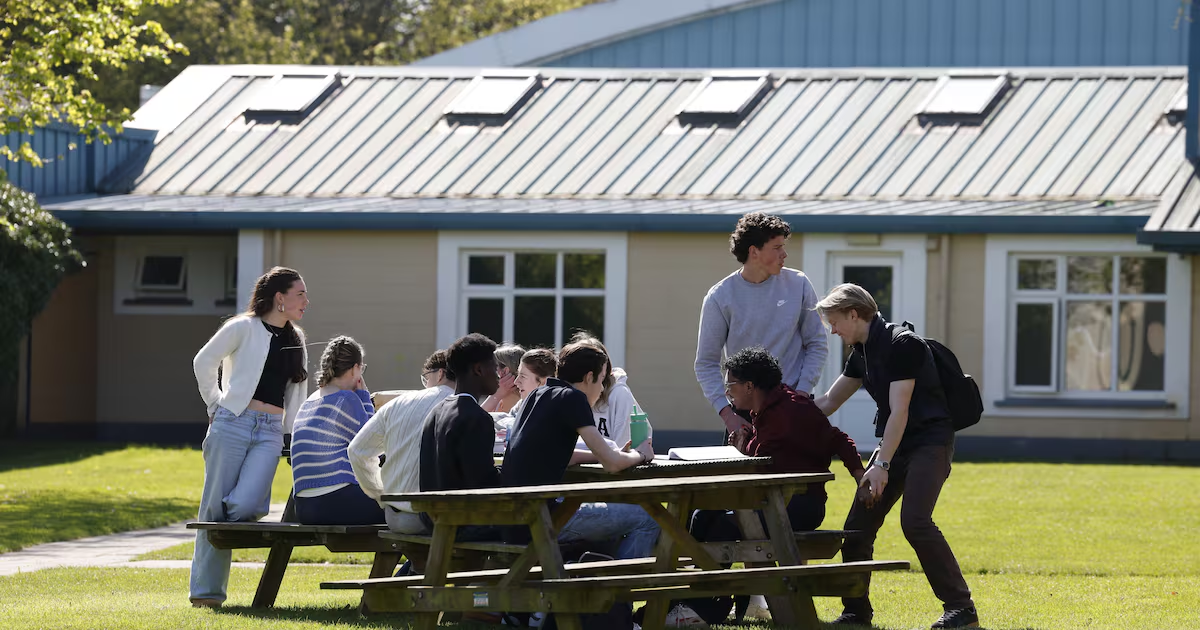
Our visit to a Quaker-ethos secondary school in Ireland – Newtown School in Waterford city – begins by attending morning assembly, known as “Collect”. The principal, Keith Lemon, sits in silence on a plastic chair facing the students and teachers sitting in rows of similar chairs in the gymnasium.The shared silence continues for a few minutes before he stands to read a passage from the Bible, this time about Jesus walking on water. “You have to get out of the boat if you want to walk on water,” he then says, adding that we all need courage and faith to cross thresholds in life. “It’s not about sitting in your comfort zone and waiting,” he says, returning to his seat as silence resumes.Boarding SchoolsThis is part of a series by Sylvia Thompson on boarding schools in Ireland – life inside the schools for students and teachers, pros and cons, the costs involved, and the freedoms and limitations. And why parents would choose to send their children to a boarding school in 21st century Ireland. ReadThen, after a few announcements and prize-giving, chairs are stacked up and students and teachers make their way to classrooms.Neville Louden is the pastoral care lead at Newtown School. He also leads Collect on certain days of the week. “Rules are kept to a minimum, but there is a high expectation of good behaviour, based on trust,” he explains. He says the principles of the Quaker ethos are simplicity, peace, integrity, community and equality, to which have been added stewardship and sustainability.“Although a minority (5-10 per cent) of students come from Quaker families, many students identify with the values of Quakers from being at school here,” says Louden.[ ‘It was the right thing to do’: The Dublin private school that dropped its feesOpens in new window ]Many of them also enjoy the discipline of sitting in silence at assembly, he suggests. “The silence is non-threatening. You can reflect, think of people, pray or keep yourself grounded for the day ahead. When they get to the senior cycle, they love beginning their day with a bit of silence,” says Louden.Newtown School was founded in 1798 on a Waterford estate previously owned by Irish politician and educational reformer Thomas Wyse. The Society of Friends bought the site to establish a school for Quaker children from Munster. Starting off with 31 boys and seven girls, numbers rose to 35 boys and 15 girls by the end of the first year.Newtown School principal Keith Lemon. Photograph: Nick Bradshaw/The Irish Times Boarder numbers rose and fell over the years, and when Newtown School entered the free education scheme in 2014 (meaning that day students no longer had to pay fees), day-student numbers increased substantially.Five-day boarding fees for the current academic year were €11,498. Seven-day boarding fees were €14,648. There is an additional, one-off fee of €2,500 for boarders who join after first year.When we visit, there are 329 day students and 86 boarders – more than half of the boarders are from abroad, particularly from Italy, Spain and Germany.[ Inside the only girls’ boarding school taught entirely through IrishOpens in new window ]“Ideally, we would have about 100 boarders, but numbers are down because of costs and because people don’t know about us,” explains Lemon, the head of Newtown School since 2009. He adds that most of the boarders are in fourth, fifth and sixth year, because “people like having their children at home now during their early secondary-school years”.The school has a history of attracting students from abroad, but, since Brexit, numbers have risen further in tandem with declining numbers of Irish boarders. While the Irish boarders return home every third weekend, the international students stay with local host families for those weekends.Javier Carbajo Elena, a live-in Spanish teacher at Newtown School. Photograph: Nick Bradshaw/The Irish Times Catering and dining staff Donna Murphy, Caroline Cooney, Alina Dauksaite and Eithne Colclough. Photograph: Nick Bradshaw/The Irish Times Lemon, who lives with his family in the principal’s residence on the school grounds, greets many of the students by name as he gives me a tour of the seven-hectare walled-in campus. “We have a relaxed uniform policy. Having a properly buttoned up tie hasn’t affected anyone’s learning. It’s about independent learning and each student discovering their voice and being comfortable in their own skin,” he says.[ Inside Clongowes Wood: Who sends their child to boarding school in 21st-century Ireland?Opens in new window ]He speaks openly about the need for new buildings, pointing to three uninsulated school blocks that are set to be demolished. Part of the boys’ boarding house has been recently retrofitted. Although the campus is clean, upgrading of some spaces wouldn’t go amiss. Teacher Stuart Greene with Franz Naundorf, Claudia Fitzpatrick, Tadhg Roche and Lars Kiriczi. Photograph: Nick Bradshaw/The Irish Times 'We have a relaxed uniform policy. Having a properly buttoned up tie hasn’t affected anyone’s learning.' Photograph: Nick Bradshaw/The Irish Times 'Some parents see boarding school as devolved parenting. But we want to work with students and their parents.' Photograph: Nick Bradshaw/The Irish Times “We work with what we have,” says Lemon, pointing to what was one of Ireland’s first school science laboratories, soon set to become a school science museum. Lemon shows me the first class for autistic students, which opened in the 2025/2026 academic year. A second one is due to be opened in the next academic year. Both are housed in a new classroom block.The prevailing atmosphere is informal and relaxed on the spacious campus, which houses classroom blocks, boarding houses, a music centre, a library, an indoor swimming pool, playing pitches, and green spaces scattered with wooden benches, where students gather at break times.Newtown School swimming pool. Photograph: Nick Bradshaw/The Irish Times Astro pitch at Newtown School. Photograph: Nick Bradshaw/The Irish Times [ Irish Quakers join ‘Twitter eXodus’, abandoning social network over misinformation and harmful contentOpens in new window ]Mobile phone use is forbidden during school hours. If a student is caught using their device, they are given a warning. If they are caught a second time, the phone is taken from them and kept in the office for a parent/house-parent to collect.The hockey pitches are also used for Waterford Hockey Club, and primary school pupils and community groups have some use of the school’s swimming pool.‘Originally, I didn’t want to go to boarding school, but I settled in really quickly... I’m excited when I go home at weekends’— Claudia Fitzpatrick, fifth-year, Co GalwayThe original Georgian House is a warren of offices and home to the first-floor visitors’ room, where potential new entrants and their parents are introduced to the school.“Some parents see boarding school as devolved parenting. But we want to work with students and their parents. If there are underlying mental-health or other problems, the support of parents can’t be forgotten. People need to be open and honest and talk about things,” says Lemon.Louden lives in the gate lodge on the school grounds and manages after-school and weekend activities (karaoke and talent nights, ceilís, walks, surfing, cycling, bowling, etc) for the boarders. The boarders can go to their place of worship on Sunday mornings or attend supervised study.Mobile phone use is forbidden during school hours. If a student is caught using their device, they are initially given a warning. Photograph: Nick Bradshaw/The Irish Times Newtown School has a history of attracting students from abroad, but, since Brexit, numbers have risen further in tandem with declining numbers of Irish boarders. Photograph: Nick Bradshaw/The Irish Times Eimear Gilhooly, a new art teacher at Newtown School, lives on campus. “It’s the first mixed school that I have taught in. I was at an all-girls’ school myself, which I think was more competitive. Here, the girls calm the boys down a bit and the boys provide a bit of balance for the girls,” she says.Eimear Gilhooly, a live-in art teacher on campus. Photograph: Nick Bradshaw/The Irish Times Terry Pulbrook is the head of the girls’ boarding house at Newtown School. “This year we only have one first-year [boarding student], two second-years and two third-years. We have 10 fifth-years – seven of whom are international, and five sixth-years, all of whom are international,” she explains.Terry Pulbrook, head of the girls’ boarding house at Newtown School. Photograph: Nick Bradshaw/The Irish Times Pulbrook, who lives in an apartment in the girls’ boarding house, says the challenge of boarding school is not the school routines. “The challenge is not being surrounded by your family. For some, that’s not something they want to give up. Their mum or dad [having attended] boarding school is not a reason to send children to boarding school. It will only work if they are happy,” she says.Views of the boarders Naia Martin, fifth-year student, Canary Islands. Photograph: Nick Bradshaw/The Irish Times Naia Martin, fifth-year student, from the Canary Islands“I came here to learn English and experience new things.”Angelica Perrotta, fifth-year, Venice. Photograph: Nick Bradshaw/The Irish Times Angelica Perrotta, fifth-year, from Venice, Italy“I came here because the [studying English abroad] agency showed me the school. I will stay one year. It’s easier to make friends with other international students because the Irish students know each other longer.”Max Kodzhaspirov, sixth-year, from Russia“I came to Newtown when I was 12. My grandmother and my brother came to this school. I love it here. The sports facilities here are better than in my Russian school. I like the Quaker ethos, which focuses on simplicity and community. You can strike up a conversation with anyone regardless of your age, interests or any disagreement you have had.”Naja Duggan, fifth-year, from West Cork“I really like it, but it definitely takes some getting used to. I’m the youngest of three, and both [my] brothers came here. I was really lonely at the start, but I’ve come out of my shell. Being a boarder definitely makes you a lot more independent.”Newtown School pupils Alanna Rainy, Hebe Lin and Emily Deacon. Photograph: Nick Bradshaw/The Irish Times Hebe Lin, sixth-year, from New Ross, Co Wexford“I’m the eldest of three children, and my parents thought I’d have better opportunities in a smaller school. I’ve become the person I am because I came to Newtown School.” Claudia Fitzpatrick, fifth-year, from Co Galway“This school offered me different things than where I live. Originally, I didn’t want to go to boarding school, but I settled in really quickly. Some days, when I’m tired, I’d like to go home, but I can’t. Yet, I’m excited when I go home at weekends. I like the [sense of] independence. You can do well if you choose to. There is no push.” Tadhg Roche, fifth-year, from Co Wexford“The buildings don’t look fancy, but the people here are very decent. I live in the countryside and I don’t have any siblings around, so my friends here are like my siblings. It’s great to meet people from all over the world.”Lars Kiriczi, fifth-year, from Munich, Germany“I came here to learn English. It’s great, with a better choice of subjects than my school in Germany. People are open, and Irish people have better social skills. I’m active in my church in Germany and I’ve been to the Quaker meetings once or twice. I think silence is a good thing. I’ve done meditation before as part of archery. If you’re not fully [focused], the arrows won’t hit the target.”Franz Naundorf, sixth-year, from near Braunschweig in Germany“It’s widespread for German families to send their children abroad to learn English. We didn’t pick the UK because it’s more expensive and the hassle with travel, because it’s not in the EU any more. I love Irish traditions – St Patrick’s Day and the sporting culture. As a boarder, you have to get along with people – even those you don’t like.”
Inside a Quaker-ethos secondary school in Ireland: ‘You have to get out of the boat if you want to walk on water’
There are currently 86 boarders in Newtown School in Waterford City, with more than half from abroad
1,957 words~9 min read