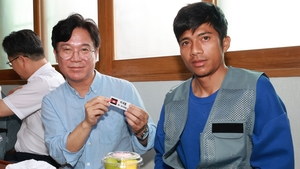
Reliance on skilled foreign workers grows, but long-term settlement remains constrained by career, wage discrimination Kim Young-hoon (left) presents a name tag to a Cambodian worker at a farm in Wanju County, North Jeolla Province, as part of a campaign encouraging employers to address international workers by their names. (Ministry of Employment and Labor) When Nalinda Kumara, a 37-year-old Sri Lankan shipyard worker, was promoted to on-site foreman in 2024, his company described it as the first such appointment of a foreign national in Korea's shipbuilding industry, a sector increasingly reliant on overseas workers.Kumara has worked for more than a decade with a subcontractor of HD Hyundai Heavy Industries. He now leads a team of 25 Korean and foreign workers, overseeing touch-up painting operations and workplace safety."I feel very proud that I opened a new path for my fellow foreign workers in shipyards," Kumara said.His promotion points to a broader shift across Korea's manufacturing industries. For more than three decades, foreign workers have largely been treated as temporary labor brought in for low-skilled jobs. But as labor shortages deepen and overseas workers accumulate years of on-site experience, some are beginning to move into more skilled and supervisory roles.His case also points to a question Korea has yet to fully answer — whether the country is prepared to help foreign workers build long-term careers and lives here. Nalinda Kumara, the first foreign national to be site foreman at the HD Hyundai Heavy Industries shipyard in Ulsan (HD Hyundai Heavy Industries) Skilled worker visa brings little changeThat question is increasingly being raised among foreign workers in Korea's small and medium-sized manufacturing sector, where many say little changes after they obtain the E-7-4 skilled worker visa."My colleagues and I have worked here for years and even trained newcomers, eventually qualifying for the E-7-4 visa. Yet we are still not treated as skilled workers," said Ali, using a pseudonym, a Pakistani worker who has spent more than six years at a packaging factory in Gyeonggi Province.Ali said the title of "skilled worker" has brought little tangible change to his working conditions or pay. He showed The Korea Herald his bank records, which indicated that his monthly wage remains just above 2.1 million won ($1,360), not significantly different from what he earned while holding an E-9 nonprofessional employment visa.While obtaining an E-7-4 visa gives workers greater legal stability and longer-term residency prospects, experts say the practical barriers many face in the labor market often remain unchanged."The E-7 visa is tied to a specific employer, and changing jobs often requires both employer consent and immigration approval," said Ryu Ji-ho, head of the Uijeongbu Foreign Worker Support Center in Gyeonggi Province. "Because E-9 workers can be matched with new employers through a government-run placement system, some workers say they feel less secure after switching to E-7-4 than they expected."For workers who have built their lives in Korea, losing a job can carry consequences beyond lost income. Even a brief period of unemployment can delay their eligibility for permanent residency by years, making many reluctant to leave their current workplace.As a result, some workers remain in jobs despite stagnant wages, unsafe working conditions or alleged human rights abuses. Others leave Korea altogether and take their skills elsewhere. Critics say such experiences could undercut the government's efforts to attract and retain skilled foreign workers. IInternational workers work on the production line at a molding factory in Gyeonggi Province. (Korea Federation of SMEs) Experience without advancementDespite cases like that of Kumara, limited opportunities for promotion remain a major source of frustration for foreign workers seeking to build long-term careers in Korea.A 2024 survey by the Migration Research and Training Center suggests a gap between the skills foreign workers are believed to have and the roles they are allowed to take on.According to the survey, more than half of foreign workers were assessed by employers as capable of performing jobs requiring moderate to high levels of practical knowledge and technical skill. Among E-7-4 visa holders, the figure rose to 67.8 percent.Despite this, only 29.3 percent of surveyed companies said foreign workers had opportunities to be promoted to managerial positions. The figure was even lower among smaller workplaces of fewer than 100 employees, where many foreign workers are concentrated.Ali said he had trained a Korean employee who was promoted to a supervisory position within a year of joining the company."The supervisor frequently addressed foreign workers as 'ya,' a blunt and often disrespectful form of address, and spoke to them in a harsh manner," he added. "I have a bachelor's degree, speak fluent English and have more experience in this job than he does. I could not understand why I was being treated that way."Experts say such workplace dynamics may reflect broader social perceptions of foreign workers in Korea, who have long been associated with manual and low-skilled labor despite a growing number of them taking on skilled roles.A 2024 survey by the Center for Social Value Enhancement Studies found that 51.6 percent of respondents expressed negative views about having a migrant worker as their supervisor, a significantly higher share than for migrants as colleagues or neighbors. Migrant rights activists call for fair wage increases and promotion opportunities for long-term migrant workers in front of Government Complex Seoul in central Seoul in 2022. The workers were employed by public institutions and provided counseling and translation services for international residents in Korea. (Migrant Center Friend) Growing consensus on long-term settlementExperts, government officials and industry officials largely agree that helping experienced foreign workers settle permanently in Korea is becoming increasingly important to sustaining the country's manufacturing sector.In shipbuilding, one of the industries facing severe labor shortages, foreign nationals accounted for 86 percent of the 14,359 workers in shipyard operations in the third quarter of 2023, according to government data.Experts warn that the departure of experienced foreign workers could leave critical gaps in skills and knowledge transfer in industries already facing labor shortages."Korea's foreign national workforce policy should shift toward a more comprehensive approach that integrates immigration, utilization and settlement support, including pathways to permanent residency," said Vice Labor Minister Kwon Chang-jun.Kwon said the government would support workers in nonprofessional visa categories as they build skills and expand opportunities for more experienced foreign talent to stay in Korea long term.Migrant support groups also say stable employment and income, along with the ability to live with family, are key factors in retaining foreign workers in Korea."Workplaces linked to large companies in Ulsan generally offer more structured conditions, including wage increases, which has led to more foreign workers bringing their families, compared with smaller firms or rural areas," said Park Yu-ri, director of the Ulsan Support Center for Foreign Residents."This shows that migrant workers are more likely to settle long-term when they feel they are part of the local community and are protected by fair systems."
Foreign workers gain skills, but stuck on career ladder
When Nalinda Kumara, a 37-year-old Sri Lankan shipyard worker, was promoted to on-site foreman in 2024, his company described it as the first such appointment o
1,139 words~5 min read