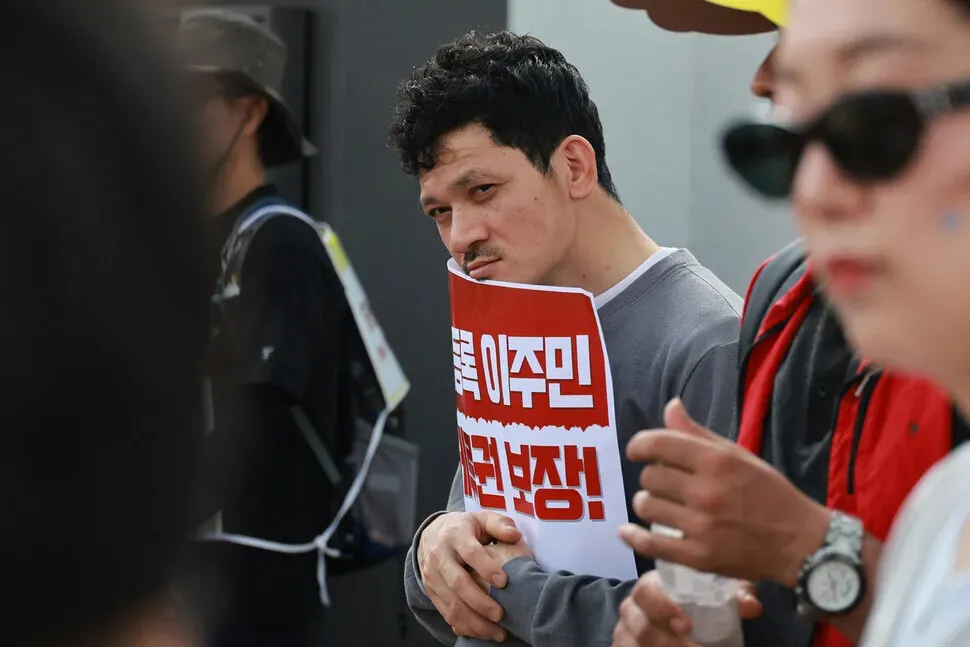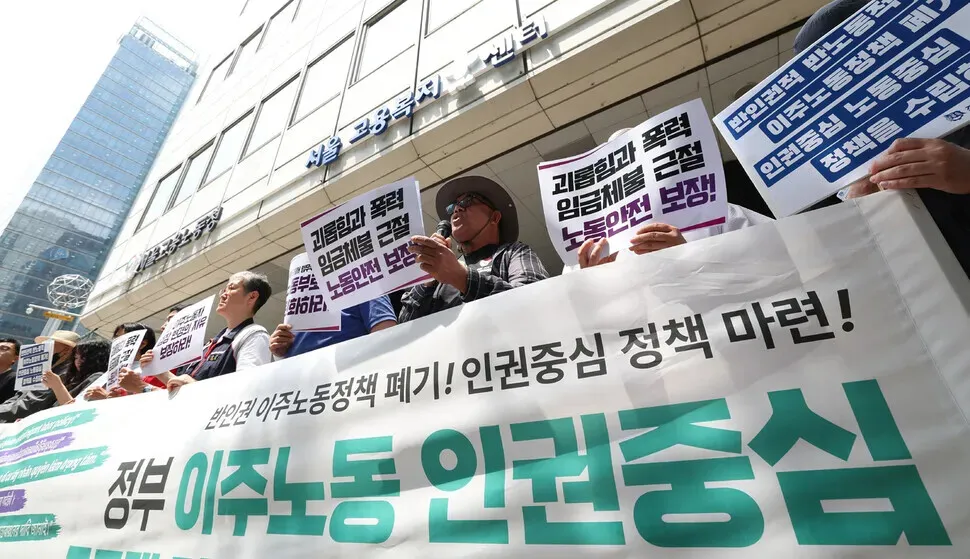
A member of KASAMMA-KO, the Alliance of Filipino Migrant Workers' Organizations in Korea, speaks at a press conference held outside the Seoul Regional Office of Employment and Labor on June 11, 2026, calling on the government to allow foreign workers to freely change employers and to put human rights first in migrant labor policy. (Kim Jung-hyo/Hankyoreh)
The South Korean government is exploring plans to bring undocumented migrant workers out of the shadows by granting opportunities to work lawfully within the system.Its reasoning is that the estimated 400,000 undocumented workers in South Korea have already established themselves as an essential workforce. Another issue that many have raised is the frequent incidence of human rights violations against them.In December 2025, an integrated support task force for foreign workers was launched by the Ministry of Employment and Labor, the Ministry of Justice, the Office for Government Policy Coordination and other government bodies. Through this framework, they joined representatives of labor, business, and academia in discussing policies related to pathways for undocumented migrant workers to gain legal status. The Labor Ministry’s vision involves revising the Employment Permit System (E-9 visa) and granting legal status to currently undocumented migrant workers who demonstrate a strong command of Korean and high work proficiency.The ministry drafted a plan that would differentiate Employment Permit System visas into three levels, allowing skilled workers to remain in South Korea for six years or longer. As part of these system changes, an avenue to legal status would be granted through the issuance of visas to currently undocumented migrant workers who meet certain conditions.But progress has currently stalled due to ongoing differences of opinion between agencies.The present total of around 400,000 undocumented migrant workers in South Korea reflects a number of structural issues. Because migrant workers who arrived through the permit system have difficulty changing workplaces legally, many end up losing legal status after leaving their jobs due to abuse, wage nonpayment and other factors.Also, although small-scale workplaces face severe labor shortages, restrictions on the legal employment of migrant workers often lead employers to hire undocumented workers instead, as they are willing to accept lower wages and can be terminated more easily. In other instances, workers choose undocumented status to earn more money due to the short duration of the employment permit visas, while others arrive through the mediation of illegal brokers.Labor and civil society groups have urged the government to guarantee undocumented workers the right to remain in Korea.“The undocumented migrant issue is the product of the avenues for lawful migrant labor being relatively narrow despite the ongoing domestic demand for workers,” explained Jeong Yeong-seop, an executive member with Alliance for Migrants Workers’ Equal Rights.“Given that these people are already living as members of South Korean society, we need to provide them with a minimum of sojourn rights and institutional safeguards,” he urged.Some observers question the effectiveness of policies that rely primarily on crackdowns and deportation“The number of people the government deports through crackdowns amounts to about 30,000 annually,” observed Lee Cheol-seung, a representative of the Gyeongnam Foreign Residents Support Center. “We get around that many new undocumented migrants each year.”Lee argued that those who meet certain conditions, such as a clean criminal record, should be “brought into the system.”Several countries have implemented policies that provide undocumented workers with pathways to legal status.In January, Spain announced a policy of granting legal sojourn status to undocumented migrant workers meeting certain conditions. The policy applied to workers without criminal records who had arrived in the country prior to Dec. 31, 2025, and could document residence for five months or longer. Children living with them were also included as beneficiaries.Those granted approval through the system are eligible for residence and employment throughout Spain for at least one year, with the opportunity to renew. The Spanish government estimates that over 500,000 people have gained legal status through the measure.By Park Da-hae, staff reporterPlease direct questions or comments to [english@hani.co.kr]