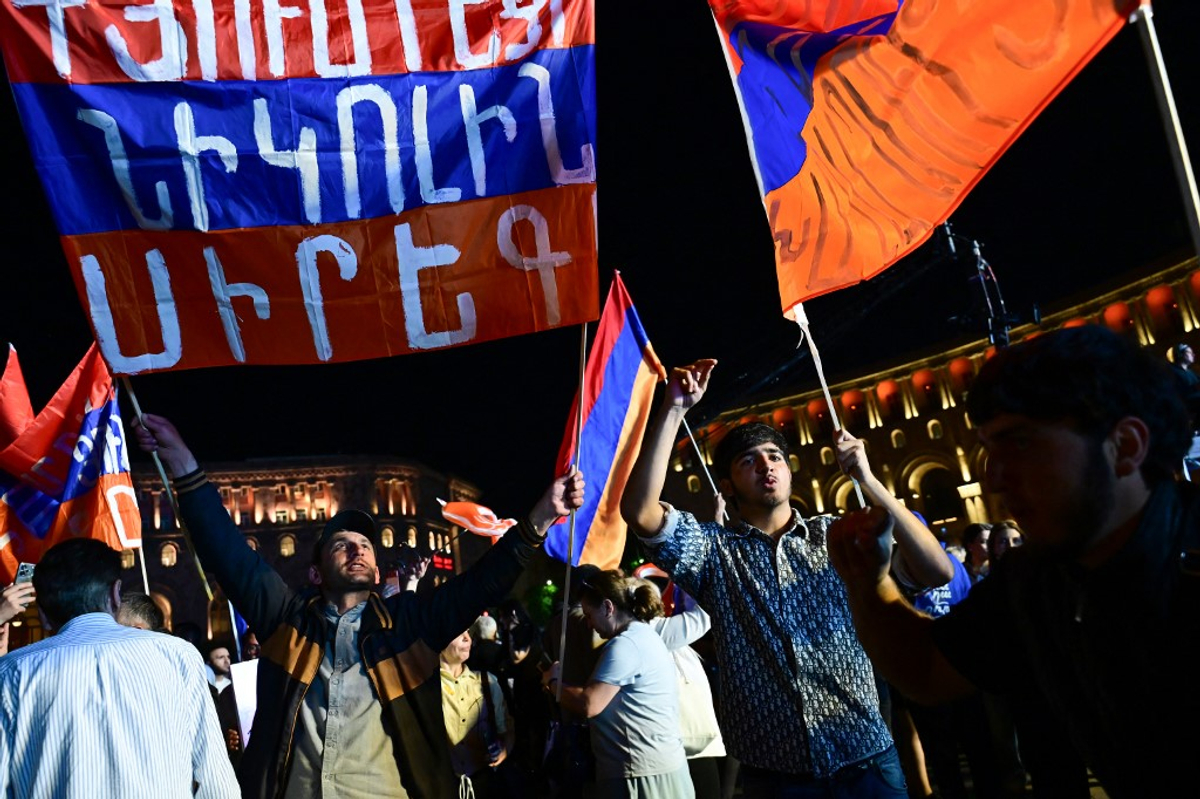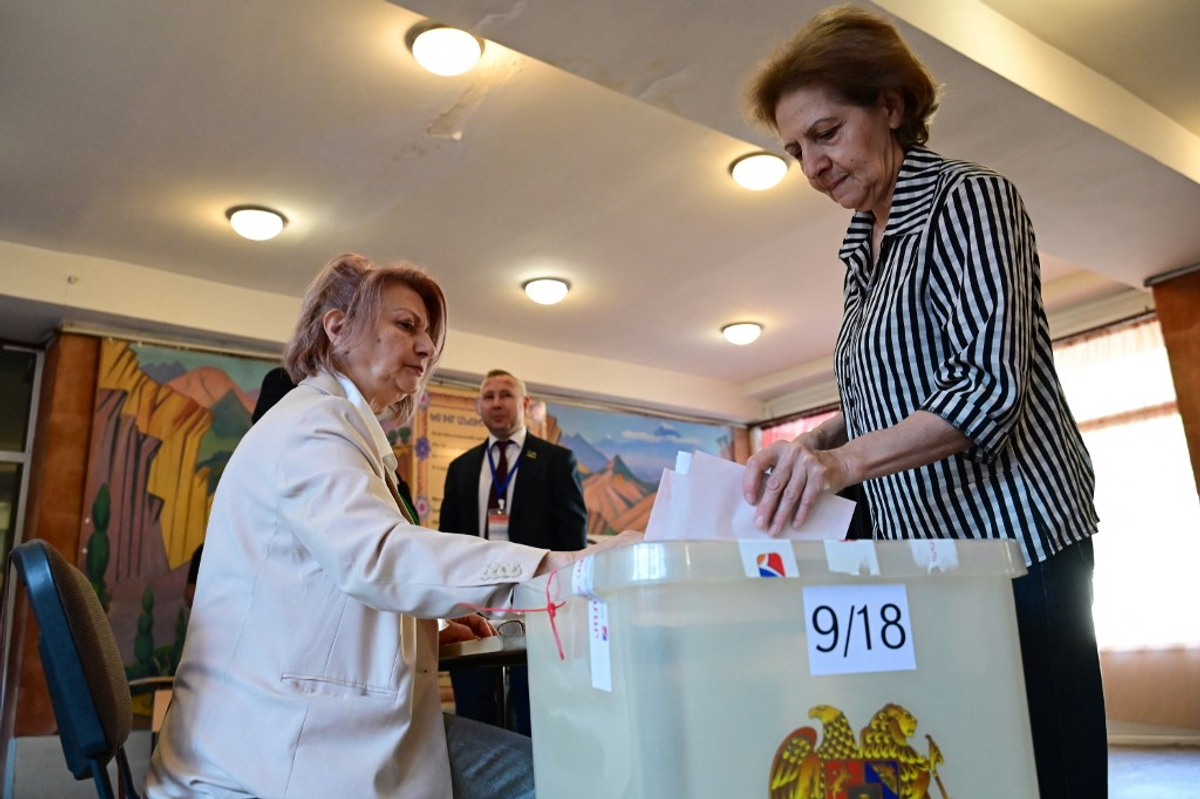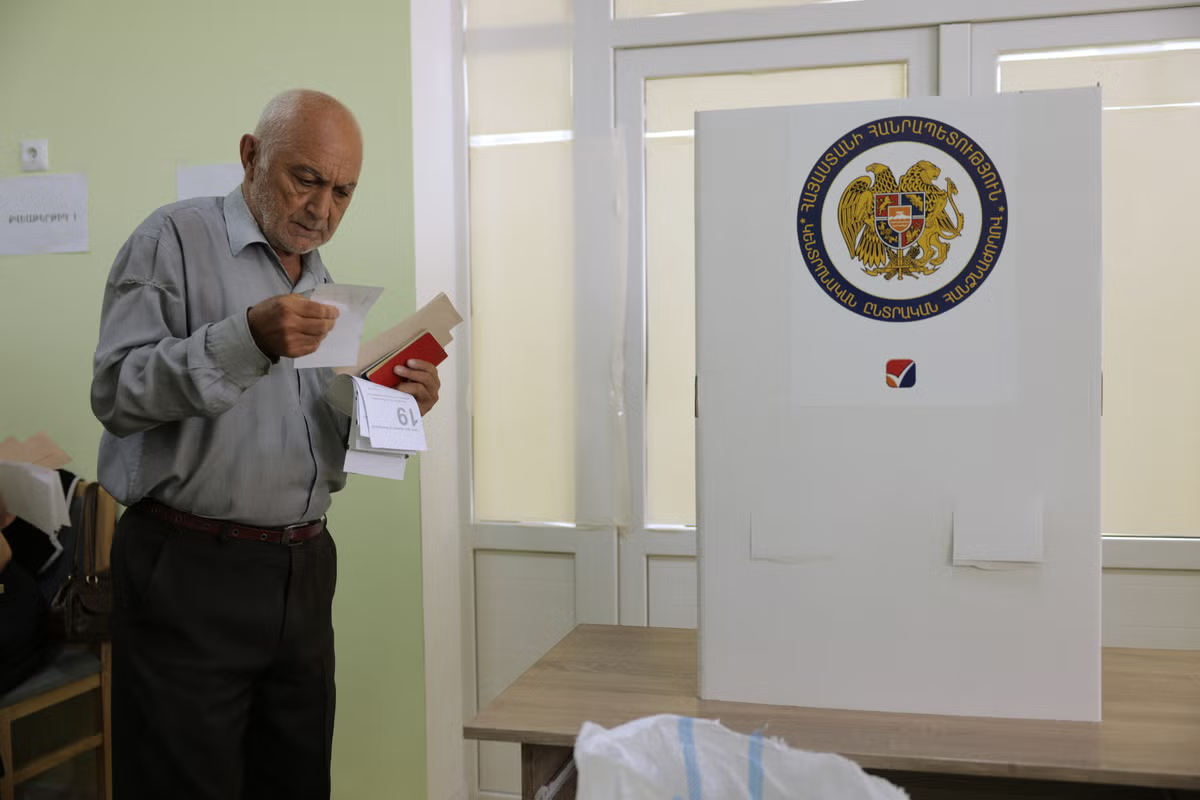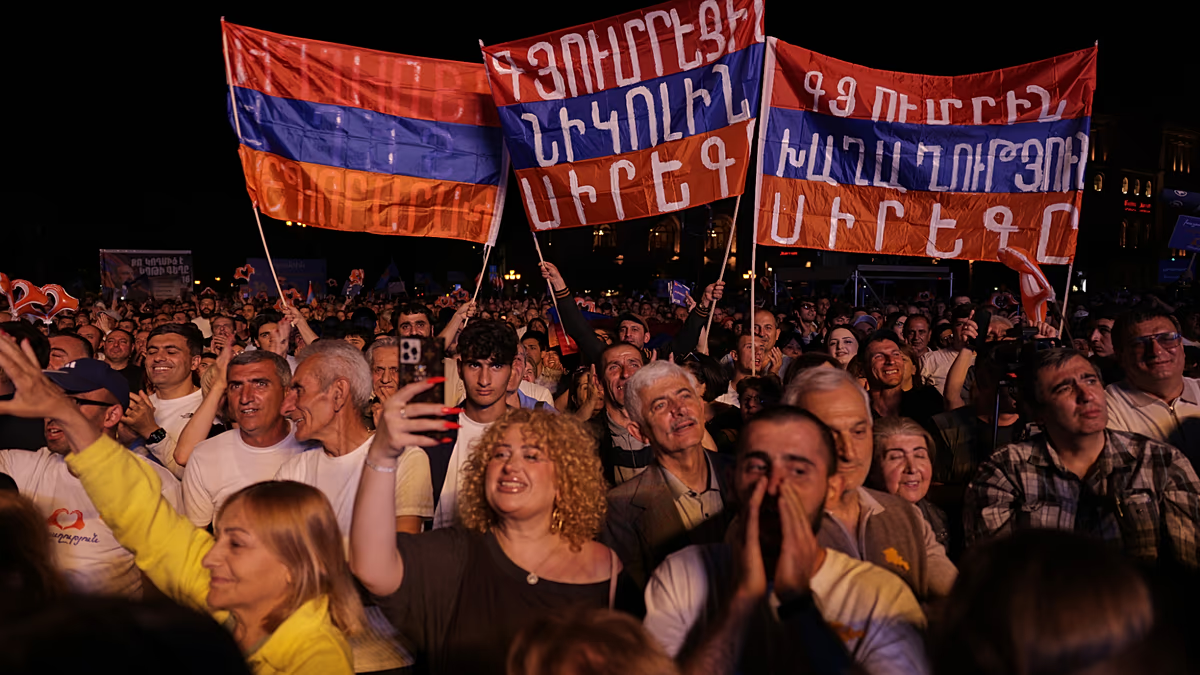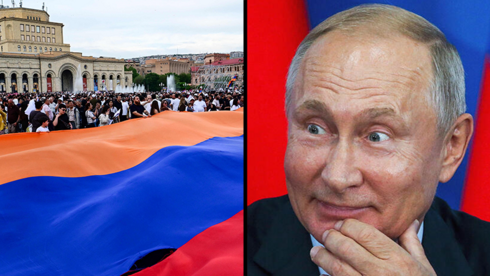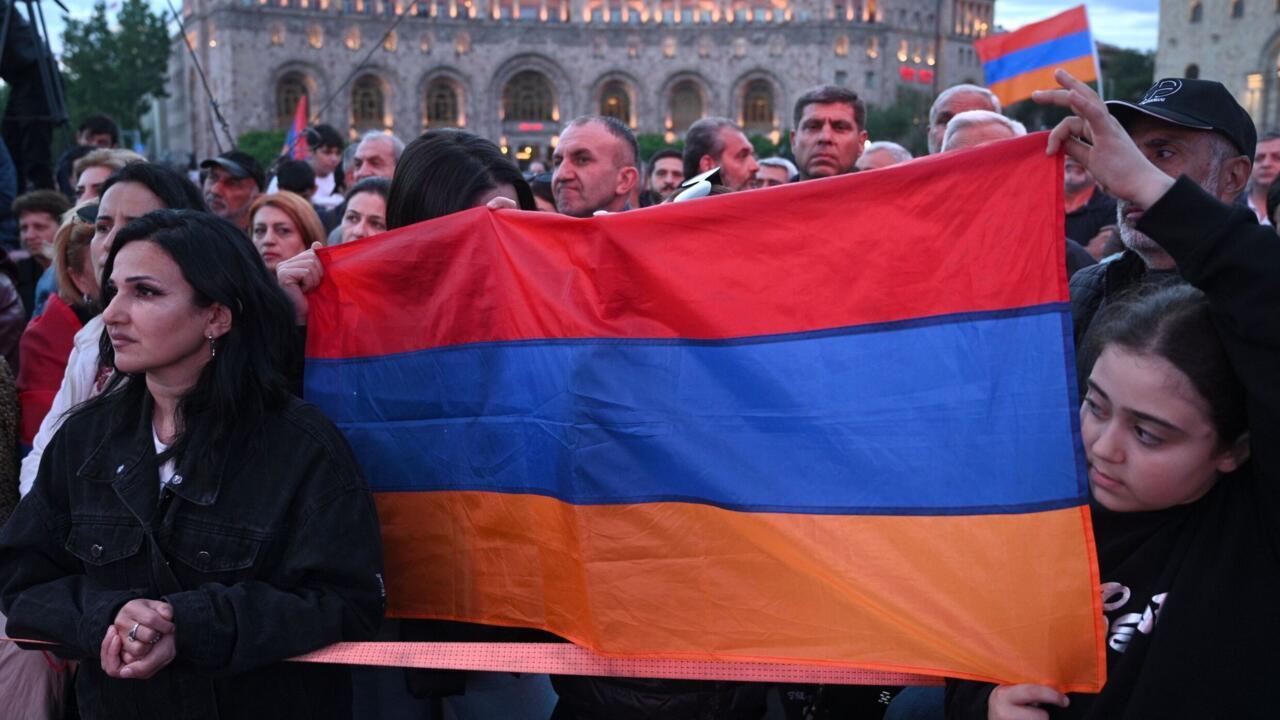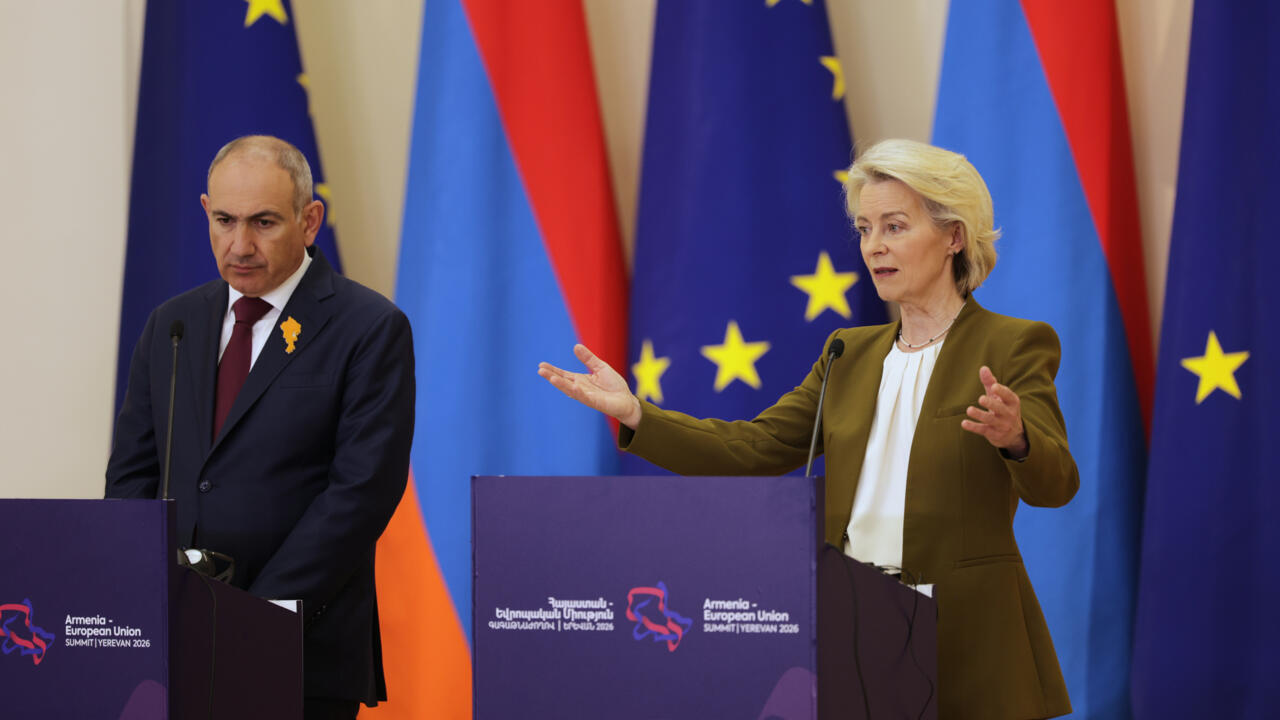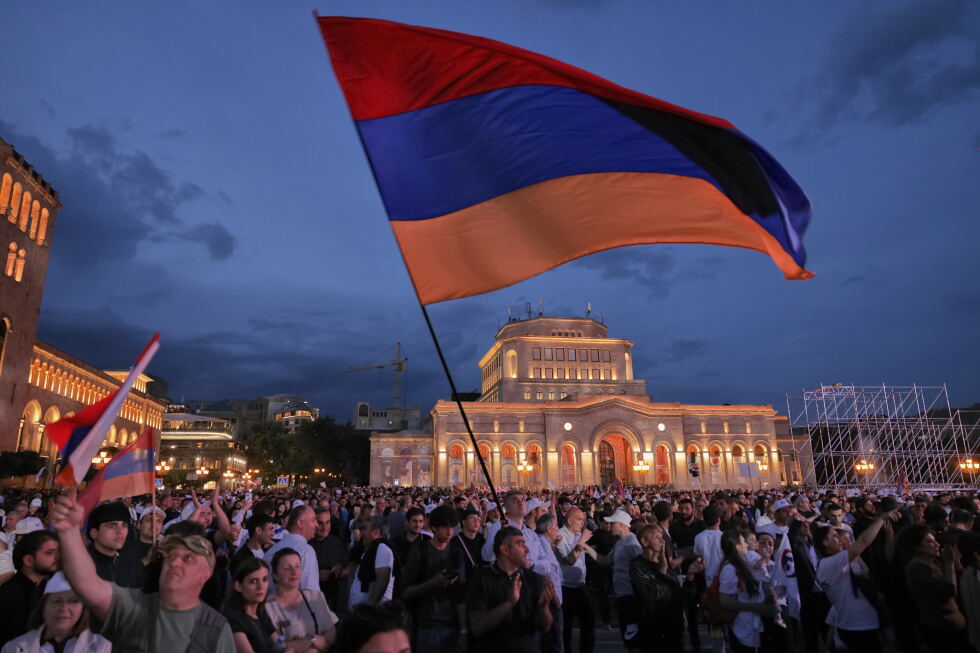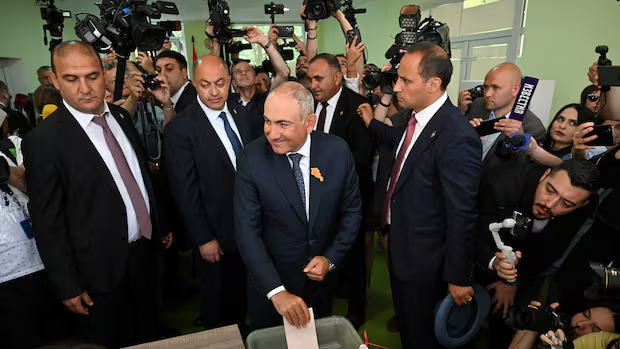
World·AnalysisThousands of people gathered in Armenia’s capital this week to decry the alleged traitorous path plotted by their current government, waving flags and warning that a vote to re-elect would mean "living here with Azerbaijanis" — the country’s longtime rival, with whom the present administration has reached a tenuous peace. But a larger shadow looms over the upcoming vote: a historic break in the country's relations with Russia.Current leader wants to join EU, while his 2 primary challengers have close ties to RussiaNeil Hauer · CBC News · Posted: Jun 06, 2026 4:00 AM EDT | Last Updated: 5 hours agoListen to this articleEstimated 6 minutesThe audio version of this article is generated by AI-based technology. Mispronunciations can occur. We are working with our partners to continually review and improve the results.Supporters of Russian-Armenian billionaire Samvel Karapetyan gather at Republic Square in Yerevan, Armenia, on Wednesday, days before the country goes to the polls. (Anthony Pizzoferrato/The Associated Press)Thousands of people gathered in Armenia's capital this week to decry the alleged traitorous path plotted by their current government, waving flags and warning that a vote to re-elect would mean "living here with Azerbaijanis" — the country's longtime rival, with whom the present administration has reached a tenuous peace.But a larger shadow looms over the upcoming vote: a historic break in the country's relations with Russia. As such, when Armenians head to the polls on Sunday, it will be for one of the most important elections taking place in Europe this year.The vote pits incumbent Prime Minister Nikol Pashinyan, in power since 2018, against an array of challengers from which two primary opponents have emerged. Both of them — former president Robert Kocharyan and Russian-Armenian billionaire Samvel Karapetyan, whose Strong Armenia party held the rally in Yerevan this week— are closely aligned with Russia. Kocharyan, who ruled from 1998 to 2008, sits on the board of directors of a major Russian financial corporation, while Karapetyan made his $4-billion US fortune in Russia, where he lived from the 1990s until recently.While Pashinyan is expected to be re-elected, the election has taken on outsized geopolitical importance. The fracturing of Russian-Armenian relationsStrong Armenia leader Karapetyan, on screen, is polling around six per cent ahead of Sunday's national election. (Anthony Pizzoferrato/The Associated Press)Pashinyan has pushed Armenia strongly westwards in recent years, signing deals with the U.S., making official aspirations to join the European Union and hosting a European Political Community summit last month. (The group was formed in the wake of Russia's invasion of Ukraine.)Russia — the country's traditional patron — appears to have had enough. On May 29, Vladimir Putin threatened the country with suspension from the Eurasian Economic Union, which would result in a massive hike in gas prices. Moscow has likewise blocked the import of a wide variety of Armenian goods, while reportedly activating disinformation networks aimed at unseating Pashinyan. On Thursday, Russia's deputy prime minister stated that "if pro-European forces win [the election]," Russia would be forced to "take necessary measures." He did not specify what those might be.French President Emmanuel Macron, left, and Armenia's Prime Minister Nikol Pashinyan pictured during the EU-Armenia Summit last month. (Anthony Pizzoferrato/The Associated Press)The Kremlin is also reportedly planning to dispatch some 100,000 Armenians living in Russia to vote against the prime minister. Armenian authorities have responded by handing out leaflets at the country's airports and border crossings, informing arrivals that accepting money in exchange for a vote is punishable by prison time.The fracture in Russian-Armenian relations has not been sudden, experts say, but rather the result of a years-long growing divide."Armenian-Russian relations have been in crisis for a long time, reflecting the fact that this is a relationship whose fundamentals are changing," said Laurence Broers, an associate fellow with Chatham House's Russia and Eurasia program, in written comments to CBC News. "The main pillar of the old relationship, the 'rescue fantasy' that Armenia's loyalty earns Russian security guarantees, has collapsed, and Moscow has lost its principal source of leverage over Armenia in the unresolved Karabakh conflict," he wrote.Nagorno-Karabakh region at heart of conflictFor more than three decades, Armenia and Azerbaijan were engaged in conflict over the Nagorno-Karabakh region, which lies within Azerbaijan's borders but is dominated by ethnic Armenians.A 1991-1994 war saw Armenian forces emerge victorious — a status quo that endured until Azerbaijan launched a second war in 2020, securing three-quarters of the territory before conquering the rest in 2023.Weapons, military vehicles and equipment surrendered by Armenian forces in Nagorno-Karabakh are displayed in October 2023. (Aziz Karimov/The Associated Press)That entire time, Russia has been Armenia's primary security partner. However, Armenia's faith in Moscow's willingness, or ability, to aid it against external threats was fatally shaken by a 2022 Azerbaijani offensive into Armenia itself, which saw Azerbaijani troops occupy territory in southern Armenia during two days of fighting. Armenia appealed to the Collective Security Treaty Organization (CSTO), a Russian-led analogue to NATO, invoking Article 4, which obliges Russia and other members to provide military aid to restore the country's territorial integrity. Moscow declined, offering only to send an "observation mission." And less than a year later, Russian peacekeepers stood aside as Azerbaijan conquered the remainder of Nagorno-Karabakh, sending over 100,000 refugees into Armenia.Since then, Yerevan — under Pashinyan's leadership — has veered sharply away from Moscow, ordering the withdrawal of Russian border guards from parts of the country and effectively freezing its participation in the CSTO. WATCH | Ethnic Armenians mourn life left behind:Nagorno-Karabakh evacuees paint sombre picture of lives left behindSeptember 29, 2023|Duration 2:17Ethnic Armenians fleeing Nagorno-Karabakh — 90,000 of them and counting — just keep coming. They mourn the lives they left behind, traumatized by the conflict they're fleeing in the contested region that is internationally recognized as part of Azerbaijan.What will Russia and Armenia's 'new normal' look like?Russia has responded by backing Karapetyan in his bid to unseat Pashinyan, so far with limited success. Recent polling shows Pashinyan's party in the lead with 32 per cent of prospective voters, compared to just six per cent for Karapetyan, albeit with 23 per cent still undecided and 21 per cent declining to say.Opposition forces have struggled to attract new supporters since the last election in 2021, where Pashinyan defeated his leading challenger by a whopping 33 per cent. "The opposition is failing to mobilize groups of voters of significant size outside of its established base over the past five years," said Narek Sukiasyan, a political scientist at Yerevan State University. "There is a certain overlap between Kocharyan's and Karapetyan's supporters, but the chances of either unseating the ruling party are quite low."As Canada plans to send election observers to Armenia, advocates warn of a democratic backslideAmid Iran conflict, combative neighbours Armenia and Azerbaijan try to stay above the frayRussia's influence in the South Caucasus writ large has unraveled in recent years. While Moscow once dominated the region through political, economic and military levers, now only Georgia remains in its orbit. That's underlined by the recent visit of Ukrainian President Volodymyr Zelenskyy to both Armenia and Azerbaijan — an event that felt unthinkable just a few years ago.While Russia and Armenia will retain some economic and political ties regardless of Sunday's vote, the Kremlin is likely to be one of many players — a list that now includes the U.S., EU, Iran and Turkey — in the region going forward. It's a state of affairs not seen since before the Russian Empire conquered the region in the early 1800s."The permanent damage is in the long-term temporality of Armenian-Russian relations: Russia's hollowed-out hegemony, its declining power and the growing influence and power of numerous other actors in the South Caucasus," Broers wrote. "I suspect Moscow and Yerevan may seek to find a 'new normal' after these elections, but this certainly won't be the last crisis between them."ABOUT THE AUTHORNeil Hauer is a Canadian freelance journalist reporting on the former Soviet Union, based in Yerevan, Armenia, but currently reporting from Ukraine. His work has been featured in CNN, Al Jazeera, The Globe and Mail, Foreign Policy magazine and other outlets. He can be found on Twitter at @NeilPHauer, or contacted via email at neil.hauer@gmail.com.
ANALYSIS | Crucial Armenian election comes amid drastic rupture with Russia | CBC News
Thousands of people gathered in Armenia’s capital this week to decry the alleged traitorous path plotted by their current government, waving flags and warning that a vote to re-elect would mean "living here with Azerbaijanis" — the country’s longtime rival, with whom the present administration has reached a tenuous peace. But a larger shadow looms over the upcoming vote: a historic break in the country's relations with Russia.
1,357 words~6 min read