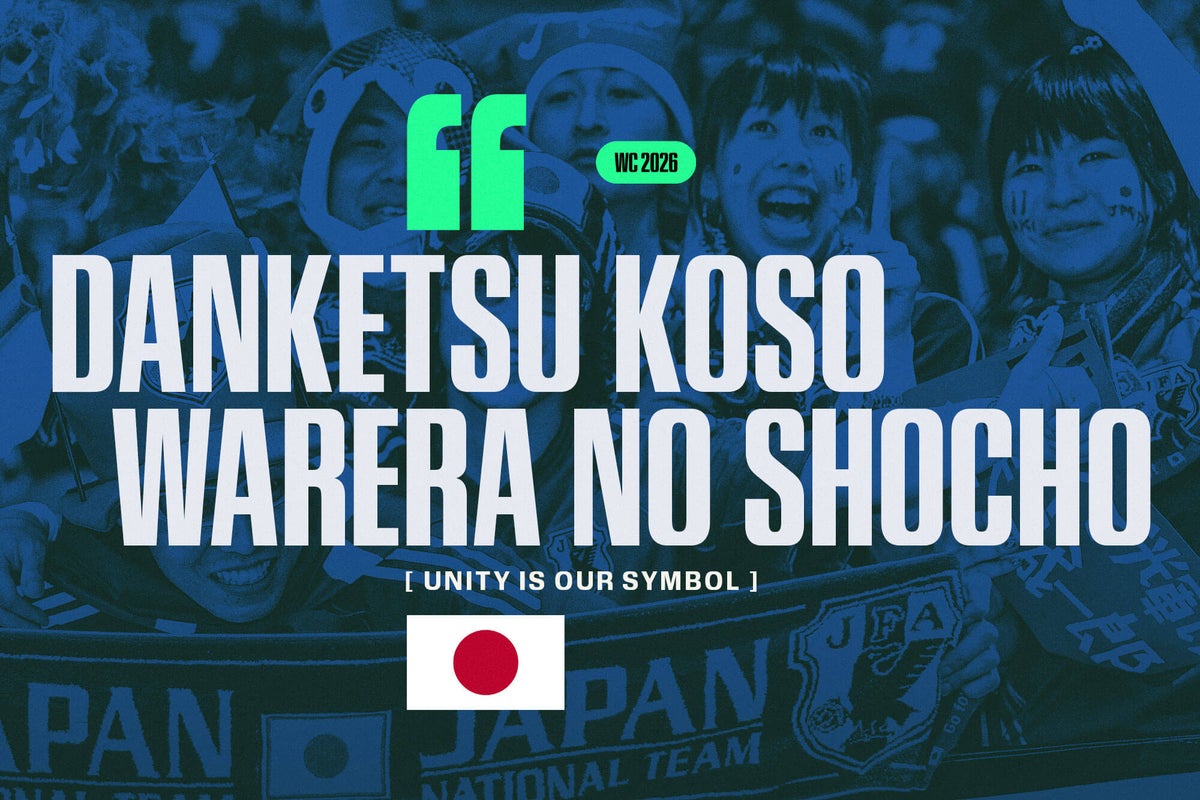
As part of our Language of Soccer World Cup series, The Athletic is speaking to supporters of all 48 nations competing at the 2026 edition to capture their unique football culture, distilled into a single phrase. You can read the articles in one place here.団結こそ我らの象徴 – Danketsu koso warera no shocho — Unity is our symbol“We might not have specific players who are outstanding individually,” says Asahi Ueda, the founder and leader of Japan’s Nippon Ultras, “but we work as a team, you know? Unity is our symbol. Offensive players work hard to defend, defensive players work hard to attack. This is Japan.”Having made their World Cup debut at the 1998 tournament in France, Japan have appeared in each of the six editions since — and though they are yet to make it beyond the round of 16, getting that far three times, have increasingly threatened a true breakthrough moment.In 2018, they lost to Belgium in that first knockout stage despite holding a two-goal lead with just 20 minutes of the 90 left, and they were beaten on penalties by Croatia four years ago after dominating the game. On both occasions, their opponents went on to reach the semi-finals, and win the third-place play-off.Their development as a football team has been powered by the collective. Japan’s level of technical mastery is amongst the highest in the world, producing an international side which more resembles a club one in terms of its chemistry and dynamism.“I think it’s about efficiency,” says New York City-based Japan supporter Kayo Kita. “Japan is famous for our cars, right? Toyota, Honda, Suzuki, Mitsubishi, Subaru… And in the same way that those cars are very efficient, so are our players. They’re not too expensive compared to the luxury cars, but they run well for a long period of time, they’re reliable, and they outperform the sum of their parts.”“Growing up, we honestly didn’t expect Japan to be that good,” says fellow fan Alexander Kiridani Feliciano. “So I guess it’s just that underdog mentality, being united. I think it’s never really been about one player. The popular players are spread out throughout the team. There’s unity. The way I always think about it is all for one, one for all.”But there is an interesting contradiction in Japan’s fan culture. Despite pride in their team’s collective ability, several supporters bring up the concept of otaku — a Japanese word referencing an almost obsessive interest in a particular topic or individual.“It means finding an icon and loving it to the extreme,” explains Chizuko Trader. “I think as Japanese fans we have a stronger tendency to do it, to get really into the player. Junya Ito (a winger at Belgian club Genk) is my favourite. His nickname is Lightning, because he’s so fast, and though he’s not always a starter, when he comes on, he makes you think you can get something.”While Ito is especially popular — in part, several admit, due to his boyband looks — other players mentioned include Brighton & Hove Albion’s Kaoru Mitoma, Takefusa Kubo of Real Sociedad and Crystal Palace’s Daichi Kamada.
Japan’s fans clean up stadiums and make friends with opponents: ‘Unity is our symbol’
As part of a special World Cup series, The Athletic is speaking to fans of all 48 competing nations to capture their unique football culture
1,380 words~6 min read