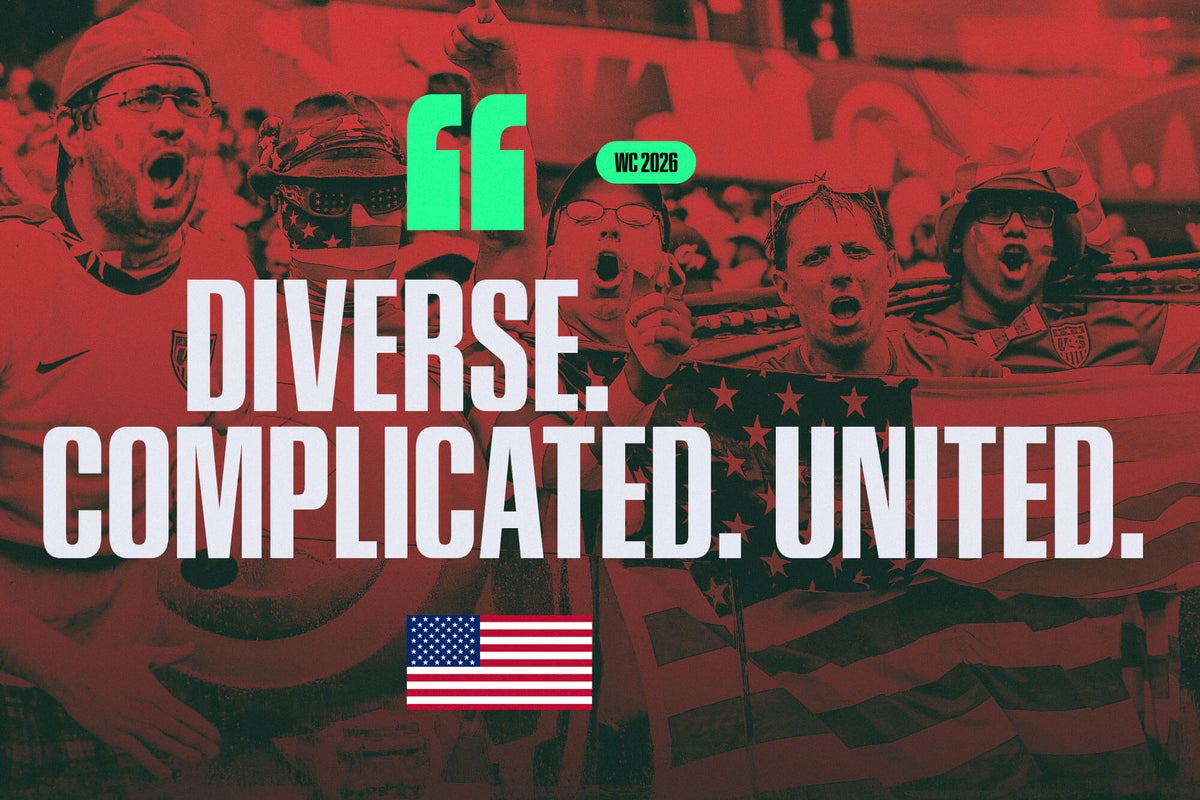
As part of our Language of Soccer World Cup series, The Athletic is speaking to supporters of all 48 nations competing at the 2026 edition to capture their unique football culture, distilled into a single phrase. You can read the articles in one place here.Diverse. Complicated. United.That, in three words, is U.S. soccer fandom. It’s the faithful few who travel coast to coast. It’s the millions attached to this infectious but fragmented sport, their interest divided among dozens of different leagues and teams. It’s also the soccer agnostics, the rabid sports fans who obsess over basketball or American football but ignore the world’s football for years at a time. Every fourth year, all those groups rally around the U.S. men’s national team, united by a belief that their overlooked squad — and this overlooked sport — can rise and shock the world.“It’s a relentless optimism,” says Antonio Borjon, a U.S. fan in Southern California.Throughout the 2026 World Cup, it will stretch from SoFi Stadium to suburban Illinois; from bars in Manhattan to homes in Birmingham, Alabama; from Denver to the Dakotas, from New Hampshire to New Mexico, all across the 50 United States.Antonio Borjon is a passionate USMNT supporter (Antonio Borjon)And it will overwhelm any cynicism, apathy or frustration that typically trails the USMNT — the now-popular moniker for the U.S. team.Its fanbase, like the vast country it represents, is varied and difficult to define. It’s also relatively nascent. American soccer, just a few decades ago, existed in society’s shadows. “I loved soccer as a child,” says Gerald Foston, whose fandom dates back to the 1970s. “Unfortunately, growing up in the South Bronx, I didn’t find many people who loved it like I did.”Then, throughout the 1990s and 21st century, soccer began attracting people from all walks of life, from all regions and backgrounds.Some, including Randy Hernandez, came to it naturally. The California-born son of Mexican immigrants, he latched onto his local team, the LA Galaxy, and later to the U.S. national teams.Others, such as Craig Hahn, adopted soccer when “it was still a very niche thing.” Growing up in Pittsburgh, he played the sport but rarely found it on TV. The EA Sports video game “FIFA,” and later the internet, became his “gateway” to the broader soccer world. But it was American soccer — and the idea of “building to something, hopefully some day to win a World Cup,” Hahn says — that “piqued my interest.”American soccer’s gorgeous complication, though, has always been that millions of Americans latch onto teams other than the USMNT. When compared to other countries, and even to other American sports, this is one of several dynamics that makes U.S. fandom distinct.If, by contrast, you were born into a family of Newcastle United fans in England’s north east, you probably support Newcastle and England’s national team. If you were born in Montevideo, you likely support either Penarol or Nacional and almost certainly love the Uruguayan national team.If, however, you are born in Wisconsin to parents who love the NFL’s Green Bay Packers; or in Washington, D.C., to parents who came from Colombia, you might feel no organic attachment to the USMNT. In a family of immigrants, you might support the motherland’s team.
Diverse. Complicated. United. This is what it is to be a USMNT soccer fan
As part of a special World Cup series, The Athletic is speaking to fans of all 48 competing nations to capture their unique football culture
1,626 words~7 min read