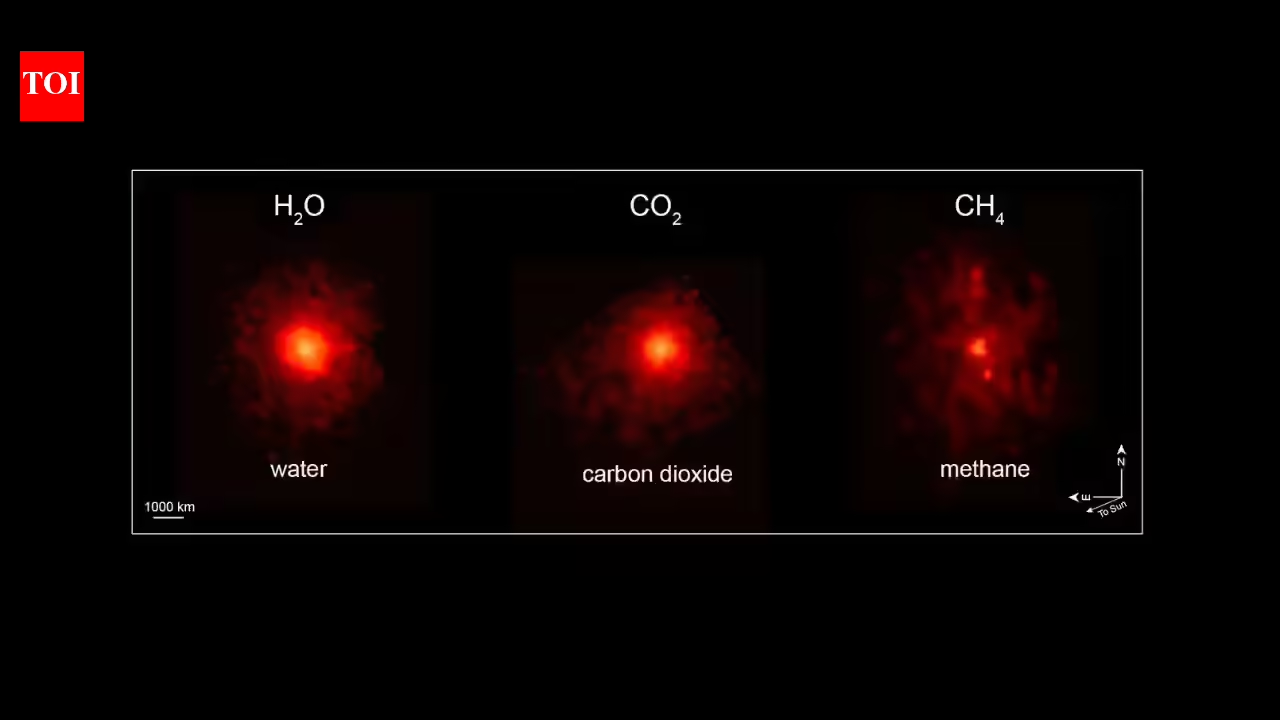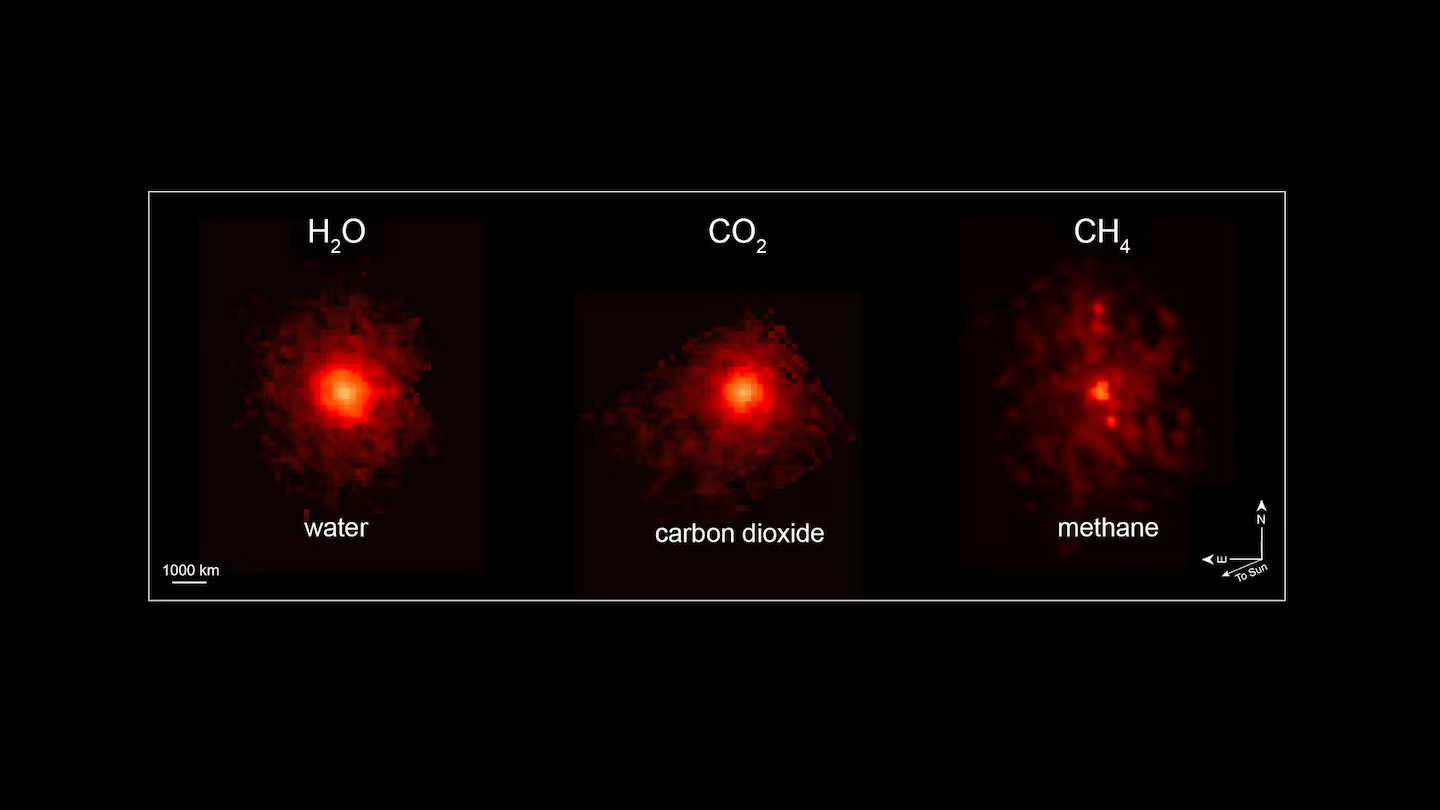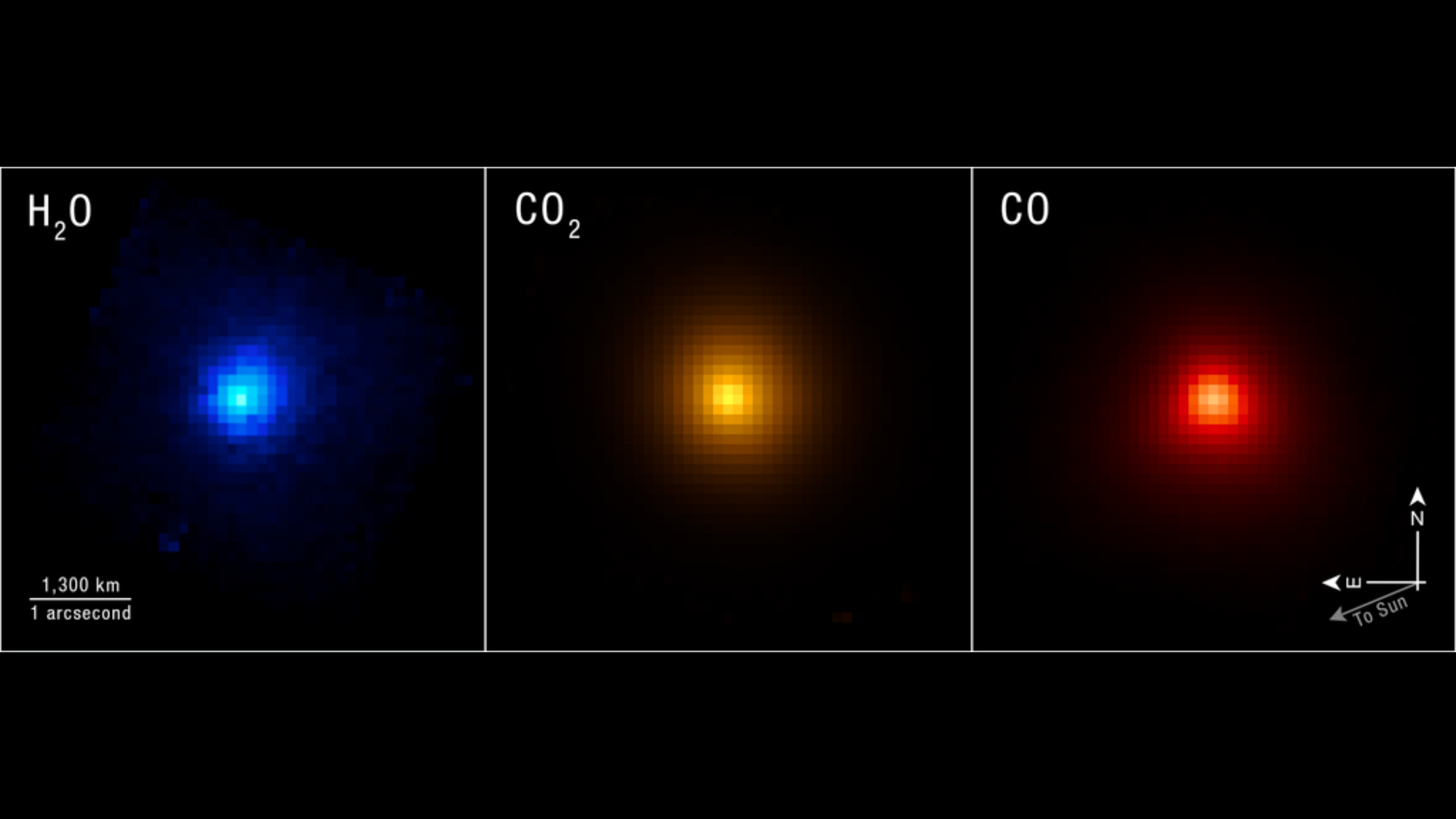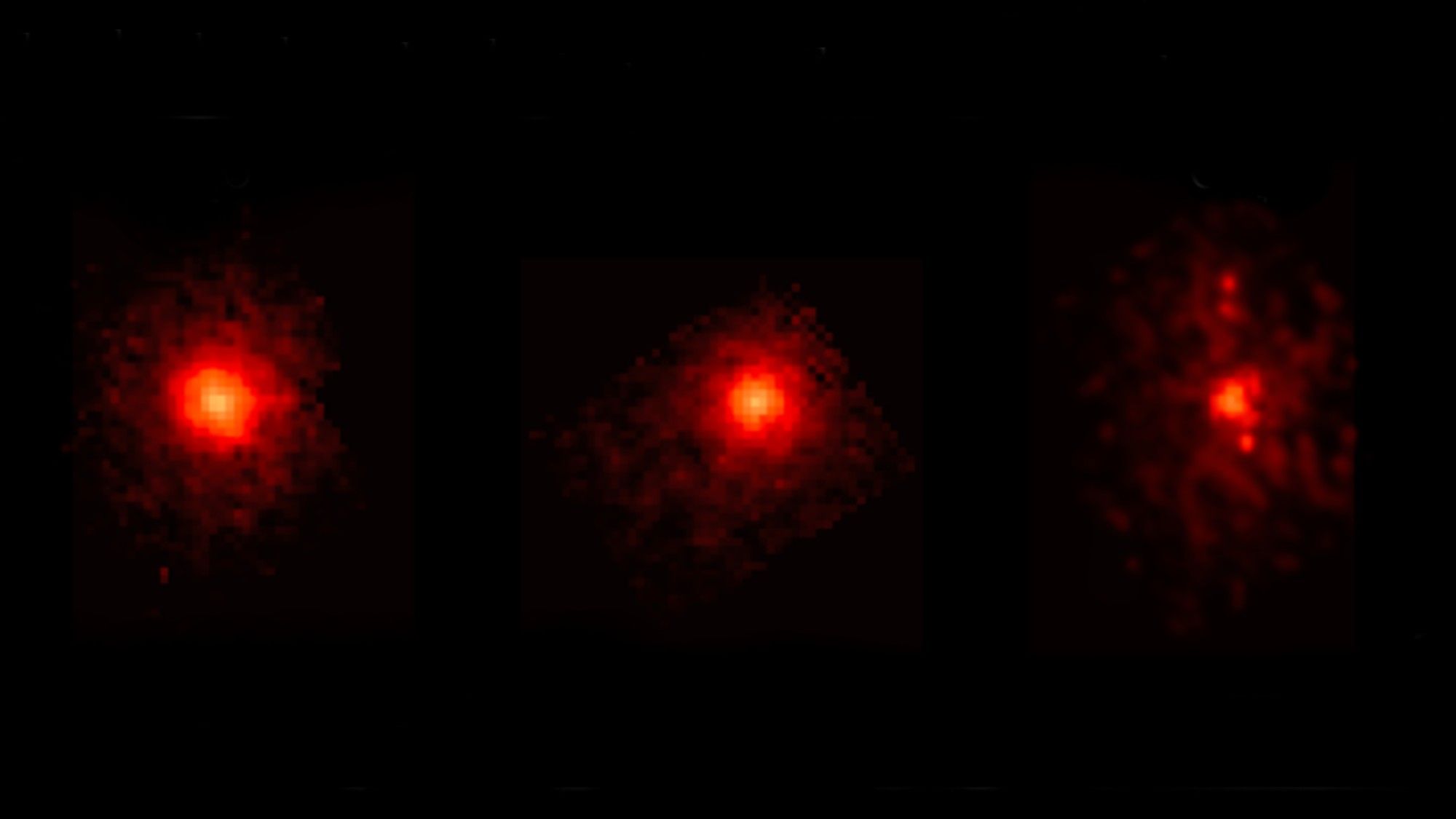
A composite image showing three side-by-side maps of different chemical signatures observed around interstellar comet 3I/ATLAS: from left to right, water, carbon dioxide and methane.
(Image credit: NASA, ESA, CSA, STScI, M. Belyakov (Caltech), I. Wong (STScI), Image Processing: A. Pagan (STScI))
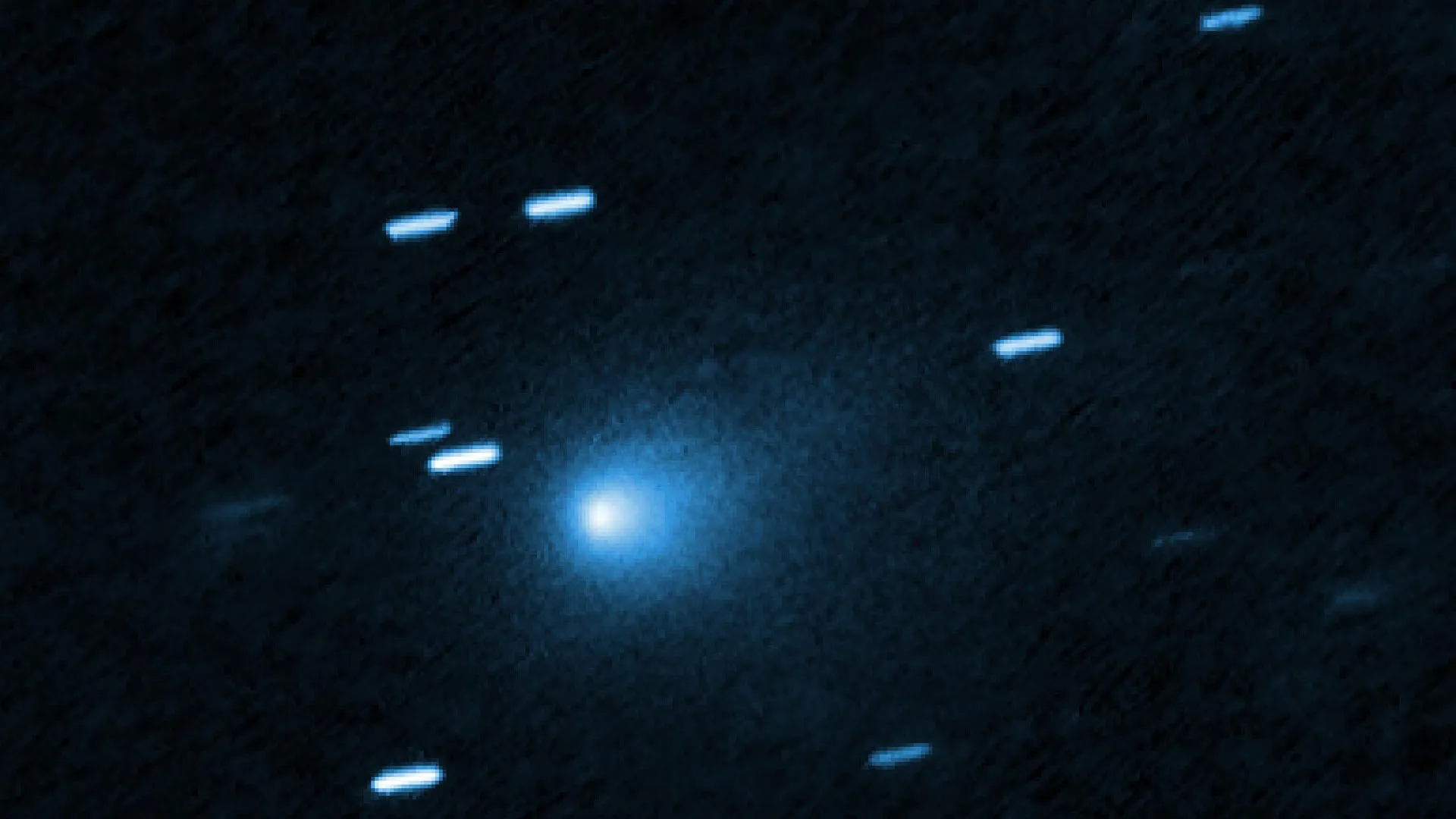
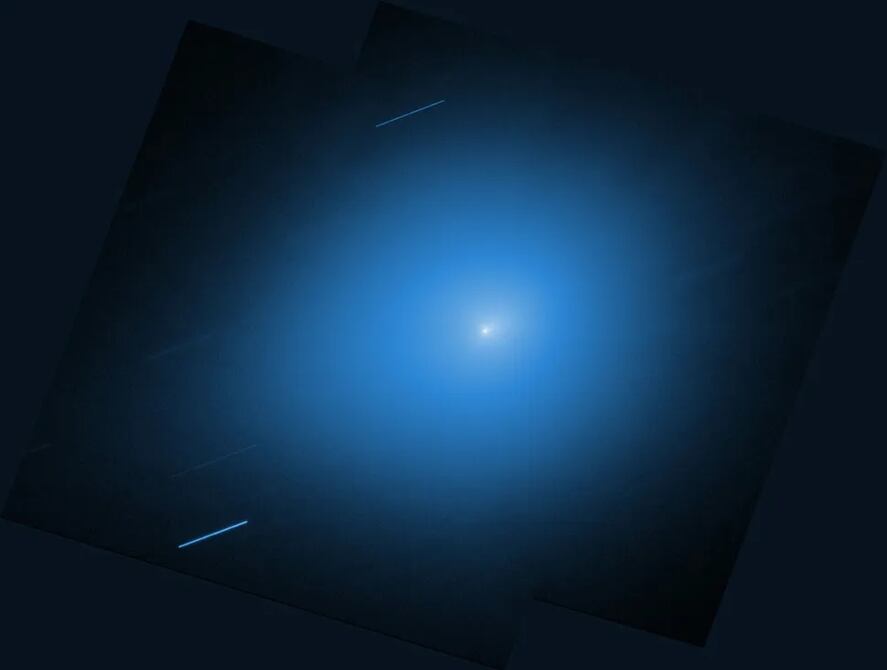
Methane has been seen spewing from comet 3I/ATLAS, marking the first time that the gas has been identified on an interstellar object. The amount of methane, relative to water, is also larger than is typically seen in comets from our solar system, further highlighting how different this interstellar visitor is than objects from our own cosmic neighborhood.The James Webb Space Telescope (JWST) initially observed the interstellar comet with its Mid-Infrared Instrument (MIRI) on Dec. 15-16 2025, when 3I/ATLAS was 205 million miles (330 million kilometers or 2.20 astronomical units) from the sun. However, there was a problem with two of the observations, which failed to acquire a guide-star in order for the telescope to point accurately. This meant that those two observations had to be repeated later, on Dec. 27, when 3I/ATLAS was 236 million miles (380 million km or 2.54 AU) from the sun.As it happened, these repeat observations turned out to be quite fortuitous.Both sets of observations came less than two months after 3I/ATLAS had reached perihelion – its closest point to the sun – on Oct. 29, 2025. The extra heating from the sun had warmed the comet’s surface, increasing the amount of outgassing from the comet, but the level of outgassing was beginning to decrease as the comet moved away.MIRI detected water vapor streaming at large distances from the comet's nucleus as icy grains in the coma (the gaseous ‘atmosphere’ surrounding the comet’s solid nucleus) vaporized.However, this is where the observations on the Dec. 27 came into play: JWST noted that the production of water vapor had dropped sharply between Dec. 16 and 27, indicating that solar heating was fading and more water-ice was staying frozen, especially since by then 3I/ATLAS had crossed the 'snow line', which is the distance from the sun beyond which temperatures are low enough for water vapor to freeze to ice."The water-ice line in the solar system is located around 2.5AU, and as 3I ATLAS approached those heliocentric distances … water production from the coldest regions of 3I’s surface and coma was starting to shut down," wrote the research team, led by Caltech's Matthew Belyakov, in their science paper. "Meanwhile, because of their much lower vapor pressures, carbon dioxide and methane are expected to have remained fully activated."JWST also detected carbon-dioxide gas and even nickel vapor, matching previous observations and confirming that 3I/ATLAS has a surprisingly large abundance of carbon dioxide relative to water vapor.