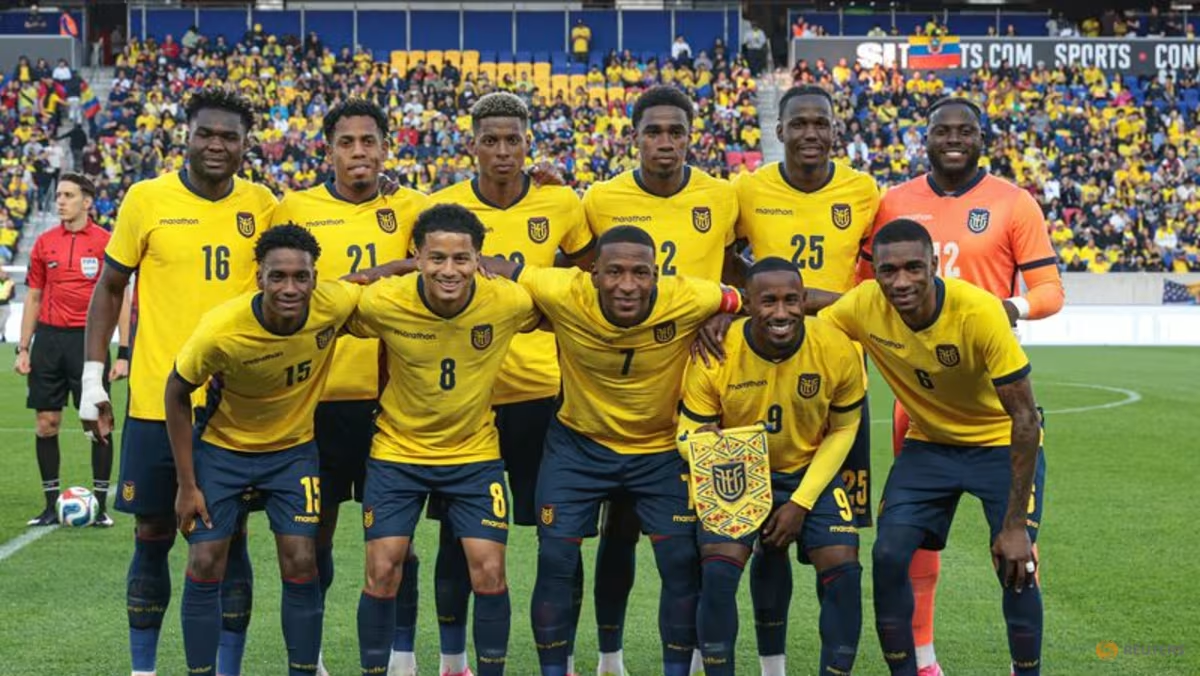
As part of our Language of Soccer World Cup series, The Athletic is speaking to supporters of all 48 nations competing at the 2026 edition to capture their unique football culture, distilled into a single phrase. You can read the articles in one place here.Con amor, hoy yo quiero cantar — With love, today I want to singFor many decades, supporting Ecuador was a thankless task.Between 1938, when they belatedly played their first match, and the end of that century, the national team — known to Ecuadorians as La Tri — qualified for precisely zero World Cups. Their record at the Copa America, the South American championship, was barely any better. In the story of global football, Ecuador were hardly even a footnote.“It was tough,” says Hugo Erazo, 40. “My whole family was obsessed with football, obsessed with the World Cup, but Ecuador were never there.”Fans normally lumped in with Brazil or Argentina and lived vicariously for a month. The thrills and spills were something, but they were not theirs. And when the tournaments ended, it was back to reality, back to the wilderness. Supporters who remember those times speak of an inferiority complex, of lingering doubts that sometimes undid the team from the inside.Yet while the picture was bleak, the mood did not always follow, even in those testing ‘before’ times. Confronted with a vast edifice of failure, Ecuador’s fans became experts in chiselling out little grace notes: only losing by the odd goal to Brazil, maybe, or making life difficult for Argentina in the breathless altitude of Quito. The minor victories were folded into a narrative that made light of all the difficulties, the burden recast as a gift.“There was always optimism,” says Ricardo Thurdekoos, who has been following Ecuador since the 1980s. “We had ups and downs, many tough moments, but I wouldn’t say it was ever painful.”The fans used to have a motto: “We played better than ever, but we lost like we always do.” It was a winking slice of fatalism, a shrug in the face of fate. One day, though, fate switched course.On March 28, 2001, Ecuador beat Brazil for the first time in their history. Seven months later, they booked a place at the 2002 World Cup, finishing second in South American qualifying, above Brazil, Uruguay and Colombia. “We started playing better football,” says Thurdekoos. “We began to beat teams we always used to lose to.”That first World Cup was a coming-out party. Progress has not been linear since then — Ecuador missed out on the 2010 and 2018 World Cups — but an entire generation has grown up believing La Tri can compete on the international stage, a feeling that has only been reinforced by huge improvements in the domestic club game and the success of high-profile players Moises Caicedo (Chelsea) and Piero Hincapie (Arsenal) in European football.“It should be our default to qualify for the World Cup,” says Danilo Carrion, a New York-based fan. “We used to be scared of teams like Argentina. We lacked a winning mentality. That has changed over the years. We have higher expectations.”
Ecuador were on the sidelines for years. Now, with love, their fans have something to sing about
As part of a special World Cup series, The Athletic is speaking to fans of all 48 competing nations to capture their unique football culture
1,223 words~6 min read