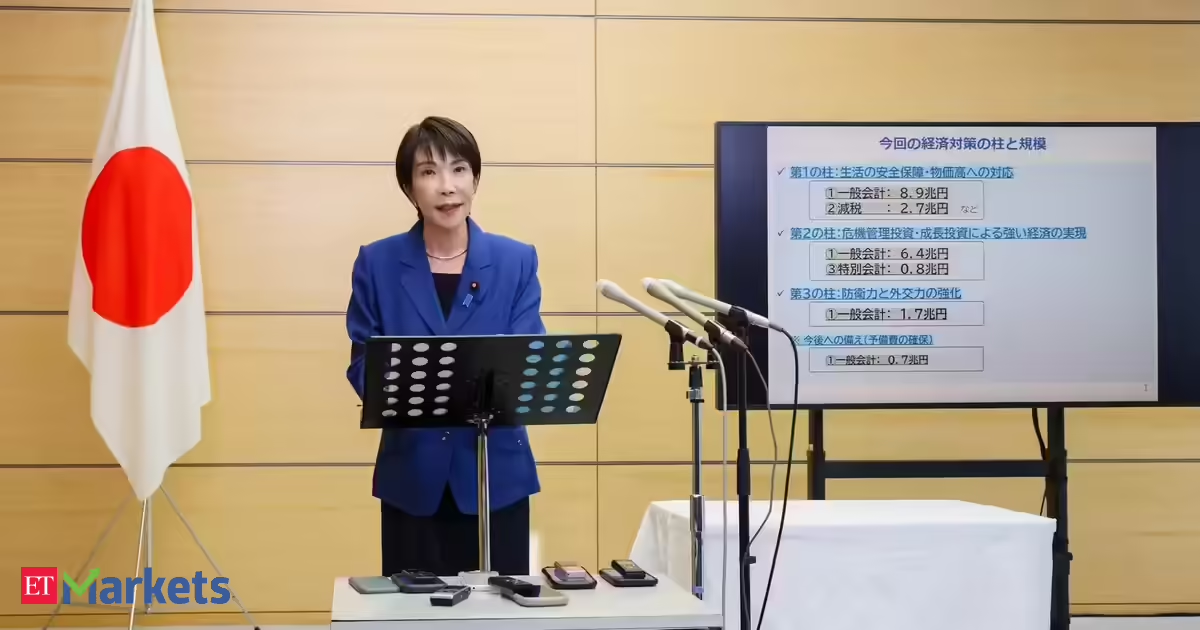
TOKYO, June 5 : Japan is ready to respond at any time on foreign exchange and reserves the right to take "decisive action" against excessive volatility, Finance Minister Satsuki Katayama said on Friday as the yen teetered near the key 160-per-dollar threshold.The remarks came as investors scrutinised official signals for any hint that Japan could be preparing another strike to rescue the faltering yen.Data released on Friday underscored the cost of defending the currency. Japan's foreign reserves, the bulk of which are believed to be held in U.S. Treasuries, suffered a historic drop in a sign of the limits of deploying sustained, large-scale intervention after Tokyo unleashed a record $73 billion yen-buying operation."On foreign exchange, we will respond appropriately at any time when necessary," Katayama told parliament.
While currency rates are affected by various factors, speculative activity made up a large portion of highly volatile moves since the beginning of the Middle East war in February, Katayama said."Japan and the U.S. are in close contact on market moves," she said, adding that Tokyo has the right to take decisive action against excessively volatile moves under a joint statement signed last year.The Japanese yen fetched 160.015 per dollar, after hitting the critical 160-per-dollar mark on Wednesday for the first time since April 30. The 160 level is widely seen in markets as a line in the sand for potential official intervention.Speaking at the same parliament session, Prime Minister Sanae Takaichi said the best way to maintain the yen's value is to boost Japan's global competitiveness through investment in growth sectors.In the statement agreed in September, the U.S. and Japan reaffirmed their commitment to "market determined" exchange rates, while agreeing that foreign exchange interventions should be reserved for combating excess volatility.POTENTIAL CONSTRAINTSThe Ministry of Finance said Japan's foreign reserves fell by $77.1 billion, or 5.6 per cent, from a month earlier to $1.306 trillion, representing the largest-ever drop after Tokyo resumed massive interventions to stem the yen's slide.Foreign securities led the decline, shrinking by $75.6 billion to $931.7 billion."It appears that U.S. Treasuries were sold to fund market intervention. Tokyo has signalled a willingness to sell U.S. Treasuries to finance such operations," Tsuyoshi Ueno, a senior economist at NLI Research Institute, said.An MOF official declined to say if U.S. bonds were sold as part of its dollar-selling intervention, noting that rising yields also lowered the market value of bond holdings and weighed on reserves.Analysts say turbulence in global bond markets could leave Washington less tolerant of another bout of large‑scale yen buying if it entails heavy Treasury sales, narrowing Tokyo's room to manoeuvre.Some have floated workarounds to ease those constraints.Yuji Saito, executive advisor at SBI FX Trade, said Japan can use the Federal Reserve's Foreign and International Monetary Authorities (FIMA) repo facility as a potential mechanism to raise dollar liquidity without outright Treasury sales.Introduced in March 2020 and designed to steady markets during the pandemic, the facility could now serve a dual purpose of easing funding pressure while signalling resolve."The point is to stabilise the bond market while sending a warning signal to currency markets," Saito said. ($1 = 159.9300 yen)