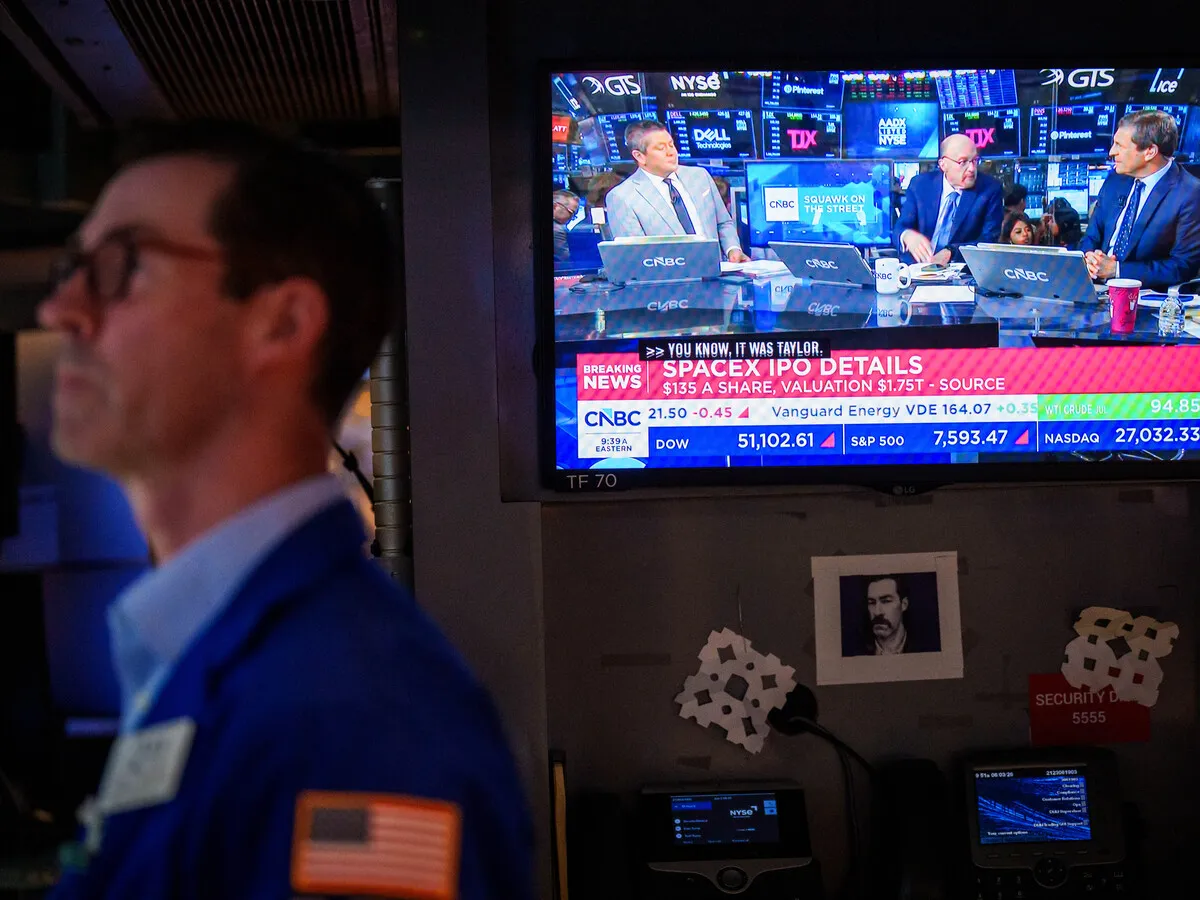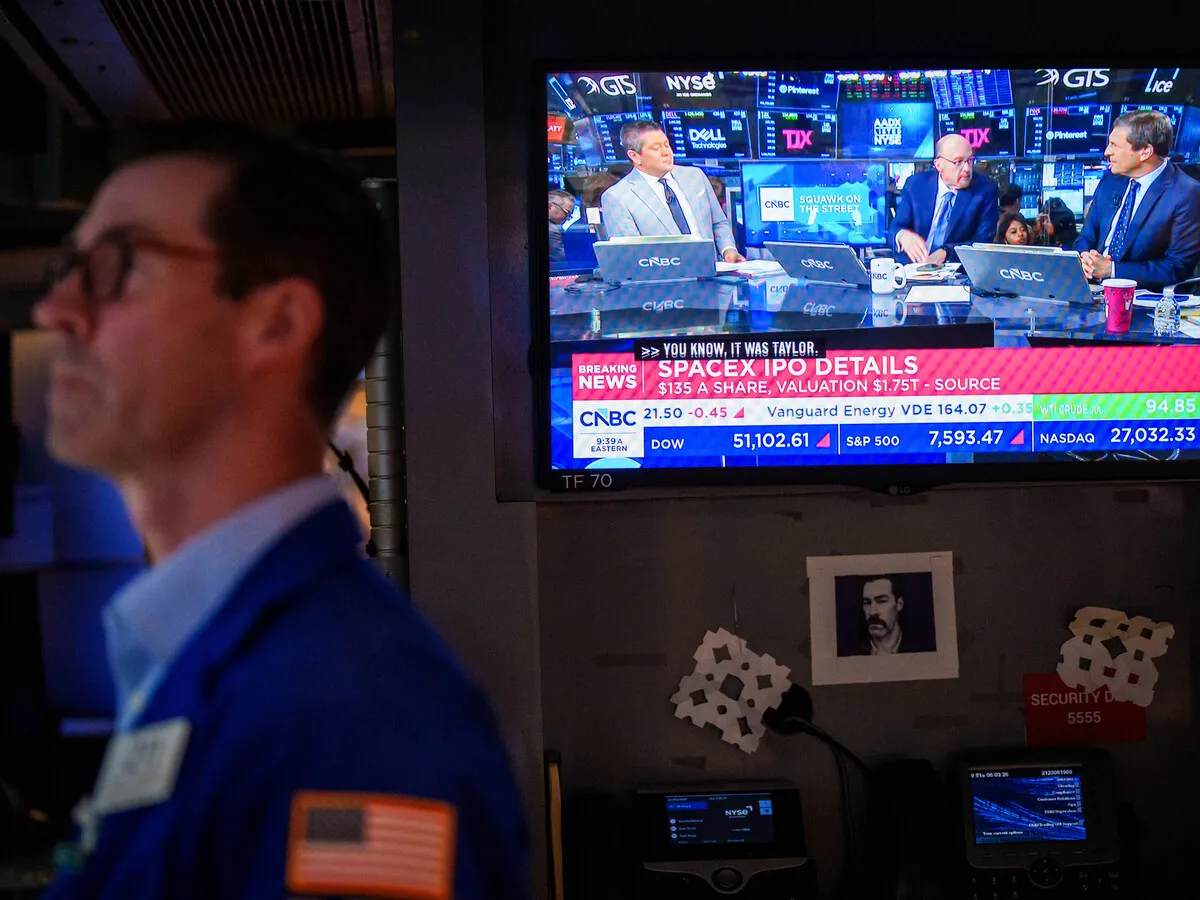
Skip to Content News Archives Economy Energy Oil & Gas Renewables Electric Vehicles Mining Commodities Agriculture Real Estate Mortgages Mortgage Rates Finance Banking Insurance Fintech Cryptocurrency Work Wealth Smart Money Wealth Management Investor Personal Finance Family Finance Retirement Taxes High Net Worth FP Comment Executive Women Puzzmo Newsletters Financial Times Business Essentials More Innovation Information Technology FP500 Podcasts Small Business Lives Told Tails Told Shopping Financial Post Store Obituaries Place a Notice Advertising Advertising With Us Advertising Solutions Postmedia Ad Manager Sponsorship Requests Classifieds Place a Classifieds ad Working Profile Settings My Subscriptions Saved Articles My Offers Newsletters Customer Service FAQ News Economy Energy Mining Real Estate Finance Work Wealth Investor FP Comment Executive Women Puzzmo Newsletters Financial Times Business Essentials HomeFinancial TimesInvestorHow mega IPOs such as SpaceX, Anthropic, OpenAI will change index investingAs IPOs grow larger and structures more complex, the value of disciplined representation only matters moreAuthor of the article:Last updated 1 hour ago You can save this article by registering for free here. Or sign-in if you have an account.With several mega IPOs expected in the near term, many index providers are continuing to refine criteria for index inclusion. Photo by Adam Gray/BloombergThis year marks 50 years since index investing was first introduced to everyday investors. At the time, the concept drew skepticism. Why would anyone settle for “average” returns rather than trying to beat the market? Today, it’s facing a different kind of test, one defined by a new wave of mega initial public offerings from companies such as SpaceX (formally, Space Exploration Technologies Corp.), Anthropic PBC and OpenAI Group PBC.Subscribe now to read the latest news in your city and across Canada.Exclusive articles from Barbara Shecter, Joe O'Connor, Gabriel Friedman, and others.Daily content from Financial Times, the world's leading global business publication.Unlimited online access to read articles from Financial Post, National Post and 15 news sites across Canada with one account.National Post ePaper, an electronic replica of the print edition to view on any device, share and comment on.Daily puzzles, including the New York Times Crossword.Subscribe now to read the latest news in your city and across Canada.Exclusive articles from Barbara Shecter, Joe O'Connor, Gabriel Friedman and others.Daily content from Financial Times, the world's leading global business publication.Unlimited online access to read articles from Financial Post, National Post and 15 news sites across Canada with one account.National Post ePaper, an electronic replica of the print edition to view on any device, share and comment on.Daily puzzles, including the New York Times Crossword.Create an account or sign in to continue with your reading experience.Access articles from across Canada with one account.Share your thoughts and join the conversation in the comments.Enjoy additional articles per month.Get email updates from your favourite authors.Create an account or sign in to continue with your reading experience.Access articles from across Canada with one accountShare your thoughts and join the conversation in the commentsEnjoy additional articles per monthGet email updates from your favourite authorsSign In or Create an AccountorThose IPOs are raising questions about whether index funds will be forced to buy them at scale, exposing them to risks.Canada's best source for investing news, analysis and insight.By signing up you consent to receive the above newsletter from Postmedia Network Inc.A welcome email is on its way. If you don't see it, please check your junk folder.The next issue of Investor will soon be in your inbox.We encountered an issue signing you up. Please try againWhen indexing began a half-century ago, IPOs looked very different. Offerings were smaller and a larger share of the company was listed and traded from the outset. That’s no longer the world we live in. With the upcoming IPOs, a smaller portion will probably be made available at listing, with additional shares entering the market for public consumption over time. Today’s pipeline of IPOs includes companies with trillion-dollar valuations, placing them among the largest companies in the market.This shift has fuelled debate about how indexes should incorporate these mega flotations amid claims that IPO structures, and even index inclusion rules, are being engineered to take advantage of passive flows. But that framing misunderstands how indexing works and how markets ultimately absorb supply and determine prices over time.From the start, index investing rested on a few core principles: broad diversification; low costs; transparency and letting the markets determine outcomes. Those principles weren’t designed for any single era. They were designed to hold up as markets change. And the market always changes.Over the years that Vanguard has been offering index-tracking funds, methods have evolved in response to those changes. One of the most important adaptations has been the shift towards float-adjusted market capitalization, meaning a company’s weight in the index is based on the shares investors can actually buy, not including shares held by insiders and other private investors that aren’t listed on an exchange.This matters enormously for today’s mega IPOs. A company such as SpaceX may carry a trillion-dollar valuation, but only a fraction of its shares is likely to be available for trading, the so-called free float. Float-adjusted indexing ensures that portfolios reflect what investors can actually buy, not the full headline valuation.Float-adjusted indexes are not allocating capital based on hype, they are allocating based on investable reality. Even with a relatively small float, SpaceX will probably be the largest IPO to date, so the dollar value available to trade will still be substantial, supporting deep liquidity and efficient price discovery. For most portfolios, the impact may be modest, but in the market, these mega IPOs will probably trade easily from day one.This high liquidity explains why large IPOs are sometimes included in indexes sooner than smaller ones. This is often described as a rush, but in practice, it’s the opposite. Large companies that meet size and liquidity thresholds simply satisfy inclusion rules faster than others.What indexing resists, by design, is the temptation to embed narratives into long-term portfolios. Indexes don’t predict which IPOs will succeed or stumble. They don’t pass judgment on business models. They take the market as it is. They promise exposure to the investable market over time with clear rules. Sometimes, that means adding companies that later disappoint but it also means owning companies early that go on to reshape industries.Facebook’s 2012 IPO offers a useful illustration. After its debut, the stock fell nearly 50 per cent in the first few months. Now called Meta Platforms Inc., the company has a market capitalization of more than US$1.5 trillion. This underscores the difference between short-term volatility and long-term investing. As the late Vanguard founder John Bogle was fond of saying, don’t look for the needle, just buy the haystack.Indexing has endured because it continues to adapt. With several mega IPOs expected in the near term, many index providers are continuing to refine criteria for index inclusion. By tying inclusion to what investors can actually buy, indexes stay grounded in economic reality rather than reacting to the excitement surrounding the deal.Fifty years ago, indexing offered investors a simple proposition: participate in the growth of markets without needing to outguess them. That proposition still holds. As IPOs grow larger and structures more complex, the value of disciplined representation only matters more.The writer is chief investment officer at Vanguard Capital Management and head of global equity at Vanguard.© 2026 The Financial Times Ltd Join the Conversation This website uses cookies to personalize your content (including ads), and allows us to analyze our traffic. Read more about cookies here. By continuing to use our site, you agree to our Terms of Use and Privacy Policy.
How mega IPOs such as SpaceX, Anthropic, OpenAI will change index investing
This year marks 50 years since index investing was first introduced to everyday investors. At the time, the concept drew skepticism. Read on
1,255 words~6 min read