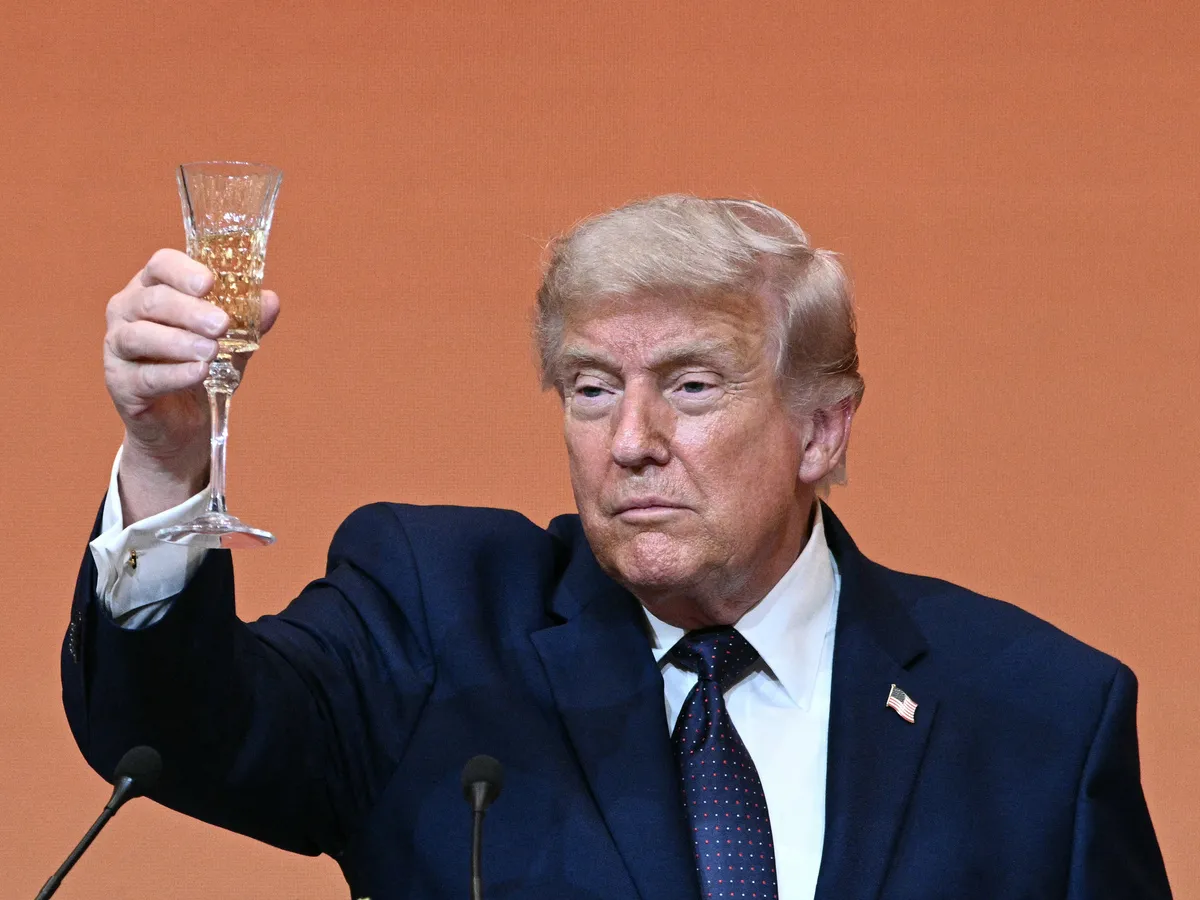
Skip to Content News Archives Economy Energy Oil & Gas Renewables Electric Vehicles Mining Commodities Agriculture Real Estate Mortgages Mortgage Rates Finance Banking Insurance Fintech Cryptocurrency Work Wealth Smart Money Wealth Management Investor Personal Finance Family Finance Retirement Taxes High Net Worth FP Comment Executive Women Puzzmo Newsletters Financial Times Business Essentials More Innovation Information Technology FP500 Podcasts Small Business Lives Told Tails Told Shopping Financial Post Store Obituaries Place a Notice Advertising Advertising With Us Advertising Solutions Postmedia Ad Manager Sponsorship Requests Classifieds Place a Classifieds ad Working Profile Settings My Subscriptions Saved Articles My Offers Newsletters Customer Service FAQ News Economy Energy Mining Real Estate Finance Work Wealth Investor FP Comment Executive Women Puzzmo Newsletters Financial Times Business Essentials HomeFinancial TimesTrump's empire of debtThis century the U.S. has embarked on wars of choice and borrowed more to pay for them. That might not end wellAuthor of the article: You can save this article by registering for free here. Or sign-in if you have an account.Perhaps Donald Trump's real legacy will be the debt to foreign nations he, like his predecessors, has accumulated — and how it has undermined American power. Photo by Brendan SMIALOWSKI/AFP via Getty ImagesIs the United States finally about to fall victim to imperial overstretch? Despite years of speculation, the country’s position as global military, economic and financial hegemon has to date remained intact.Subscribe now to read the latest news in your city and across Canada.Exclusive articles from Barbara Shecter, Joe O'Connor, Gabriel Friedman, and others.Daily content from Financial Times, the world's leading global business publication.Unlimited online access to read articles from Financial Post, National Post and 15 news sites across Canada with one account.National Post ePaper, an electronic replica of the print edition to view on any device, share and comment on.Daily puzzles, including the New York Times Crossword.Subscribe now to read the latest news in your city and across Canada.Exclusive articles from Barbara Shecter, Joe O'Connor, Gabriel Friedman and others.Daily content from Financial Times, the world's leading global business publication.Unlimited online access to read articles from Financial Post, National Post and 15 news sites across Canada with one account.National Post ePaper, an electronic replica of the print edition to view on any device, share and comment on.Daily puzzles, including the New York Times Crossword.Create an account or sign in to continue with your reading experience.Access articles from across Canada with one account.Share your thoughts and join the conversation in the comments.Enjoy additional articles per month.Get email updates from your favourite authors.Create an account or sign in to continue with your reading experience.Access articles from across Canada with one accountShare your thoughts and join the conversation in the commentsEnjoy additional articles per monthGet email updates from your favourite authorsSign In or Create an AccountorBut Washington’s status may be about to be hit by fast-changing geopolitics and geoeconomics — and the habit, picked up by the U.S. this century, of borrowing from tomorrow to pay for wars today.The conflict in Iran has been costing an estimated US$2 billion a day in short-term direct costs. The ratio of U.S. public debt to GDP is set to breach its historic post-second world war high. And President Donald Trump has submitted to Congress a national defence budget request for 2027 of an astonishing US$1.5 trillion, double the figure for 2020.Get the latest headlines, breaking news and columns.By signing up you consent to receive the above newsletter from Postmedia Network Inc.A welcome email is on its way. If you don't see it, please check your junk folder.The next issue of Top Stories will soon be in your inbox.We encountered an issue signing you up. Please try againThat number includes nothing for Trump’s latest war of choice. Suddenly the risk of overstretch looks very real — both to the U.S.’s friends and to its foes.When Trump visited Xi Jinping last month, the Chinese president made a pointed reference to a concept of overstretch put forward over two millennia ago by the ancient historian and general Thucydides.“Can China and the U.S. overcome the Thucydides trap?” Xi asked in his very first comments on welcoming Trump to the Great Hall of the People in Beijing.The nub of Thucydides’ argument, initially used about the fall of Athens, is that dominant powers decline when the financial and military costs of maintaining external security commitments exceed the productive capacity of the domestic economy.The challenge posed by rising powers is also instrumental in precipitating the incumbent’s loss of primacy.The concept has obvious explanatory force in relation, for example, to the end of the British empire, the fall of the Austro-Hungarian empire, the decline of the Ottomans and the collapse of the Soviet Union, to name just a handful of examples. But does it work in the American case today, as Xi seemed to imply?For much of the 20th century the U.S. was less vulnerable than earlier hegemons such as Britain because it adopted a less territorially expansionist — and hence, in comparative terms, less expensive — form of imperialism.Washington preferred to exercise political and economic influence and soft power, latterly within the rules-based international order that it helped invent, with occasional aberrations such as the Vietnam war.But since the 1990s, Democratic and Republican presidents have pursued more interventionist policies in the name of humanitarianism, the promotion of democracy and American values — although some saw the rhetoric as just a mask for foreign-policy realism.The U.S. is still the world’s biggest economy and most potent military power. Its defence budget in 2025 was over US$900 billion, equivalent to 35 per cent of total global defence spending and more than three times the defence budget of China, the next most powerful military actor.The American economy is notable for its high productivity and an impressive capacity for innovation, not least in AI. The question, then, is what could undermine the country’s otherwise winning formula for protracted hegemony.The most plausible answer is costly wars and unstoppable surges in deficits and debt — a combination aggravated by Trump’s erratic foreign policymaking.Consider, first, the issue of war finance.In 1951, with the U.S. engaged in the Korean war, President Harry Truman said: “We could try to escape the financial cost of defence by borrowing — but that would only transfer the financial problem to our children and would increase the danger of inflation with its grossly unfair distribution of the burden.”Instead, he said: “The sensible and honest thing to do now is to tax ourselves enough, as we go along, to pay for the financial costs of defence out of our current income.”No such restraint has been apparent in recent decades. Linda Bilmes of the Harvard Kennedy School notes that since the September 11 2001 attacks the funding pattern of U.S. military conflicts in Iraq, Afghanistan and the wider region has been unprecedented.“For the first time since the American Revolutionary War,” she wrote recently, “costs were paid for almost entirely by debt.”She argues that the U.S. also reduced oversight of military spending by using emergency appropriations to fund operations, concealing expenses through poor accounting and integrating the private sector into core military activities.Bilmes labels this combination of policies the “Ghost Budget” — one she blames for “less accountability for war spending, lower civic engagement, greater corruption, higher total expenditures and prolonged conflicts”.The Brown University Costs of War project has estimated that the total budgetary costs and future obligations of the post-9/11 wars, including US$2.2 trillion in future costs for veterans’ care, were about US$8 trillion in 2021 dollars. The figure does not include any future interest costs on the debt.Against total current U.S. government debt held by the public and federal agencies of about US$36 trillion, this guns-and-butter tally amounts to fiscal incontinence on a very grand scale.This, along with the financial crisis of 2007-09 and the COVID pandemic, is an important reason for the return of public debt close to the level of 1946, in the immediate aftermath of the second world war. And there is no prospect of a fiscal peace dividend of the kind experienced at that time or after the end of the cold war.The U.S. Treasury’s interest bill has ballooned from 1.5 per cent of GDP in 2021 to more than three per cent today. The U.S. deficit is currently running at nearly six per cent of GDP. There is no likelihood that this will come down significantly under Trump, despite promises by Treasury secretary Scott Bessent to halve it by the end of the president’s term.Nor is the deficit likely to fall much under Trump’s successors because there is a structural deficit bias built into U.S. politics.The last time the U.S. government ran a budget surplus was in 1998-2001 under Bill Clinton. This Democratic legacy was promptly thrown away by the Republican President George W Bush on the Iraq war.The lesson is clear, as Alan Auerbach, an economist at the University of California, Berkeley, recently argued in the IMF’s F & D Magazine: “The key to fiscal consolidation is bipartisan agreement. Neither party can then blame the other for short-term outcomes voters may not like.”But with increasingly polarized politics there is no prospect of a bipartisan attempt to solve the fiscal problem.As well as higher debt servicing costs, Auerbach adds, the damage to the economy includes an increasing U.S. external imbalance and the crowding out of productive investment.Despite such imbalances, the markets for U.S. Treasury bonds and the dollar itself have remained stable because of what was termed in the 1960s as America’s “exorbitant privilege” by Valéry Giscard d’Estaing, then the French finance minister who went on to be his country’s president.The dollar’s status as the world’s pre-eminent reserve currency and the Treasury market’s role as the world’s safest haven in crises have ensured that the U.S. government has constant ready access to international capital along with low borrowing costs.Conventional wisdom holds that there is no realistic alternative to the dollar. The Eurozone, China and Japan do not have deep, liquid government bond markets capable of providing safe assets to the world on the requisite scale.But foreign investors are now moving out of Treasuries because of the debt problem, threats to the independence of the U.S. Federal Reserve, the westernization of the dollar through financial sanctions and the erosion of political checks and balances under Trump.In other words the markets are finally buying into the overstretch story. For their part the leading credit rating agencies have downgraded the U.S. S&P as early as 2011, Fitch in 2023 and Moody’s in 2025.Until relatively recently, the largesse of monetary authorities was crucial in funding big increases in borrowing by the U.S. and other rich countries.Between 2008 and 2021, the managers in charge of central banks’ reserves bought up 63 per cent of the extra debt issued by G7 governments, according to a study this year for the Group of Thirty financial think-tank by Agustín Carstens, Klaas Knot and Stijn Claessens — respectively, the ex-heads of the central banks of Mexico and the Netherlands and a former senior IMF official.But central banks have recently been unwinding their balance sheets, running down the dollar component of their reserves and looking for alternatives including gold, commodities and the more liquid currencies of smaller advanced countries.Indeed, a report by the European Central Bank showed this week that gold had now replaced U.S. Treasuries as the world’s top reserve asset. By the end of last year bullion accounted for 27 per cent of all global central bank reserve assets, up from 20 per cent a year before. Treasuries fell from 25 to 22 per cent over the same time.This leaves a gap that has been substantially filled by hedge funds, mainly American owned but often counted as foreign investors because of their bases in tax havens such as the Cayman Islands.Many own Treasuries as part of highly leveraged “relative value trades”, financed by short-term borrowing that has to be constantly rolled over.William White, former chief economist of the Bank for International Settlements, points out that this works well — until it does not.White argues that the purchase of government debt by non-bank institutions such as hedge funds depends in turn on their access to short-term financing such as the repo market. He adds: “Should any disturbance interrupt that access, as in March 2020 [during the COVID-19 pandemic] or April 2025 [when Trump announced swingeing tariffs], an intense deleveraging spiral could easily follow.”Recent shocks from hedge fund margin and collateral calls have made the Treasury market more fragile and a potential source of systemic risk.Although the benchmark 10-year Treasury yield remains roughly where it was at the beginning of Trump’s second term, the odds are rising that his administration could find itself confronting debt market turmoil of the kind that toppled former United Kingdom prime minister Liz Truss after her unfunded tax-cutting “mini” Budget in 2022.The Federal Reserve could then be obliged to buy Treasuries to prop up the market, perpetuating a morally hazardous boom and bust cycle in which investors assume the central bank will always come to the rescue when markets slump.Each bust risks an ever-greater bill for taxpayers.White also worries about fiscal dominance — a phenomenon in which the central bank cannot raise interest rates to meet its inflation target because of the punishing servicing cost of high, short-term public debt. This in turn undermines price stability.Another possible concern is financial repression, where the government forces banks and other financial institutions to buy its IOUs at below-market interest rates.White foresees in the longer term a stagflationary world marked by the formation of two blocs, one dollar-based, the other renminbi-based with the Chinese currency being backed increasingly by gold.A tangible step in this direction is the development of payment systems that do not rely on the dollar. Perhaps the most notable of these is the central bank digital currency platform mBridge, for which the chief technological input has been provided by the People’s Bank of China.In their report to the Group of Thirty, Carstens, Knot and Claessens warn of growing threats to global financial stability and have elsewhere highlighted three ingredients of this “witches’ brew”.They list the breakneck growth of non-bank financial actors such as private credit funds and hedge funds, the reversal of regulatory reforms put in place after the financial crisis, and the “relentless rise in public debt across major economies, compounded by geopolitical fragmentation and rising tensions that leave little room for policy error”.All these factors apply with particular force to the U.S. — as does the diagnosis.Carstens, Knot and Claessens add: “While we do not predict an imminent crisis — the timing of such events is impossible to call — we do find that warning signs are multiplying and the window for preventive action is narrowing.”The wisdom of the late Rudiger Dornbusch of MIT is relevant here. He famously remarked that “in economics, things take longer to happen than you think they will, and they happen faster than you thought they could”.Barry Eichengreen, a professor at the University of California, Berkeley, draws a telling parallel in his latest book between the currency of Trump’s America and that of Nero’s Rome.The denarius served as an international currency across the Roman empire.Nero resorted to debasement, reducing the silver content of the denarius, in a desperate effort to finance his ambitious program of canal building, the reconstruction of Rome following the great fire of 64AD and the building of his extravagant 300-room Domus Aurea palace — all this while prosecuting costly wars on multiple fronts.It was a classic case of imperial overstretch and marked the beginning of the protracted erosion of Rome’s economic and military primacy.Louis XIV, the warmongering, profligate Sun King of France, apologized on his deathbed for having “loved war too much… and spent too much”.While the world well knows there is zero likelihood of any recantation from the unapologetic 47th president, such an admission would make a fitting envoi for Trump.But perhaps Trump’s real legacy will be the debt he, like his predecessors, has accumulated — and how it has undermined American power.© 2026 The Financial Times Ltd Join the Conversation This website uses cookies to personalize your content (including ads), and allows us to analyze our traffic. Read more about cookies here. By continuing to use our site, you agree to our Terms of Use and Privacy Policy.
Trump's empire of debt
Washington's status as a hegemony may be hit by fast-changing world, and the habit of borrowing from tomorrow to pay for wars today. Read on
2,710 words~12 min read