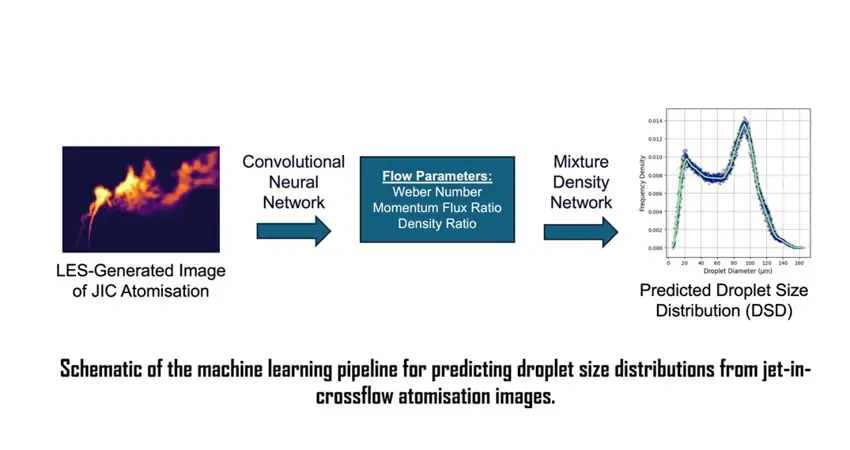
Researchers at the University of Oxford have developed a new artificial intelligence framework that can predict the microscopic behaviour of liquid sprays from images alone — reducing calculations that would normally take hundreds of simulation hours to just seconds.
The study, led by Professor Konstantina Vogiatzaki, focuses on “jet-in-crossflow” sprays, where a liquid jet is injected into a fast-moving gas stream. These sprays are widely used in technologies ranging from aircraft engines and industrial cooling systems to fuel injection and clean-energy applications.
One of the biggest challenges in understanding sprays is predicting the sizes of the droplets they produce. Droplet size strongly affects how efficiently fuels burn, how cooling systems perform, and how pollutants spread. However, accurately modelling these microscopic droplets usually requires extremely computationally intensive simulations.
The Oxford team tackled this challenge by combining high-fidelity fluid simulations with deep learning. Their new two-stage AI system learns how to connect large-scale spray images - the visible “macroscopic” behaviour of the jet - with the underlying microscopic droplet-size distributions.