For years, analyzing the chemical makeup of materials has required large and costly laboratory instruments known as spectrometers. These systems are used in everything from disease diagnosis and food inspection to pollution monitoring. Traditional spectrometers work by splitting light into its component colors using prisms or gratings, then measuring the intensity of each wavelength. Because this process requires light to travel across a relatively long distance, the instruments are often bulky and difficult to miniaturize.
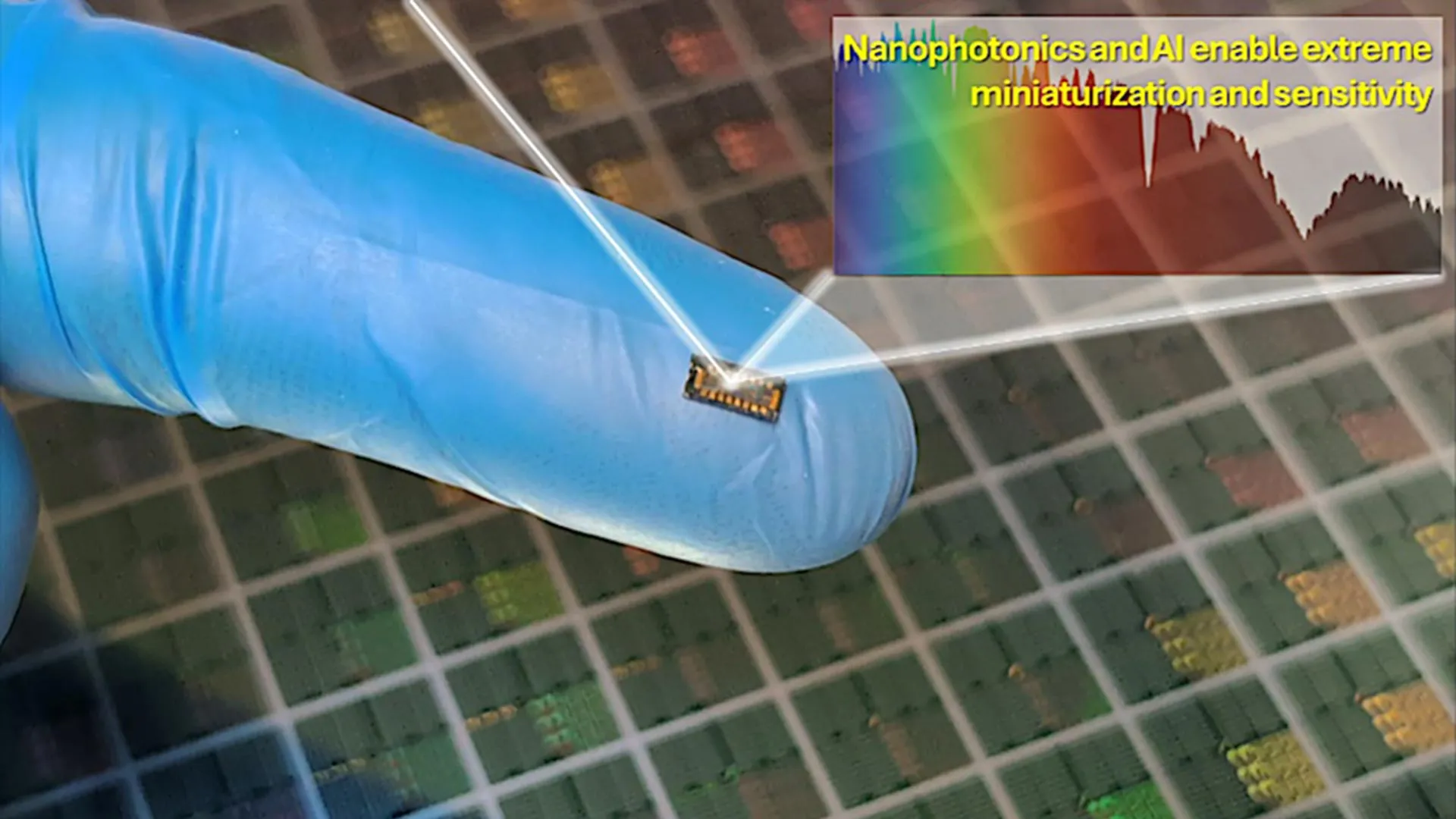
Now, researchers at the University of California Davis (UC Davis) have developed a dramatically smaller alternative. Writing in Advanced Photonics, the team describes a spectrometer-on-a-chip so tiny it approaches the size of a grain of sand. Instead of relying on large optical components to separate light physically, the new system uses artificial intelligence (AI) and a small array of specially engineered sensors to reconstruct the spectrum computationally.
Replacing Bulky Optics With AI
The chip abandons the standard method of spreading light into a rainbow. Instead, it relies on 16 unique silicon detectors, each designed to react slightly differently to incoming light. Rather than isolating individual colors directly, the detectors collect encoded signals that contain hidden spectral information.