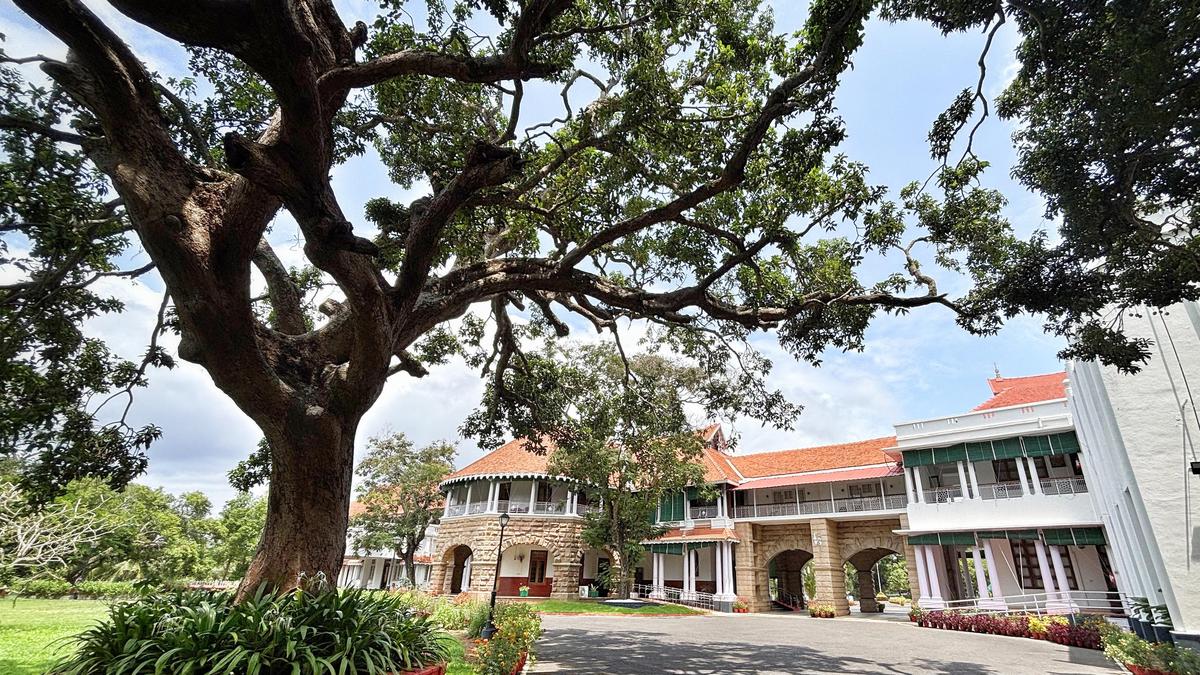
Curiosity got the better of me and I shot off a request to explore one of the verdant spaces in Thiruvanathapuram — Lok Bhavan Kerala, the official residence of the Governor of Kerala. The heavily-guarded power centre, stretching across almost half the tree-lined Vellayambalam-Kowdiar stretch, has a treasure of tree flora and what better time to write about it than the World Environment Day.On the appointed day I make my way up the tarred avenue — it is a small climb as the buildings stand on a small hillock. I walk in with the knowledge that it has the first digitalised garden with QR codes among the Lok Bhavans in India.The sprawling 12-hectare green campus has 183 species of tree flora, as per the team that conducted digitalisation in 2019 during the tenure of Governor P Sathasivam. Six years down the line, the number has grown.
Governor Rajendra Vishwanath Arlekar planting paddy saplings
| Photo Credit:
Nirmal Harindran
“It took us six months to complete the digitalisation. We were contacted by the Governor’s office after we digitalised the trees on the Kanakakunnu premises,” says Akhilesh SV Nair, then a research scholar with the Department of Botany, University of Kerala, who carried out the process with A Gangaprasad, who was then the honorary director, Centre for Biodiversity Conservation, University of Kerala.With flora of all kinds — herbs, shrubs, ornamental plants, hedge plants and avenue trees — occupying the sprawling campus it was difficult to fix a starting point for the tour. So, we start from near the Band Stand built near the main buildings where stands the giant jamun or njaaval. The bed of fallen ripe fruit underneath indicates that is the fruiting season. The branches have spread all over the place, a portion even bending close to the ground, making it easy to pluck the ripe fruits. “The fruits are smaller than the variety sold on roadsides. We have two other njaaval varieties here,” says Rajaneesh Kumar R, garden supervisor.History saysBuilt in mid-19th century, the Lok Bhavan was once the guest house of erstwhile kingdom of Travancore. “It used to be called Traveller’s Bungalow. The king of Bobbilli was the first one to stay there. It is also the first building in the city to be fully electrified,” notes historian Malayankil Gopalakrishnan. When Kerala was formed in 1956, there were three Raj Bhavans - at Thiruvananthapuram, Ernakulam (Bolgatty Palace) and Munnar (Devikulam Palace). Later Bolgatty Palace was converted to heritage hotel and Devikulam Palace became the Government Guest House.As we proceed, I realise that the premises is a haven for mangoes. Wherever you look there is a mango tree, starting from the main entrance. And the best part? All of them are laden with mangoes. “The production is high this year since the weather was conducive. Although we don’t have the exact number of varieties there would be more than 75,” says Rajaneesh.