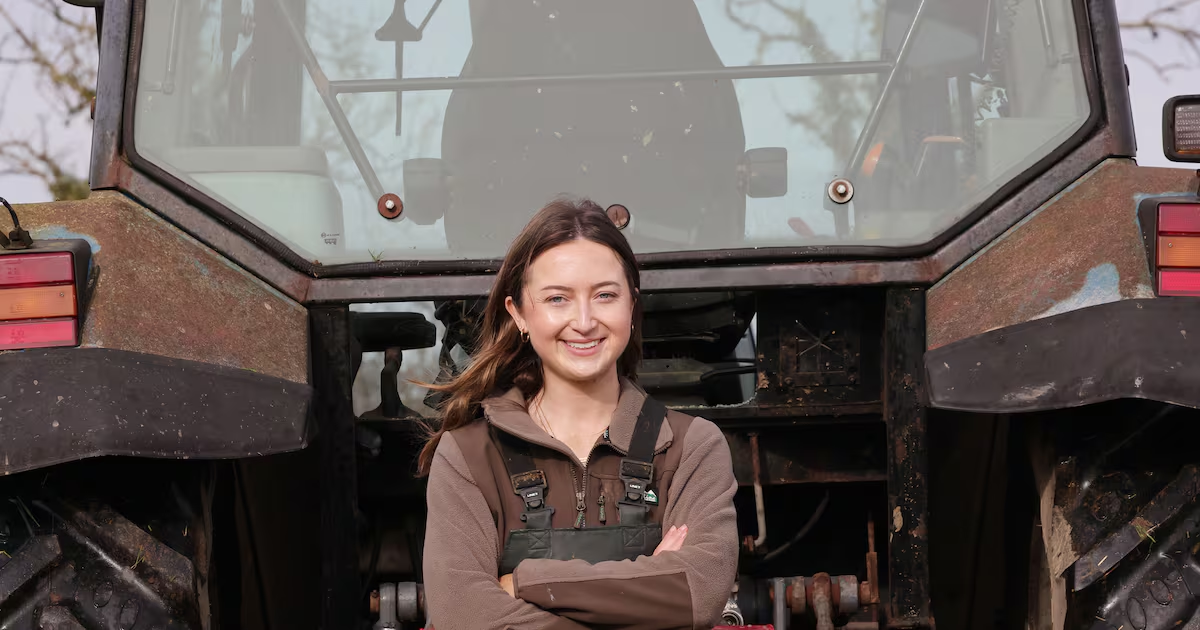
Before most of her 95,000 Instagram followers are awake, Sophie Bell has already checked and fed the calves, changed the fences and filmed a 90-second explainer on bovine tuberculosis – the topic of her masters thesis. And that’s all by the time she leaves for her 9 to 5 as a civil servant. The video will be watched far beyond her own parish – by students considering agricultural science, young women unsure whether farming is for them, and by an industry still reckoning with who gets to be visible within it.A third generation beef and dairy farmer from Virginia, Co Cavan, Bell is part of a new wave of Irish women agri-influencers narrating the vocation in real time. Women still account for just more than one in eight farm holders in Ireland, according to the Central Statistics Office, a figure that has shifted only incrementally in decades. Yet in classrooms, lecture halls and on TikTok feeds, that picture is starting to change.“I think we really need to gather the fact that it’s not just a male industry,” says Bell. “We’ve always been there working behind the scenes and maybe not always recognised and taken for granted but now we’re definitely a lot more involved in managerial roles as well.” Since entering a joint partnership on the family farm with her father a couple of years ago and undertaking more administrative responsibility, Bell says she receives regular communication regarding planning permission and advertisements addressing her as “Sir”.“On the actual letter itself it says, ‘Dear Sir’, I’ve had to change contracts because it said ‘he’ in the contract ... It’s strange to see we have to do things like that nowadays.”In Dublin’s Smock Alley Theatre earlier this month, crowds flocked to hear the voices of three women farmers, including Bell, “in a celebration of love, love of land, community and the systems that feed us”.Joined by Ailbhe Gerrard, owner of Brookfield Farm in Co Tipperary, and Clare-based dairy farmer Carina Roseingrave, Bell shared her story, which was accompanied by live music and food tasting.[ Women farmers for climate: ‘We are passionate about soil health, animal care, biodiversity’Opens in new window ]The United Nations (UN) has designated 2026 as the International Year of the Woman Farmer, in a bid to highlight women’s contributions and address gender gaps in global agri-food systems. Research by the UN’s Food and Agriculture Association found women are essential to small-scale agriculture, farm labour and day-to-day family subsistence; up to 80 per cent of the food in most developing countries is produced by women and they are responsible for half of the world’s food production. Despite about a third of farm labourers in Ireland being women, the assumption that it’s an almost exclusively male industry still creeps into the everyday lives of Bell and her peers.Katie Larkin, known to many as her social media handle “The Abbey Cow Girl”, is a fourth generation suckler farmer from east Galway who is also in her 20s. Now studying veterinary medicine in Poland, Larkin has more than 80,000 followers combined across her social media platforms which she uses to share the pressures facing farmers in Ireland. She recently shared one video, with more than 100,000 views, on the Mercosur deal. “The whole Mercosur trade deal, if it came in, the rural farmer is gone,” she says. Bell agrees. The deal has provoked sharp opposition from Irish farmers because it involves opening the European market to cheaper South American agricultural products – including 99,000 tonnes of beef every year.“It doesn’t just affect farmers, it affects the consumer ... a lot more TikTokers came out and spoke about the threats it imposed,” adds Larkin.[ Ministers flag up opportunities for Irish exporters in muted Mercosur responseOpens in new window ]With importation of Brazilian beef being contentious against the backdrop of farmers’ opposition to the EU trade deal, the recent Bord Bia revelations feel “like a kick in the guts,” to families like Larkin’s.“We’re Bord Bia approved ... It’s so much stress and pressure on farmers and then you have the likes of Larry Murrin importing beef. It’s kind of like a kick in the guts to us here and everything that we’re doing and abiding by the rules,” she says.The Bord Bia chairman, who is also chief executive and founder of Dawn Farms which has been using Brazilian beef for some products, has come under fire in recent months with the Irish Farmers Association (IFA) campaigning for his resignation. Murrin has rejected claims that this represents a conflict of interest with his role in Bord Bia, or in any way compromised food safety in Ireland. His food company imported less than 1 per cent of its beef from Brazil in 2025, an Oireachtas committee was told last month.In Larkin’s view, “agriculture just gets such a bad name,” and the industry is in need of more unity to drive change.“Teachers have their unions and nurses have their unions, but farmers, we’re on our own, so unless we all stand together – nothing’s ever going to be done about it.” The agricultural sector 'really needs to encourage and help out young people,' says Sophie Bell. Photograph: Alan Betson Katie Larkin is a fourth generation suckler farmer from east Galway. Photograph: Joe O'Shaughnessy Bringing back the “community aspect” to farming is a wish for Bell, too, who believes her generation has “sort of been forgotten about”. The pair are part of a growing movement of young women bringing agriculture to the fore of their content creation, using their online platforms to show the realities of working in the sector today.“In comparison to when I was growing up, I’d always seen such a community aspect to agriculture,” says Bell. “Everyone had the time to help out ... now it’s a real rush and stress to get it done and can sometimes be a one-person operation, which can feel isolated I suppose.”“In politics we do feel as if our struggles are set aside or not talked about,” she says, adding that the issues young people in Ireland face are “very much apparent” and yet often dismissed. Emigration is an increasingly tempting prospect for young Irish farmers, with many seeking opportunities abroad in Canada, Australia and New Zealand – to name just a few popular destinations.For Bell, who “would love to be able to pursue everything in this country”, the agricultural sector “really needs to encourage and help out young people and recognise that this is the reality at the moment”.“Everything is quite slow to make happen ... I think a lot of people will emigrate by the time those solutions are brought forward or fixed, if they are at all.” The cost-of-living crisis has pushed many passionate young farmers to work other full-time jobs to make ends meet, and without careful management, Bell warns that this “can burn the candle at both ends” leading to burnout.Farmer Sophie Bell has recently graduated from her masters in agricultural extension and innovation. Photograph: Alan Betson Both Bell and Larkin studied agricultural science in secondary school, and went on to pursue related degrees at third level. Before securing her dream course in Warsaw, Larkin earned a dairy business degree from University College Dublin (UCD). Bell is also a UCD alum, recently graduating from her masters in agricultural extension and innovation having completed her undergraduate degree abroad at Harper Adams University.Peter Keaney, an agricultural science teacher from Wilson’s Hospital School in Co Westmeath, says the gender gap in the classroom is closing – something he has seen translate to more girls opting for the subject in college as well.Of 24,670 senior cycle students studying agricultural science in the 2025/26 school year – 10,928 are female and 13,742 are male, the Department of Education said.Female students accounted for just over 38 per cent of the 21,436 students who studied agricultural science in the 2015/16 school year, and 44 per cent of those studying it this academic year.In teaching a subject which Keaney considers “part and parcel of Irish society”, he says the increasing uptake of agricultural science among students who are girls and women teachers alike is “hugely positive” to see.[ The grass ceiling: ‘It’s amazing the number of women who are interested in farming who don’t get the farm’Opens in new window ]“At agricultural science teachers’ conferences, I would say I’m in the minority now. I would say it’s at least 50:50, if not 60:40 in terms of female teachers,” he says, acknowledging that the teaching profession is, in general, more female-dominated.“There was a little bit of a stigma way back that it was a fellas thing ... but I wouldn’t say it’ll be long before you’d see 50:50, girls now see it as a huge science area and it’s always developing.”Katie Larkin has more than 80,000 followers across her social accounts which she uses to share the pressures facing farmers. Photograph: Joe O'Shaughnessy In Keaney’s sixth year class, there are eight boys and seven girls, while the split between fifth years falls at 10 girls, six boys. “The access that students have now going toward third level, there’s huge opportunity,” says the teacher of the field’s diversification. “There aren’t as many young people going back into farming, let them be male or female, or definitely into full-time farming. But it’s amazing the amount that might be working in the agricultural field.”Responding to a parliamentary question late last year, Minister for Agriculture Martin Heydon noted an almost 10 per cent rise in the number of women completing Teagasc education programmes over five years. He said that “female participation is growing from 856 participants in 2020 to 1,331 participants this year [2025]” with women comprising 28 per cent of overall course completions in 2024 compared to 17 per cent in 2020.'I think we really need to gather the fact that it’s not just a male industry,' says Sophie Bell. Photograph: Alan Betson/The Irish Times Turning to gender pay gaps, much has changed in the 12 years since the Department of Agriculture started internally recording and reporting on this.In 2013, the department’s gender pay gap was 20.5 per cent, it now stands at 7.78 per cent (in mean hourly remuneration). In median hourly renumeration, it lies at 10.08 per cent, reflecting a higher proportion of staff at more senior levels of the department are men. As this gap gradually closes, influencers like Bell and Larkin are refusing to wait for institutional change, not just documenting rural life but redefining who belongs in it – at all levels.
‘It’s not just a male industry’: The young women changing farming stereotypes
In classrooms, lecture halls and on TikTok feeds, the picture is starting to shift as young Irish women narrate the vocation in real time
1,750 words~8 min read