Documented AI incidents rose to 362 in 2025 from 233 in 2024, while hallucination rates across 26 leading models ranged from 22% to 94%. These numbers show that the quality of AI Agents is becoming a serious bottleneck. The real danger arises when we try to test AI Agents using traditional software QA workflows.
Conventional Quality Assurance (QA) works when a fixed input follows a defined code path and returns an expected output. AI agents behave differently because they interpret intent, retrieve context, call tools, generate responses, and make decisions across changing conditions. This is where specialized non-deterministic AI systems testing becomes essential. It helps AI development teams evaluate behavior, reasoning paths, tool use, safety boundaries, edge cases, and drift without forcing AI agents into rigid pass-or-fail checks.
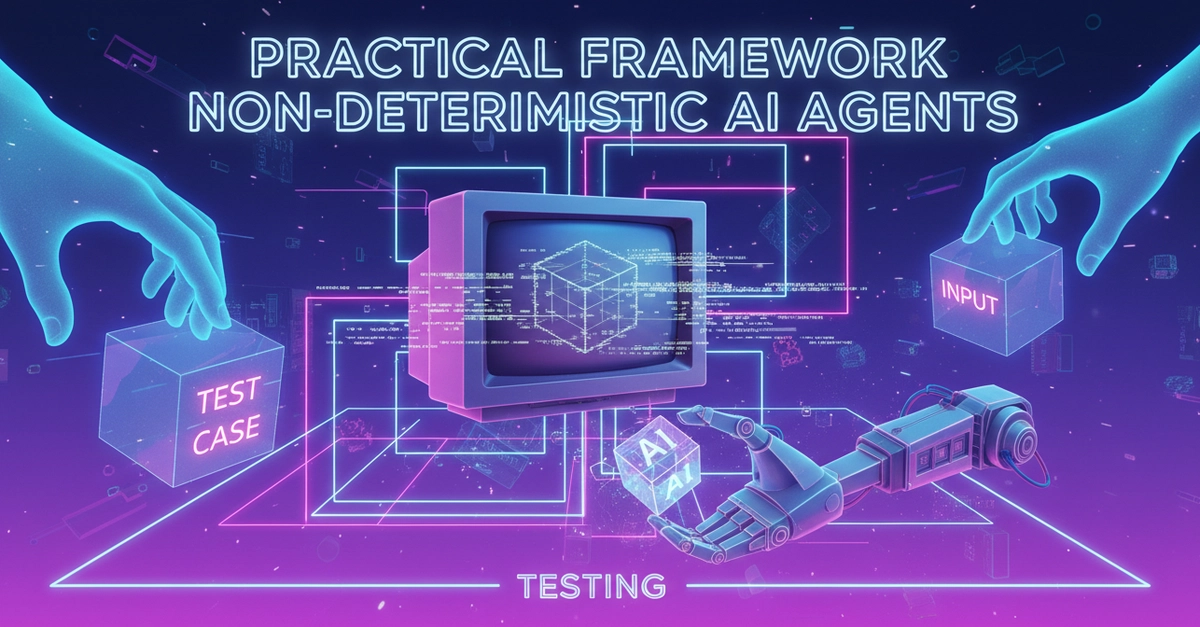
This blog explains why traditional QA fails, provides an AI Agent testing framework, and common pitfalls to avoid in non-deterministic AI testing. Let’s dive in.
Why Traditional QA Fails for Testing Non-Deterministic AI Agents?
Understand why fixed test cases, exact-match assertions, and release-stage QA fall short while building AI agents that reason under changing conditions. Here is a highly technical breakdown of why traditional QA paradigms fail to validate non-deterministic AI systems: