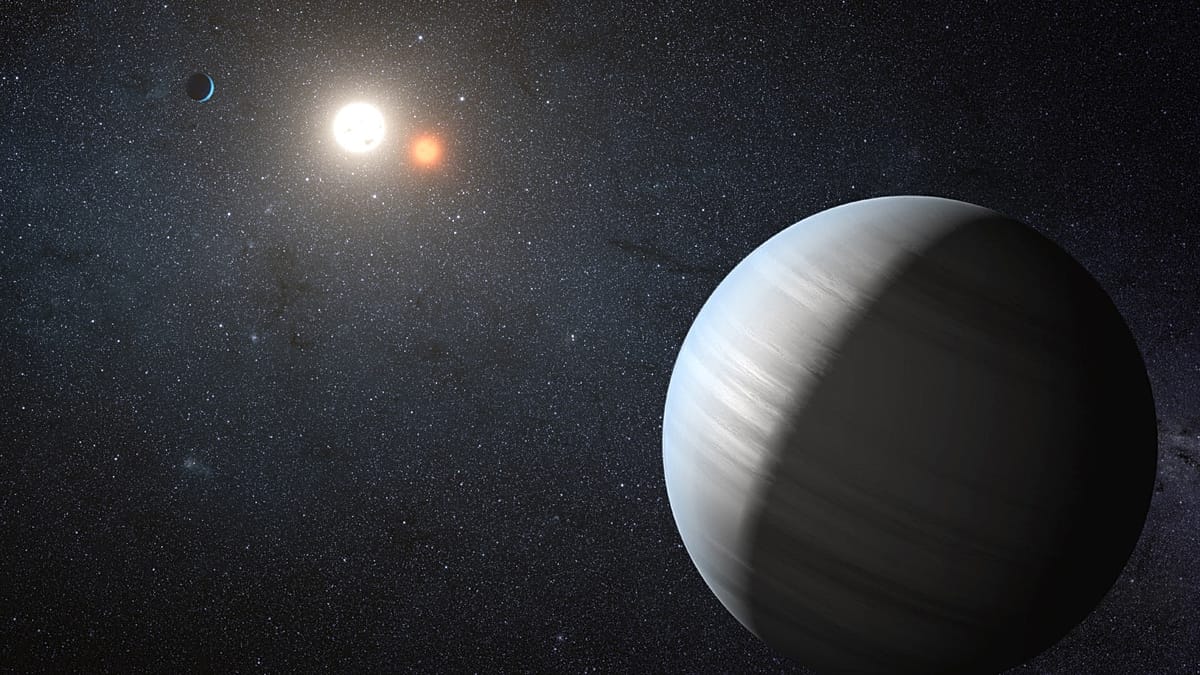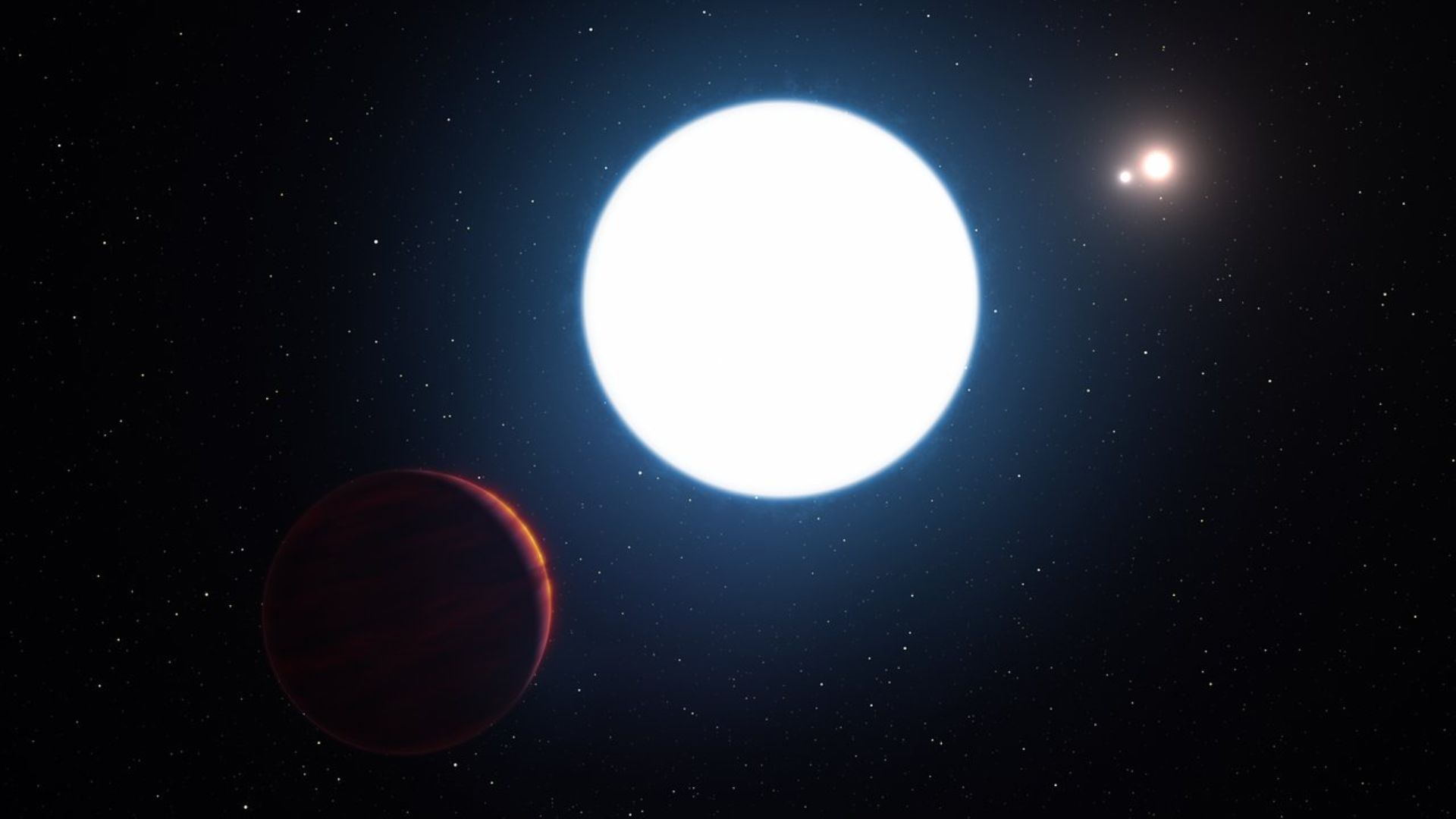
An artist's impression of a planet orbiting a star in a triple system.
(Image credit: ESO/L. Calçada/M. Kornmesser)
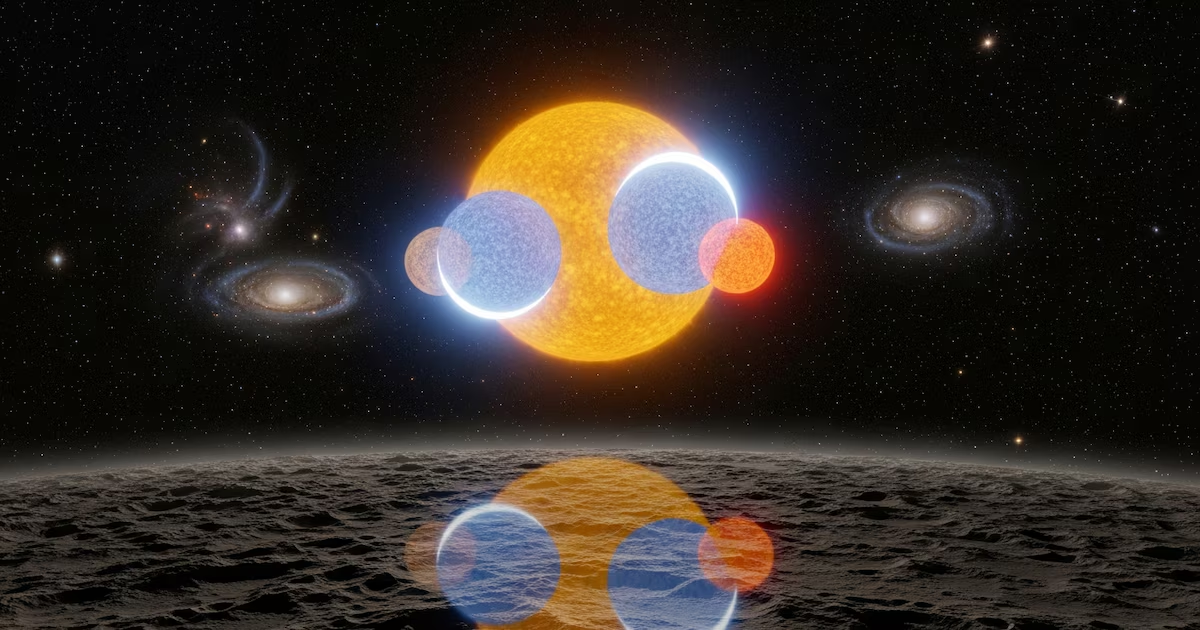
A triple star system in which the stars all eclipse one another from our vantage point is standing out as one of the best studied stellar trios; as the stars age, they could even merge.The triple system, known as TIC 295741342, is 3,080 light-years from Earth and was found by NASA's TESS (Transiting Exoplanet Survey Satellite) mission. It features a binary system composed of two stars almost identical to the sun, orbited by a larger third star of 1.7 solar masses.Triple star systems abound in the galaxy, but what makes TIC 295741342 more remarkable is that all three stars orbit each other in the same plane, and that plane is aligned edge-on to us.TESS charts the light curves of stars, which is essentially a graph of brightness versus time. Typically, it is looking for the small dip in light as an exoplanet moves in front of, or transits, its star, but TESS also excels at witnessing stars in binary and triple systems also moving in front of each other — not just transiting, but eclipsing.The light curve for TIC 295741342 is described by Brian Powell, who is an astronomer at NASA's Goddard Space Flight Center, as having a "head-and-shoulders" pattern, especially when inverted. TESS detects a dip in light as the stars of the binary at the heart of the TIC 295741342 eclipse one another. This dip is one of the "shoulders." Then, TESS detects another, deeper dip in light as the third, outermost star moves in front of the binary and eclipses both its stars, creating the "head."As the binary moves out from behind the third star while still eclipsing each other the light curve steps back up to the initial dip in light – the other "shoulder" — and finally back to full brightness when no stars are in eclipse.Powell told Space.com that "very few known triple star systems are so near-perfectly coplanar as TIC 295741342, especially for being such a wide system."Disk fragmentationBy coplanar, Powell means that all three stars orbit in the same plane, just as the planets of the solar system orbit in more or less the same ecliptic plane. Our planets are found in the same plane (or more specifically, within six degrees of it) because they formed from a disk of gas and dust that ringed the young sun. Powell suspects the stars of TIC 295741342 also formed from a disk, but one that fragmented."The protostellar disk broke into pieces to form stellar companions," said Powell.Not all triple systems form this way. In many cases, the third star orbits at an angle to the central binary — but in those scenarios, the third star was gravitationally captured by the binary while they were all still in the close confines of their birth cluster.Disk fragmentation is not a rare phenomenon, however. Hundreds of coplanar triple systems have been found, their numbers enhanced in particular by the discoveries made first by NASA's Kepler Space Telescope and now TESS. Yet few triple star systems are as well studied as TIC 295741342.