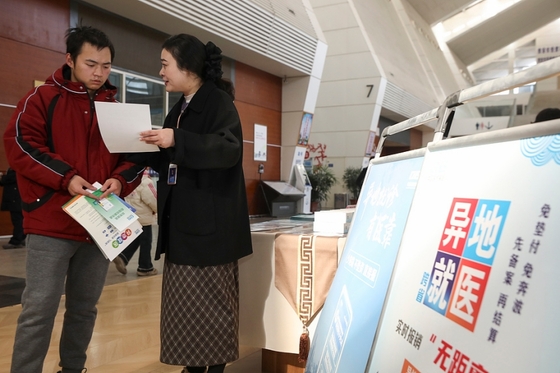
1. China's state-backed health insurance system faces mounting financial strain due to a surge in patients traveling across regional borders for medical treatment. From 2019 to 2024, off-site medical visits grew from 98 million to 397 million, with costs rising from 436.1 billion yuan ($64.39 billion) to 786.774 billion yuan. By 2024, off-site care accounted for 26.4% of total national medical insurance fund expenditure. [para. 1][para. 2][para. 3]2. This off-site medical treatment refers to insured patients seeking care outside their registered locality, driven by labor migration, an aging population moving to live with children, and patients seeking higher-quality care for severe illnesses in top medical hubs. [para. 4]3. The strain varies by insurance type: urban employees recorded more off-site visits (262 million vs. 134 million for residents), but residents had a higher total bill (468.36 billion yuan vs. 318.41 billion yuan), indicating they primarily travel for high-cost inpatient care and serious illnesses. [para. 5]4. Recent growth has been driven by outpatient services, with interprovincial outpatient direct settlements reaching 224 million visits in 2024 (a 90% year-on-year increase). Interprovincial travel overall reached 238 million visits, an 85% jump from 2023, narrowing the gap with intraprovincial travel. [para. 6][para. 7]5. Using Shanghai hospitalization data, researchers found the vast majority of traveling patients are cancer patients: digestive tract cancers (26.62%), respiratory cancers (20.93%), benign tumors (9.63%), and breast cancer (7.88%). Over 84% were hospitalized in tertiary hospitals, and over 60% originated from the Yangtze River Delta region. [para. 8]6. Managing costs is difficult under the current insurance framework, which uses "directories of the treatment location, policies of the registration location," leading to disparities in deductibles, reimbursement rates, and payment caps. Studies show off-site patients incur higher inpatient costs due to factors like age, disease complexity, and payment policies. The root problem is China's localized, municipal-level insurance pooling, which creates fragmented systems with varying benefit levels. [para. 9][para. 10][para. 11]7. Regulatory authorities are attempting to standardize the system: in May 2024, the National Healthcare Security Administration released a draft plan for a unified national basic medical insurance directory, starting with interprovincial patients. However, a regulatory vacuum exists because off-site patients are still billed on a fee-for-service basis, giving host hospitals little incentive to control costs—indeed, many actively recruit off-site patients to boost revenues. One hospital reportedly remained indifferent to oversight, claiming other regions could not audit its books. [para. 12][para. 13][para. 14]8. The Duke Kunshan report recommends integrating off-site care into local case-based payment systems (DRG/DIP) with a phased approach: "provincial first, then national; inpatient first, then outpatient; common illnesses first, then complex cases." The National Healthcare Security Administration has mandated integration for provincial off-site hospitalizations by end of 2025, with provinces like Zhejiang and Hubei already experimenting. Better cooperation between funding and delivering regions is needed, including an early warning system for off-site fund operations and performance evaluations for host cities. One expert suggested linking host-city regulators' performance evaluations to their policing of off-site care, with financial rewards for recovered funds. [para. 15][para. 16][para. 17][para. 18]AI generated, for reference only
Surging Demand for Off-Site Medical Care Strains China’s Health Insurance Funds, Report Says
A surge in patients traveling across regions for treatment has driven off-site medical spending to more than a quarter of China’s national health insurance budget, raising pressure on local regulators
TL;DRAI
Off-site medical visits in China surged from 98M (2019) to 397M (2024)—costing 786.8B yuan, 26.4% of insurance spend—driven by labor mobility and demand for premium care. Municipal-level pooling fragmentation and fee-for-service billing fuel overruns; Beijing mandates DRG/DIP integration by 2025 to control costs nationally.
507 words~2 min read