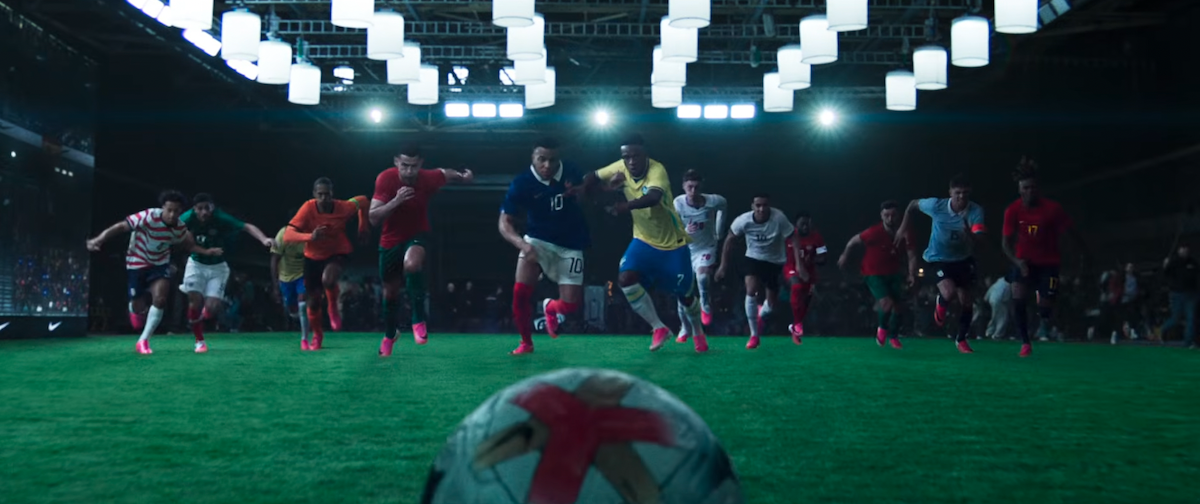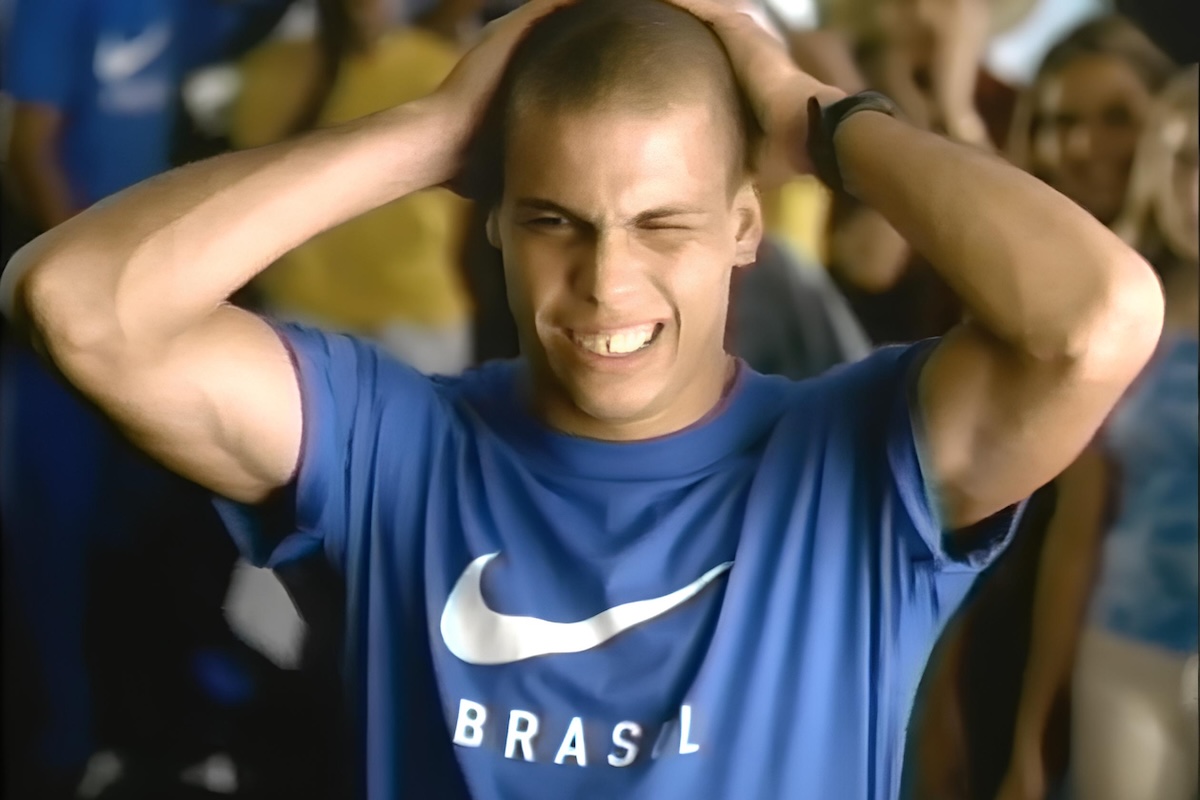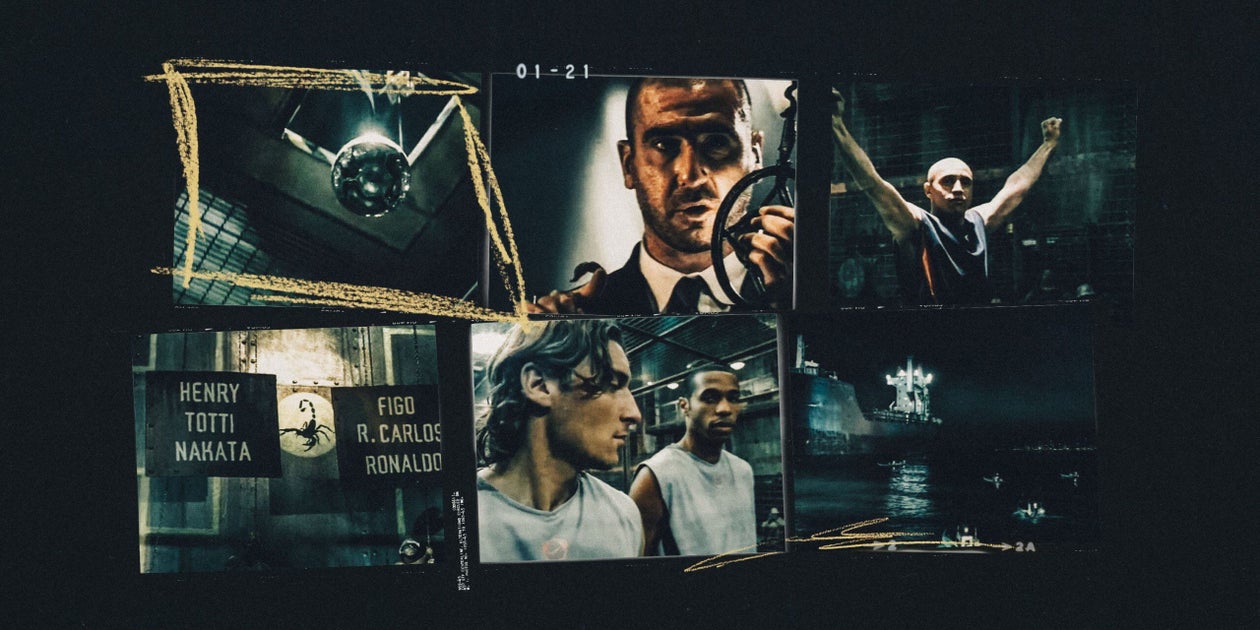
Get free access to the most comprehensive World Cup coverage in The Athletic app.Five small boats approach a cargo ship in the dead of night.Inside the ship, among the boxes and containers, is a floodlit metal cage. On a walkway above, holding a cane and inexplicably limping, is Eric Cantona. He grabs a boxing-style dangling microphone and growls three words into it: “First goal wins.”Thus begins one of the great football adverts: Nike’s 2002 Secret Tournament film.If you’re reading this, there is every chance that you can conjure a few of the images that follow that opening sequence from memory. Maybe you recall Freddie Ljungberg’s rainbow kick. It could be Denilson twisting himself into another dimension or Thierry Henry using Francesco Totti’s back as a springboard.You might remember the list of players that, over three breathless, Elvis-soundtracked minutes, turned a thousand playground daydreams into reality — or something like it.There had been star-studded football ads before, but nothing on this scale. Secret Tournament featured 24 players. Many of them were established superstars. Some, like Ronaldinho and Javier Saviola, were still on the up. The only real outlier was Seol Ki-hyeon, not far off a complete unknown, there to represent South Korea, one of the two hosts of the 2002 World Cup. (The other host was not a problem: Nike had the stylish Japan midfielder Hidetoshi Nakata on their books.)The story was simple: eight teams of three, a knockout tournament. This was recognisably a football set-up — Nike’s previous big football ad, 2000’s The Mission, had aped a spy thriller — but made to look edgy, frayed, clandestine. The action was technical and inventive but also anarchic, in the image of its director, former Monty Python actor Terry Gilliam, by this point a big name in Hollywood.It was impossible to wrench your eyes away. Nearly a quarter of a century later, it still is.With World Cup 2026 fast approaching and the latest slate of football adverts being released into the wild — including Adidas’ Timothee Chalamet-starring Backyard Legends, a spot with certain thematic echoes — The Athletic set out to get the inside track on the iconic Nike advert: the happy memories and the inspiration but also the mishaps, the internal politics, the war stories; tales of stressed creatives and moany stars; the behind-the-scenes verdict on which footballers could actually act — and which really, really couldn’t.This is the story of Secret Tournament, told by those who made it.Unleashing creativityNike had been on a run of memorable football adverts. The three that preceded Secret Tournament — Good vs Evil (1996), The Airport (1998) and The Mission — had all been produced by advertising agency Wieden + Kennedy Amsterdam, who were tasked with building on the formula ahead of World Cup 2002.Glenn Cole, former creative director at Wieden + Kennedy Amsterdam: “Making those epics had become a tradition by then. The goal for years had been to (compete) with Adidas in the sport. When we started, we were number five or six, behind Umbro, Diadora, Lotto. The goal was to be number one by 2002 and this was the year.“The Nike football brand was more mature, ready for prime time. They had the ‘right’ to be in the game in a more significant way. Honouring that was daunting. I remember feeling overwhelmed by the pressure of beating what we had done before.”With the World Cup heading to East Asia, the brief was to make the accompanying advert more global than ever. Bigger, too: Nike’s roster for the promotional campaign ran to 24 players. At the same time, the brand was not an official tournament sponsor like its main rival, Adidas.Cole: “The idea of brilliant football was our North Star. The question was how to express that on the biggest stage, knowing that we were the outsiders. ‘We’re not a formal sponsor, so how do we hijack it?’“We were given the assets: a chrome ball, Eric Cantona, players from around the world of varying degrees of fame and skill. At the time, there was a lot of talk about the rules of the game — players getting fined, just feeling a little constricted. Our seed idea was to create a place where players could be unleashed. We thought about a set of street tournaments and started making the rules: ‘What if it was one goal wins, a high-stakes environment?’“The idea of a tournament was embraced by Nike. It seemed like we could give a bit of structure to street football skills, which is where all the innovation is.”The cage, the boat, the roll callAn initial idea was for the tournament to take place in a court in the backstreets of Tokyo, the players arriving on scooters. That proved unworkable. Instead, the action would take place inside a metal cage, situated in the hold of a cargo ship, all recreated in a vast warehouse sound stage in Formello, around 10km outside Rome.Cole: “The fact it was on a barge was because we felt we needed some neutral ground. International waters seemed like a good starting point.”Stefano Maria Ortolani, production designer: “The idea of the cage came from the agency. Once we had that, we proposed the structure with the bridge up above. It gave it two layers, two different heights.“It was quite a big construction. We had to recreate the interior of the boat first, with all the rivets and these enormous crates, showing that we were inside the hull. It was a long process. I liked the nets made of chains; there was a very particular sound every time the ball went in. And I liked that it was all so dirty.”As Ortolani and his team worked, the talent was being assembled. Some of the players — Ronaldo, Totti, Nakata, Luis Figo, Edgar Davids, Denilson, Lilian Thuram — had appeared in previous Nike adverts. For most, though, this was a new experience. “One ‘wow’ after another,” was how former Lazio and Spain midfielder Gaizka Mendieta described it in 2002 and that was no outlier view.Javier Saviola, former Barcelona and Argentina striker: “It was a really nice surprise when I got the call. It was an enormous pleasure and not something I had been expecting. I felt privileged to be there with some of the best players in history. The quality was spectacular.”Ortolani: “There were so many champions. I only realised a few years later how good some of them were. Like Ronaldinho: he was still young and wasn’t very well known at that moment.”Cole: “The appeal was when they heard who the cast was, who the other players were. They didn’t want to not be part of what ended up looking like the top 24 players in the world. That was the draw.”The Secret Tournament teamsTriple Espresso: Thierry Henry, Francesco Totti, Hidetoshi NakataThe Onetouchables: Patrick Vieira, Ruud van Nistelrooy, Paul ScholesToros Locos: Freddie Ljungberg, Javier Saviola, Luis EnriqueCerberus: Edgar Davids, Lilian Thuram, Sylvain WiltordOs Tornados: Luis Figo, Roberto Carlos, RonaldoFunk Seoul Brothers: Denilson, Ronaldinho, Seol Ki-hyeonTutto Benne: Fabio Cannavaro, Tomas Rosicky, Rio FerdinandEquipo del Fuego: Claudio Lopez, Gaizka Mendieta, Hernan CrespoTop scorers: 1 — Totti, Wiltord, Mendieta, Roberto Carlos, Nakata, Figo, HenryChaos factorThe main shoot took about a month, just before Christmas 2001. With the European season still in full swing, the logistics of it were challenging.Ortolani: “The players all had matches at the weekend and they only had Mondays free. We could only shoot with them then. The rest of the week was spent filming close-ups: body doubles doing tricks with the ball, just their legs visible. It usually takes around three days to do a commercial. This took weeks. It was like a movie shoot.”Nicola Pecorini, director of photography: “It was completely nuts from a practical point of view. We had a huge crew so we could optimise the time we had with the players. On the Monday, for example, we had six or seven cameras and crews.”On one Monday, players from Arsenal and Manchester United shared a flight to Rome the day after a Premier League game between the two sides. Arsenal had won; Ruud van Nistelrooy and Paul Scholes especially weren’t best pleased at having to see their rivals again. “I f**king hated it,” Scholes said on The Overlap last year. Tim Wolfe, the copywriter on the ad, told The Times in 2022 that Scholes was “in a really bad mood, really hard to direct”. There were other issues, too.Ortolani: “At one stage, Figo had an injury, something with his leg. Imagine! Everybody was very, very worried about it. It wasn’t anything serious but still… you know, he was playing for Real Madrid.”Pecorini: “For whatever reason, the various Nike departments decided to combine the players in the worst possible way, practically speaking. We never had the winning team – Henry, Totti, Nakata – on set together. Never. They were never in the cage at the same time. It was crazy.”
This is the story of Nike’s Secret Tournament advert, told by those who made it
A cargo ship, a floodlit metal cage, 24 of the world's best players, and Eric Cantona. This was one of the greatest soccer ads of all time
4,518 words~21 min read