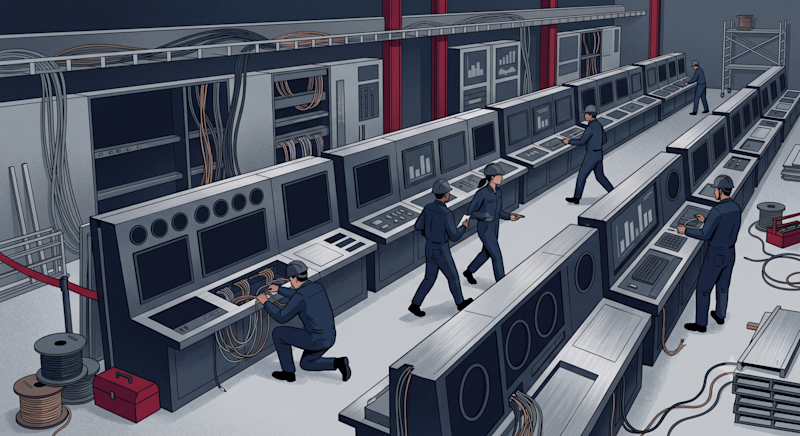
In Q1 2026, VentureBeat's Pulse Research surfaced the “Governance Mirage”: the gap between the governance org charts enterprises had drawn and the control layers they had actually built. Forty-three percent said a central team owned AI governance; 23% couldn't agree on who owned it at all; and 31% named vendor opacity as the single biggest obstacle.This new wave of research asks the next question: Once you've admitted the governance problem, what breaks first when you try to fix it? The answer from our respondents is unambiguous. The failure point is not the model. It's the runtime.Enterprises are discovering that AI agents built on stateless infrastructure — Python scripts, LangChain chains, ad hoc orchestration — cannot survive the operational realities of production. Container restarts erase context. Token costs breach business cases. Hallucinations in Step 3 compound into catastrophic failures by Step 12. And the majority of engineering teams are spending more time managing this "plumbing" than building the intelligence that was supposed to justify the investment.What emerges from this survey is a picture of an industry at a critical fork. The organizations that survive the Agentic Reckoning will be those that treat runtime durability as a first-class engineering concern — not an afterthought to be patched with retries and prompting. The ones that don't will find themselves back where RPA left enterprises a decade ago: a graveyard of clever pilots that couldn't survive Day Two.MethodologyVentureBeat conducted this survey in May 2026 as part of its ongoing Pulse Research series on agentic AI adoption in the enterprise. Respondents were filtered to organizations with 100 or more employees. The final qualified sample consists of 132 verified, highly qualified technology leaders at the forefront of enterprise AI agent deployment. They span:Directors of AI/Analytics (8%)Directors of Engineering/IT (16%)VP of Data/AI/Analytics (5%)VP of Engineering/IT (5%)CIOs/CTOs/CISOs (15%) Product and Program Managers (13%) Consultants (9%) Software and ML Engineers (9%) Enterprise Architects (8%) Other (12%)Industries represented include Technology/Software (42%), Financial Services (20%), Professional Services (8%), Healthcare/Life Sciences (7%), Retail/Consumer (6%), Education (4%), and others.Given our strict filtering criteria, this cohort provides a robust and authoritative look at emerging agentic infrastructure trends.Respondent demographics by company size:Large enterprise (10,000+ employees): 35% of the sampleMid-to-large enterprise (500–9,999 employees): 48% of the sampleGrowth enterprise (100–499 employees): 17% of the sampleThese quantitative findings capture a critical moment in infrastructure evolution and are best synthesized alongside VentureBeat’s Q1 2026 governance reports and our deep-dive practitioner conversations conducted throughout the quarter.Finding 1: The runtime is the problemThe "spine vs. brain" debate is overThe foundational question of enterprise AI in 2026 is whether agent failures trace back to the model's reasoning capability — the Brain — or to the runtime infrastructure's inability to manage state, survive failures, and coordinate execution — the Spine. We asked our respondents directly. Integration/governance challenges were the biggest problem. But Spine issues were close behind. Finding 1 — The runtime is the problem 47% say the real friction is the Integration/Governance Gap — lack of standardized connective tissue (e.g., MCP) to safely govern data access between agents and enterprise systems 37% say failures are primarily a Spine problem: stateless infrastructure too fragile for production 17% say the Brain is the primary failure mode: frontier models still lack the System 2 reliability needed for complex edge cases once workflows exceed 10+ reasoning steps However, 17% still say the Brain is the primary failure mode. That’s not a rounding error — it’s a signal. The organizations in this cohort are not disputing the infrastructure problem; they are telling us that the models themselves are not yet reliable enough for the edge cases their workflows are generating. The model-versus-runtime debate is genuinely three-sided. Read together, these three answers are not fully in conflict. The Spine and Gap camps are struggling with infrastructure and governance respectively. The Brain cohort is struggling with something upstream: reasoning reliability at scale. This is a significant finding. The frontier model wars — GPT-5 vs. Claude 4.7 vs. Grok — are consuming enormous mindshare in the enterprise technology press. Our respondents are telling us that war is, for now, beside the point. The models are smart enough, but the infrastructure around them is not."The models are smart enough, but our stateless infrastructure is too fragile to manage long-running, multi-step agentic processes."
Agentic Reckoning: Enterprise AI has a runtime problem
VentureBeat surveyed 132 enterprise AI leaders: the production failure point isn't the model — it's the runtime layer most teams are patching with retries instead of fixing.
3,514 words~16 min read