Agentic AI for Multi-Agent Orchestration Governance
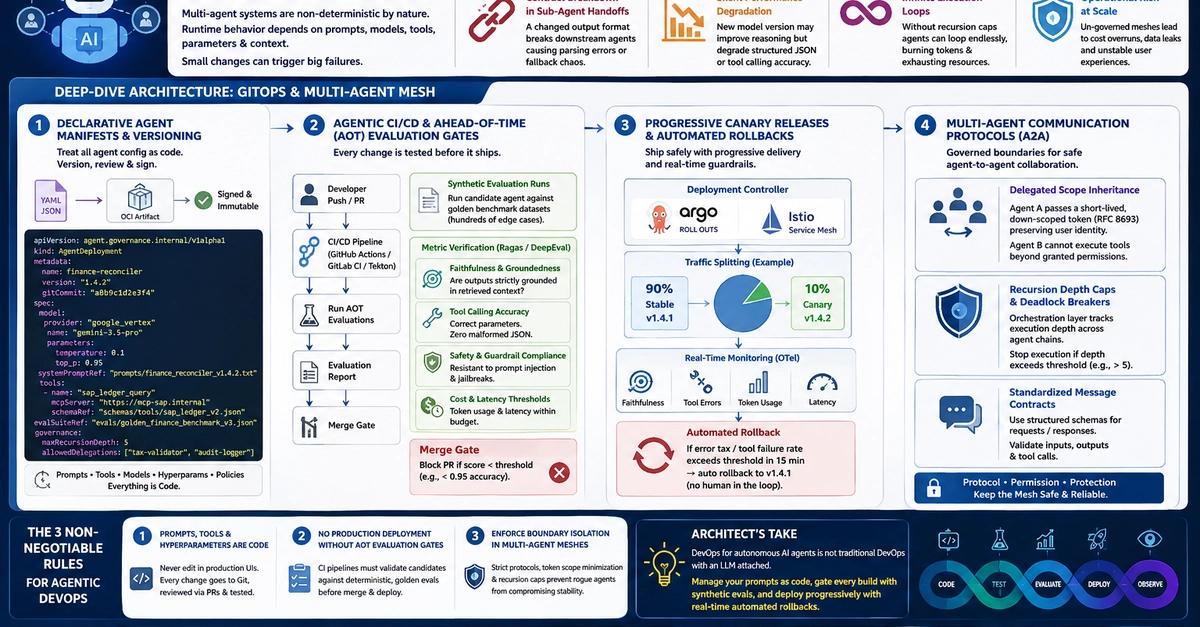
The root cause of most multi-agent failures isn't model accuracy. It's governance gaps. When a customer support agent and a sales agent both claim the same lead, you don't have an ML problem. You have an ownership problem. And that problem compounds fast. A fleet of 50 agents making 200 decisions per minute can't be governed by ad-hoc rules and Slack approvals. You need a layered framework that enforces boundaries, resolves conflicts, and keeps every agent's goals tied to what the business actually needs. That's the architecture we're going to walk through.
The operating problem
Why do we keep treating agent governance as an afterthought? We design clever multi-agent systems, wire them together with message queues, and then bolt on access controls and logging only when something breaks. That approach fails at scale. The practical pain is simple: agents that are individually competent become collectively dangerous when they operate without clear permissions, shared communication protocols, and a way to resolve disputes.
Consider a platform team deploying a set of agents that handle customer inquiries, qualify leads, and route requests. The support agent detects a high-value customer asking about enterprise pricing. It flags the interaction for sales follow-up. The sales agent, monitoring the same CRM event stream, picks up the lead and begins outreach. Both agents now believe they own that relationship. One sends a follow-up email while the other schedules a call. The customer receives duplicate, contradictory messages. That's not a hallucination problem; it's a governance failure. No one defined which agent has authority over a lead at each stage, and no conflict resolution protocol kicked in.