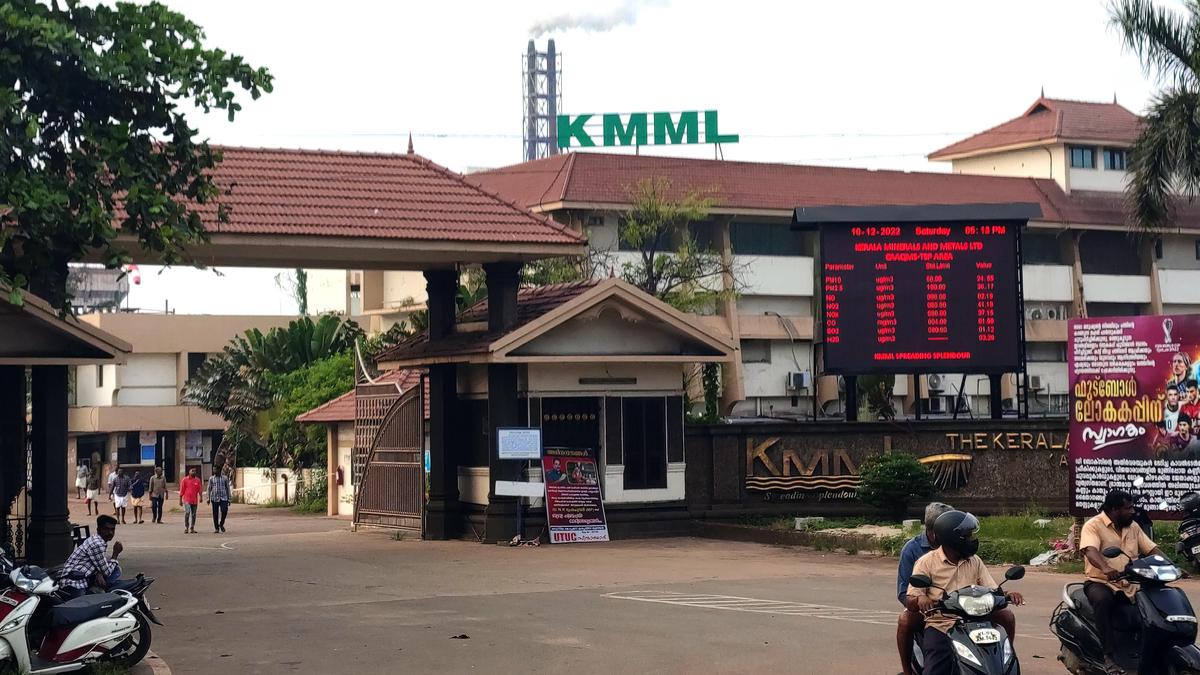
Kerala Minerals and Metals Limited in Kollam
| Photo Credit: SURESHKUMAR C
For years, a sprawling 60-plus acres inside Kerala Minerals and Metals Limited (KMML) stood as a stark reminder of the environmental cost of industrial progress. This was mined-out land, an ecological dead zone reduced to a structureless matrix of coarse sand tailings. The extraction of heavy mineral sands had completely stripped the soil of its natural nutrients, reducing it to an infertile deadland permanently frozen in time.However, a quiet environmental resurrection is unfolding across these barren flats. Through a rigorous, step-by-step restoration process, a terrain once written off as dead is steadily reclaiming its breath. This ecological recovery will hit a major milestone on June 5, when the former wasteland will welcome over a hundred sandalwood saplings and a miyawaki forest as part of its new botanical belt.This trial deviates entirely from routine crop cultivation because sandalwood is a unique hemiparasite. Its roots must physically attach to a neighboring host plant to draw water and essential nutrients, as it cannot survive long-term in isolation. “This aromatic grove is just one piece of a grander green blueprint. To facilitate this underground lifeline, we have carefully arranged permanent host plants, including fast-growing moringa trees, ensuring the delicate saplings can establish vital root connections,” says T.Karthikeyan, HOD, Mineral Separation unit,KMML. Alongside the sandalwood grove, the company is transforming another 50 cents of land into a dense Miyawaki forest, while simultaneously planting 5,000 whistling pine trees to anchor the green belt. The team had initiated the healing process by infusing the loose sand with massive amounts of organic manure, including cow dung, to rebuild the soil’s natural fertility from scratch. “It is a long-term investment in ecological health, with experts predicting that after a couple of years of organic conditioning, the self-sustaining land will no longer require regular human attention,” says Mr. Karthikeyan.The groundwork for this ecological turnaround began some years ago with experimental farm trials, which have successfully converted sections of the degraded mining ground into productive organic orchards and fields. Early reforestation efforts laid a strong foundation and nearly a hundred coconut saplings were planted over years. The reclaimed area recently saw the successful cultivation of Thilarani, a premium sesame variety known for its rich, deep brown seeds.Today, this once-barren expanse has transformed into a thriving tapestry of agricultural life, hosting fresh vegetable patches, endemic Punna trees, and a variety of seasonal crops that actively stabilide and enrich the local ecosystem. This multi-layered growth is part of a larger, long-term vision for the region. The heart of this environmental mission lies in a promise, to breathe life back into a scarred landscape and hand a vibrant, thriving ecosystem back to the local community. “By 2028, the company envisions a complete transformation of the entire 60-acre expanse, turning a once-barren mining site into a permanent sanctuary of green,” he adds. Published - June 02, 2026 07:29 pm IST