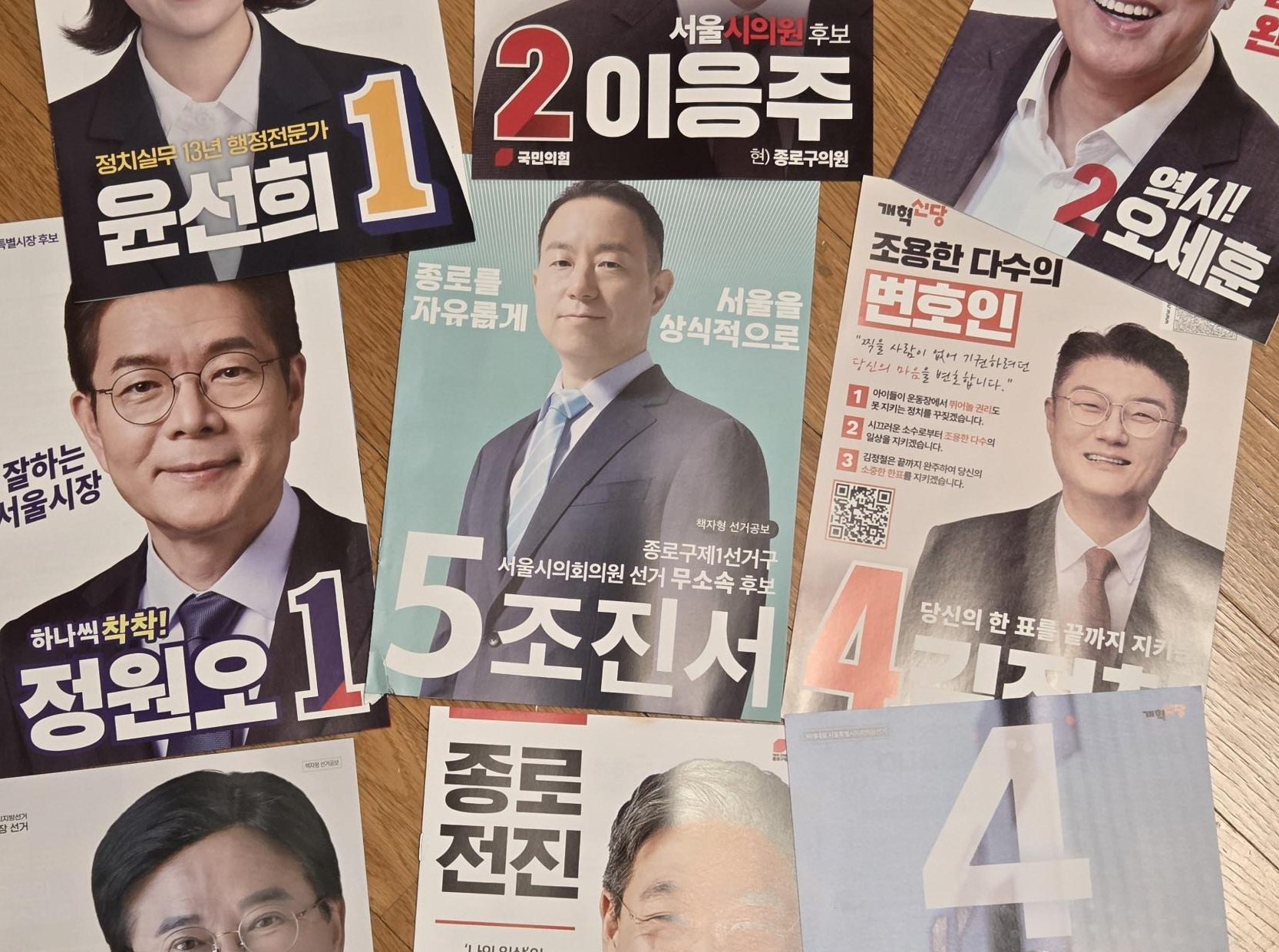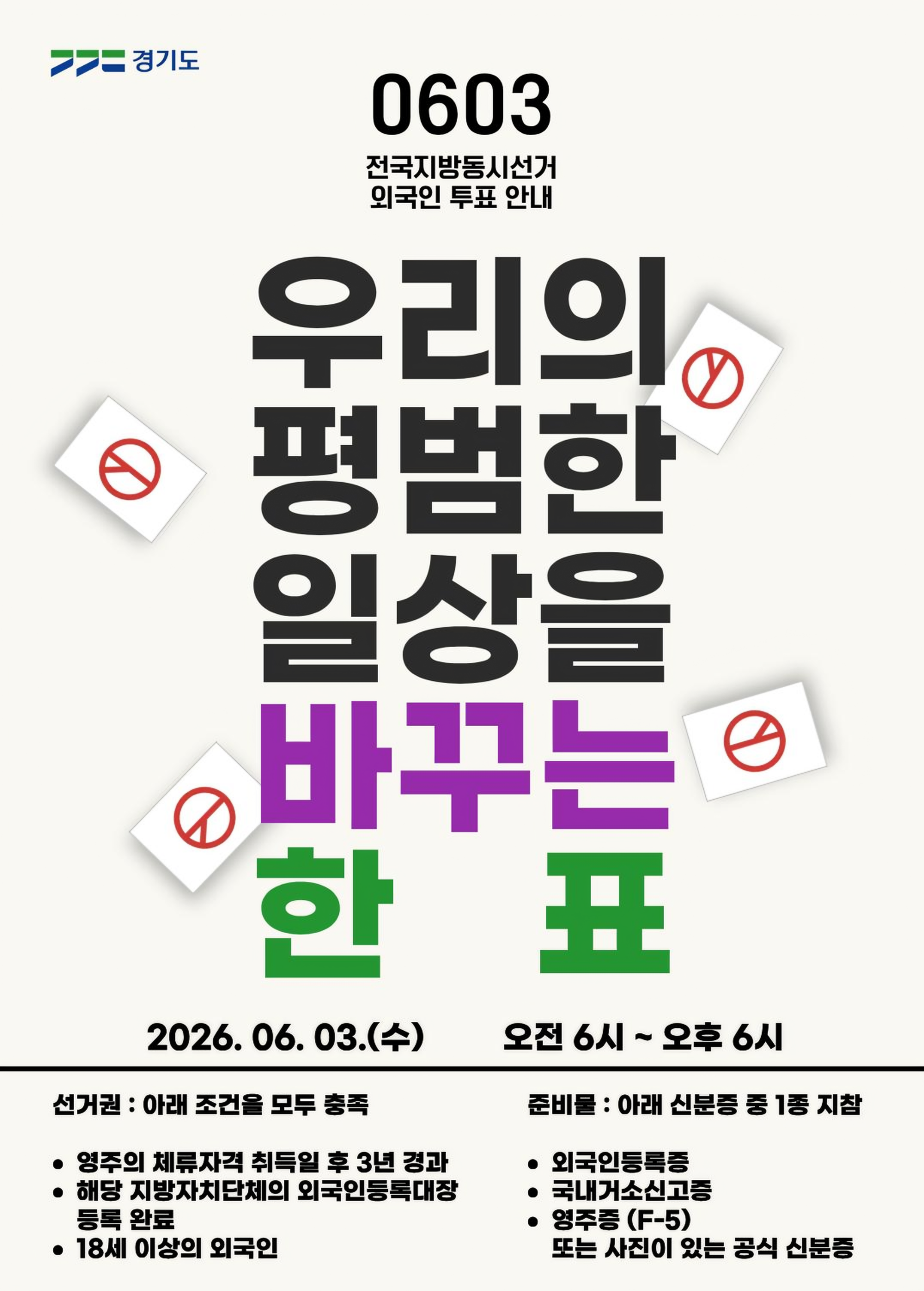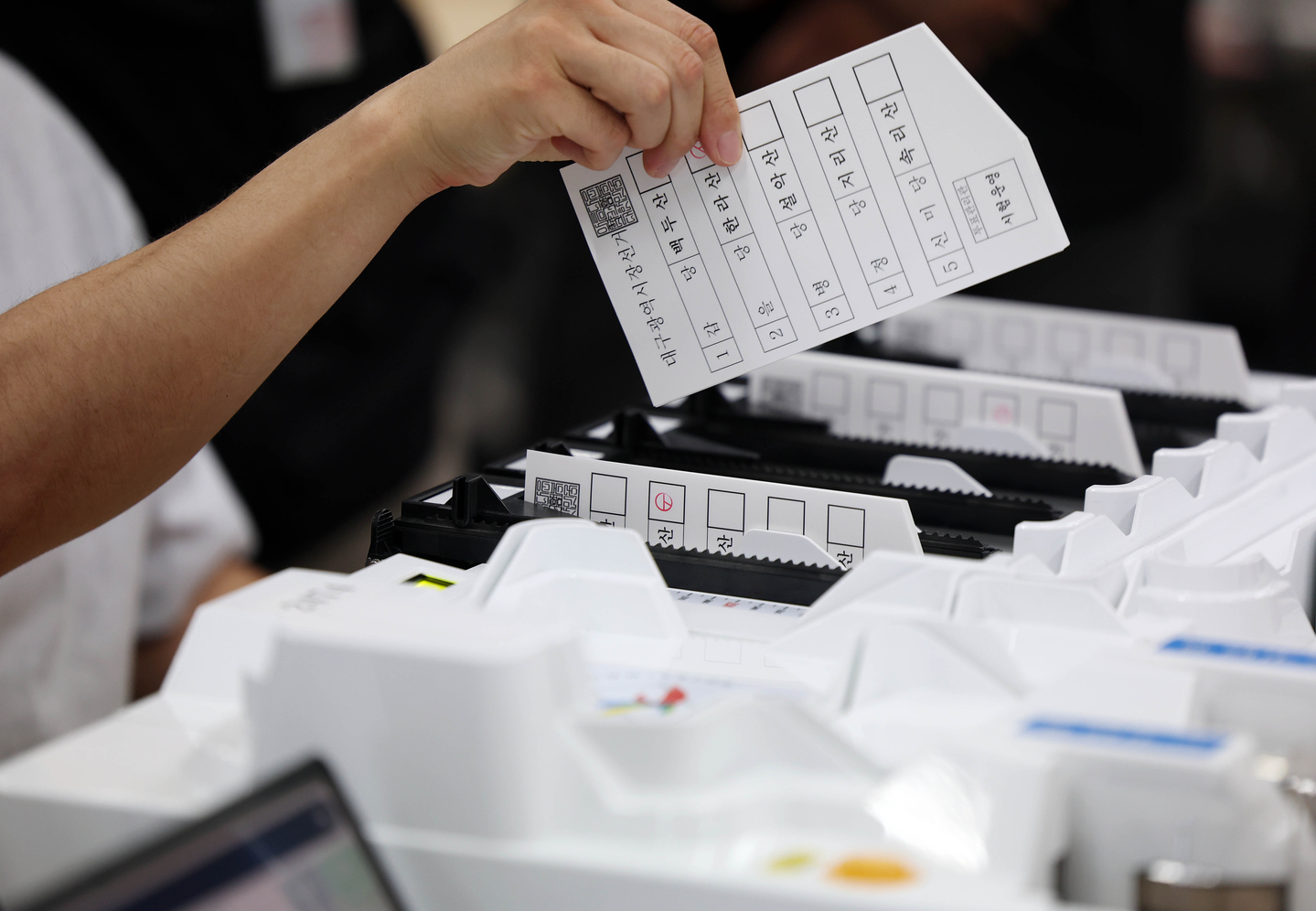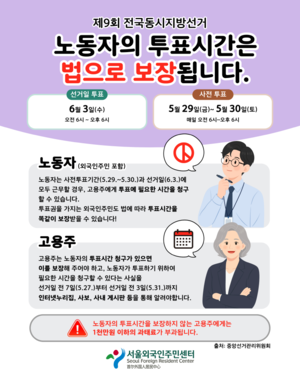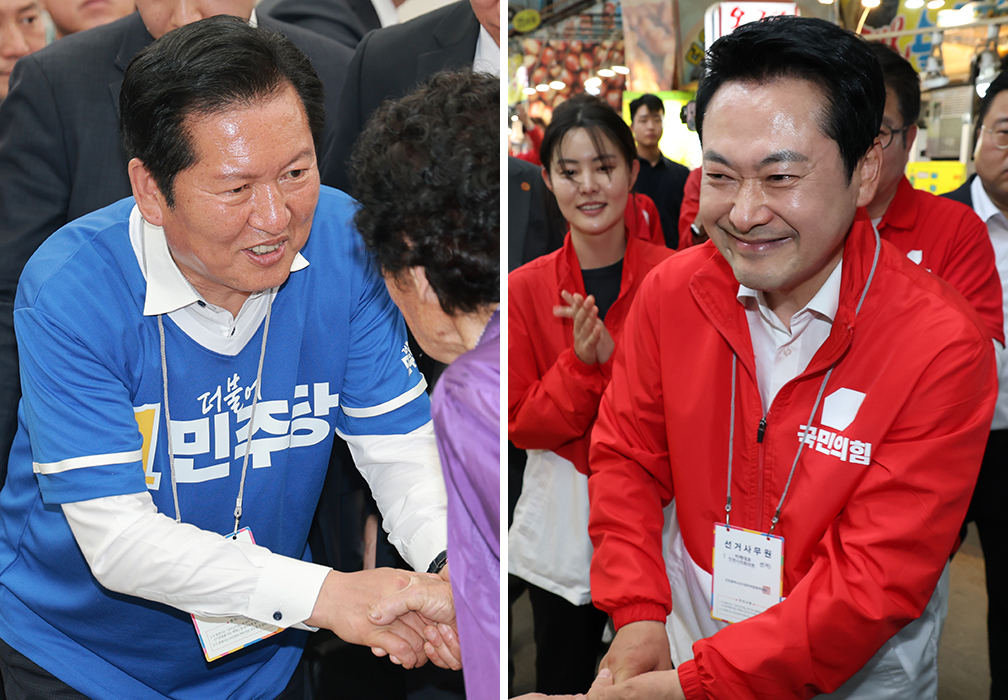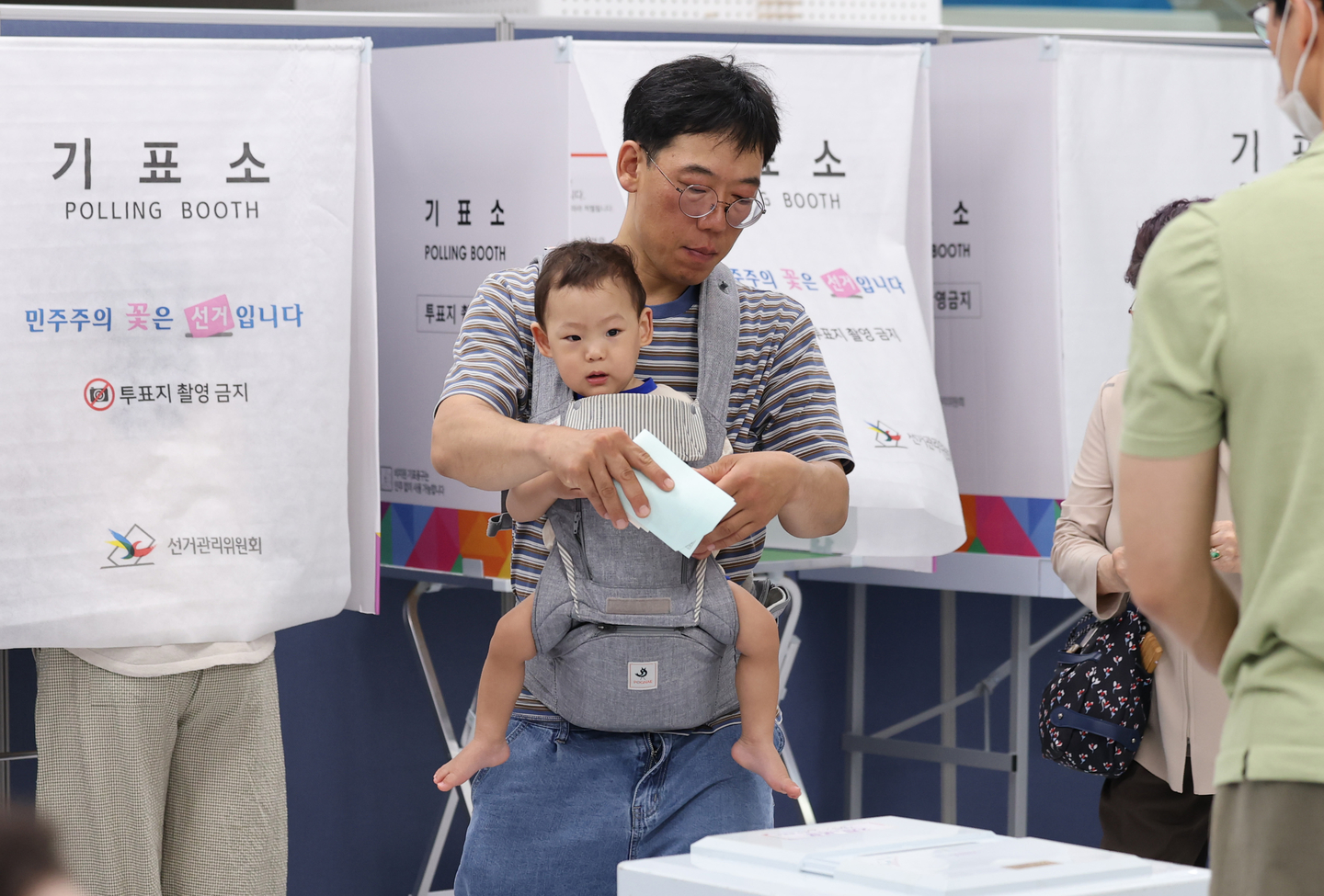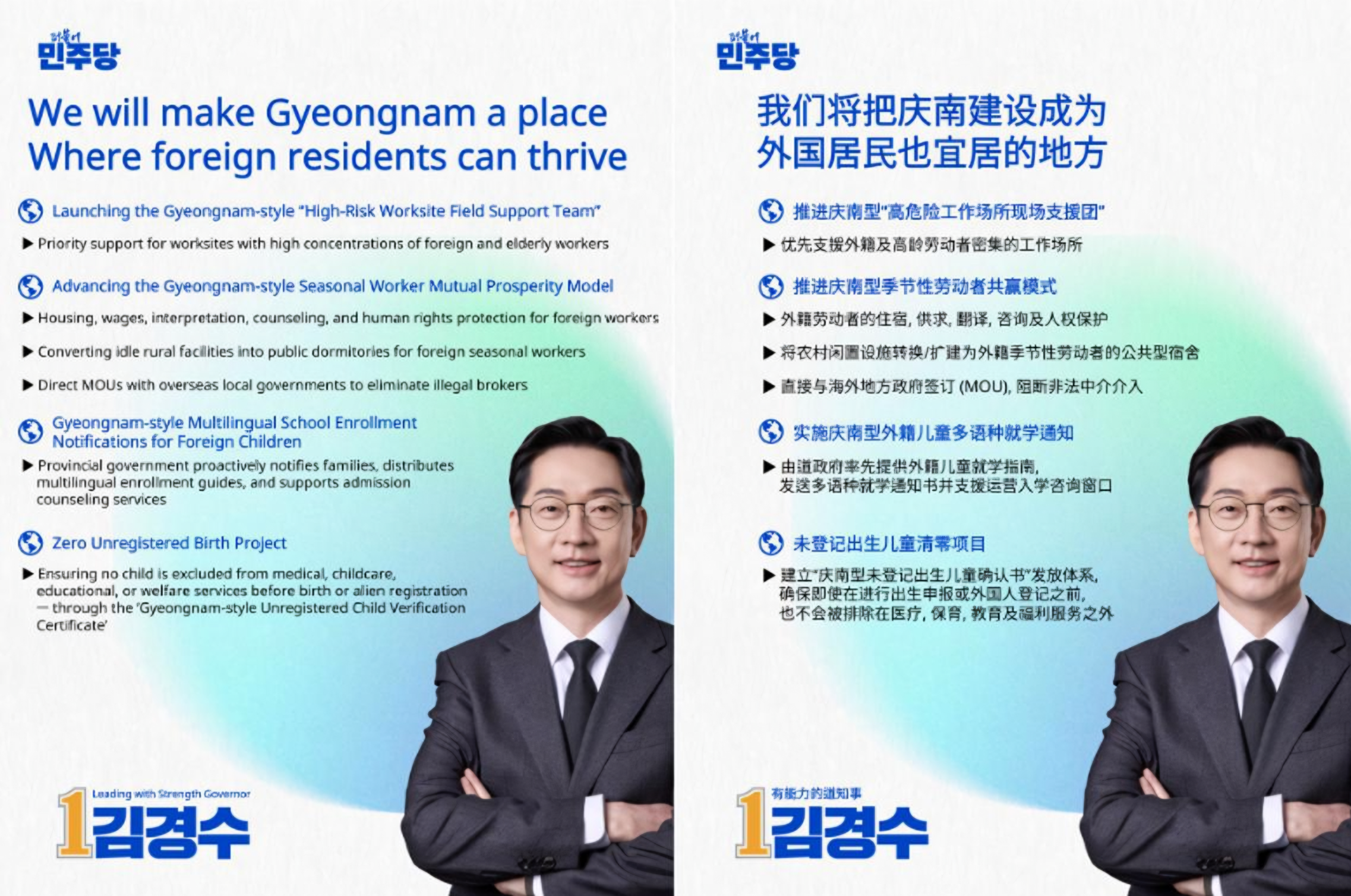
Campaign pledges in English, left, and Chinese by Kim Kyoung-soo, gubernatorial candidate for South Gyeongsang Province of the Democratic Party of Korea / Courtesy of Kim's campaign teamWhen Stephane Mot, a French national living in Korea, learned he was eligible to vote in local elections, it came as "a good surprise." Most eligible foreign voters never get that far. Though the number of registered foreign voters hit a record 151,532 ahead of the June 3 local elections, turnout keeps falling, dragged down by language barriers, lack of outreach and little awareness that the right exists at all. In the 2022 local elections, just 13.3 percent of eligible foreign voters cast a ballot.In Korea, foreign nationals aged 18 or older can vote in local elections — for mayors, governors, district heads, local councilors and education superintendents — three years after obtaining an F-5 permanent residency visa. Chinese nationals make up the overwhelming majority, accounting for roughly 78 percent of eligible foreign voters for the 2022 elections.As the eligible foreign voter pool grows, some election commissions and candidates are stepping up multilingual outreach.Regional branches of the National Election Commission (NEC), including the office in Gangwon Province, are distributing voting guides in multiple languages — including versions in English, Chinese and Vietnamese — to assist eligible foreign voters.Some candidates publish their policy manifestos in multiple languages. Kim Kyoung-soo, gubernatorial candidate for South Gyeongsang Province of the ruling Democratic Party of Korea (DPK), released his official campaign pamphlets in 10 different languages, including English, Chinese and Vietnamese to target some 20,000 foreign voters. “If immigrants living in South Gyeongsang Province cannot learn about candidates' pledges because of language barriers, that is another form of discrimination. I will work to make the province a place where immigrants are not discriminated against or left behind,” Kim said. Many foreign residents, however, say they still struggle to find basic information about local elections and the policies that affect their communities.“The declining turnout is driven primarily by low public interest in local elections, combined with a widespread lack of awareness among foreign nationals regarding their eligibility to vote,” said Lee Jae-mook, professor of political science at Hankuk University of Foreign Studies.Mot, the French national, said outreach to foreign communities well ahead of elections would help boost participation."What can be done sufficiently ahead of the election is to have a campaign targeting foreign communities which is nonpartisan and to boost the turnout," he said. However, he acknowledged that candidates and election agencies forgo publishing printed campaign materials in multiple languages because it is not effective for regions with small international electorates and said that individual voters can easily use their smartphones to translate Korean pamphlets.“There are so many candidates and it's impossible to translate (all of them)," he said. "If you want to know more about it, then you can again scan and search. And now there are really a lot of translation tools.”Growing backlash against foreign voting rightsKorea became the first country in Asia to grant voting rights to foreign residents through a landmark 2005 revision of the election law under the Roh Moo-hyun administration. The policy was initially introduced in hopes of securing reciprocal voting rights for overseas Koreans through bilateral treaties, in particular for ethnic Koreans living in Japan, known as Zainichi Koreans. It took effect during the 2006 local elections, when 6,726 foreign nationals were eligible to vote for local government heads.However, as Japan and other regional neighbors have not enacted similar reciprocal treaties, Korea remains a rare exception in Asia. Public sentiment toward the policy has soured. Last year, a video went viral featuring Hwang Eun-hwa, a Chinese-born naturalized Korean city councilor representing Ansan, Gyeonggi Province, endorsing a DPK candidate in Chinese for the 2022 local elections.The clip sparked a debate over immigrant political participation, with most online reactions hostile to both her use of Chinese and the law granting foreign voting rights.“Naturalized Koreans should learn Korean and vote. There is no point of promoting the election campaign in Chinese,” a comment reads.This screenshot shows a public petition submitted in 2020 to the presidential office website with 215,646 signatures, calling for the revocation of local voting rights for Chinese nationals with permanent residency in Korea. Captured from Cheong Wa Dae websiteA petition, submitted in March 2020 to the presidential office website where it gathered 215,646 signatures, called for the revocation of local voting rights for Chinese nationals with permanent residency in Korea. Shin Yul, political science professor at Myongji University, said the original rationale for the law has weakened. Korea remains the only country in Asia granting voting rights to foreign residents, while nations with sizable Korean diaspora populations — most notably Japan — have not reciprocated.“The law was originally introduced in hope to win reciprocal voting rights for overseas Koreans. But with Japan failing to adopt a corresponding measure, Korea needs to reevaluate the sustainability of this mandate.”Professor Lee added that any review of the law should be grounded in broader public consensus.“Expanding foreign language services is inherently positive, but doing so could trigger further social friction. Unlike the United States, where Spanish effectively functions as a co-official language alongside English without major issues, Korea does not recognize Chinese, Japanese or English as official languages,” Lee said.He called on the NEC to conduct a comprehensive survey measuring actual voter awareness among eligible foreign nationals and to assess public sentiment on providing multilingual election services. “Based on the survey, the NEC can then come up with a sustainable public consensus,” he said.
Foreign voting rights under strain as information barriers persist - The Korea Times
When Stephane Mot, a French national living in Korea, learned he was eligible to vote in local elections, it came as "a good surprise." Most eligib...
918 words~4 min read