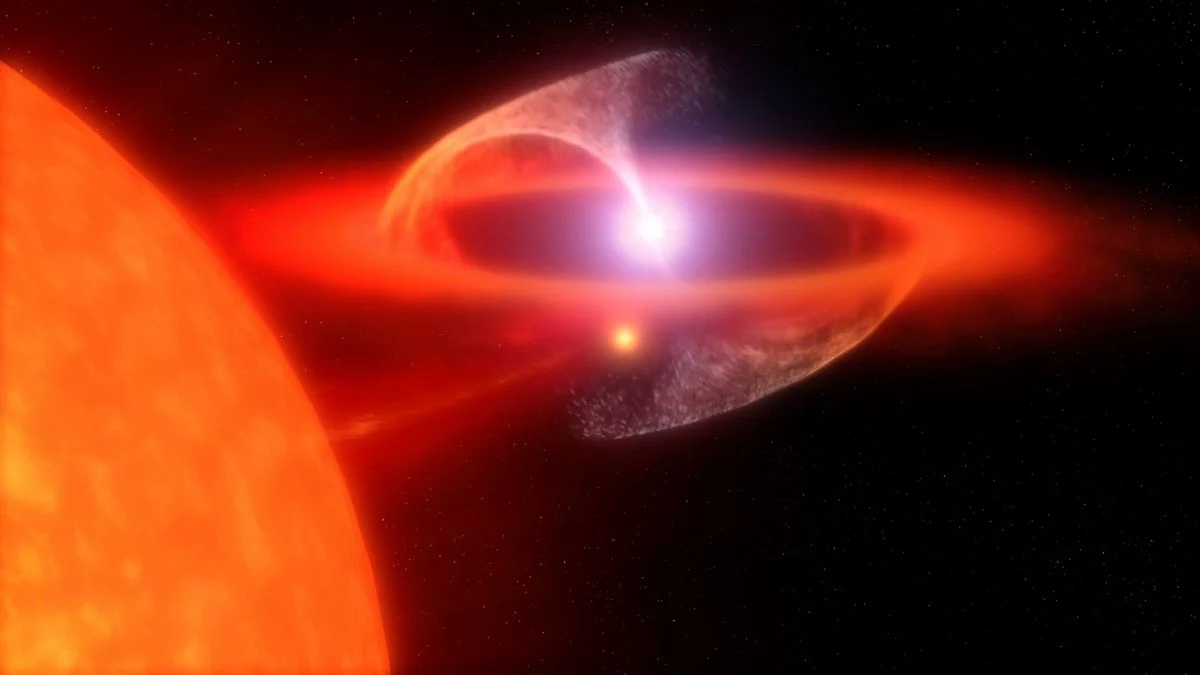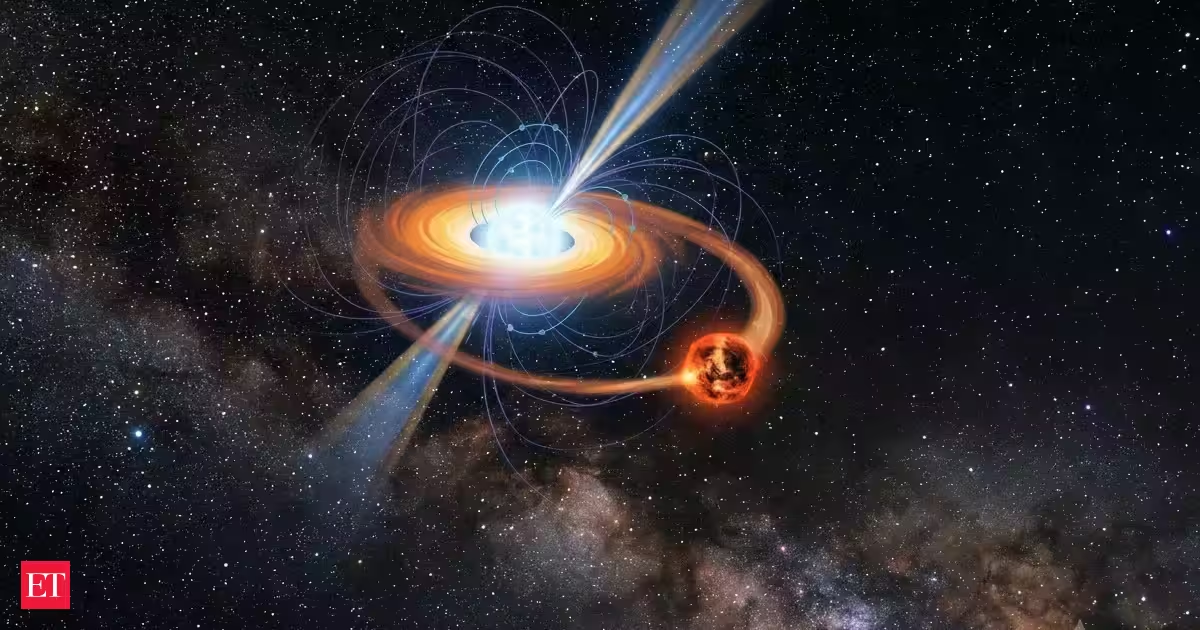
Artists' impression of the white dwarf binary ASKAP J1745-5051. The smaller, dense white dwarf star is accreting material from the larger, but less dense red dwarf star. The interaction of their magnetic fields and the heat from the material accretion creates signals in radio and X-ray light frequencies. Credit: Carl Knox (OzGrav/Swinburne) and Dr. Joshua Preston Pritchard (CSIRO).
An international team led by astronomers at the University of Sydney has uncovered the clearest evidence yet for the origin of an unusual class of cosmic signals. In doing so, they have identified a rare stellar system that is providing scientists with a natural laboratory to study extreme physics.
Using CSIRO's ASKAP radio telescope, the team discovered a small, dense star, called a white dwarf, shredding material from its larger, but less dense, companion star.
As this material spirals in, it produces powerful bursts of radio waves and X-rays in a cycle that repeats every 1.4 hours.
The findings are published in Nature Astronomy.