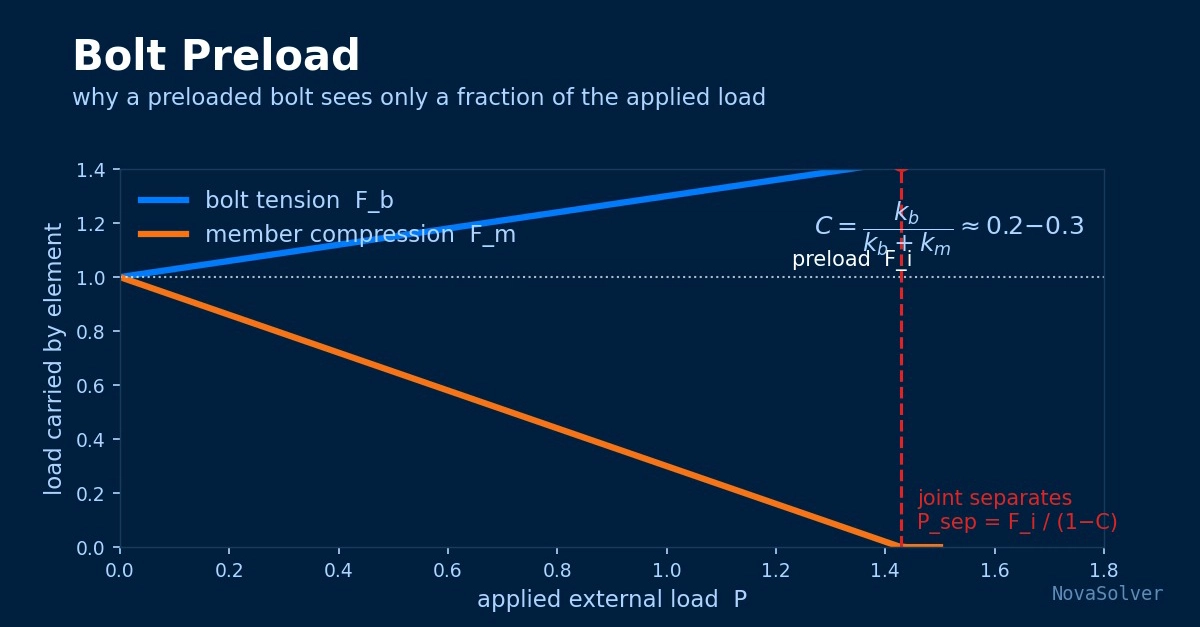
A bolt that simply "holds two parts together" is doing far more than that. When you tighten it, you stretch it like a spring, and that stretch squeezes the joint members together with a force that often dwarfs the load the joint will ever see in service. A loose-feeling bolt and a properly preloaded one can look identical from the outside, yet behave like completely different machine elements. One rattles itself apart; the other survives millions of load cycles.
This article explains what bolt preload is, why it governs joint reliability, and how to convert a tightening torque into a clamp force with a worked example you can repeat at your bench.
Why this calculation matters
Preload is the quiet hero of every bolted joint. A correctly preloaded bolt resists loosening because the friction generated by the clamp force holds the nut in place. It resists fatigue because most of an external cyclic load is absorbed by the relaxing joint members rather than by the bolt itself. And it keeps gasketed joints sealed because the clamp force never drops below the seating pressure.
Under-tighten, and the joint can gap, leak, or shake loose. Over-tighten, and you yield the bolt during assembly or strip the threads, leaving nothing in reserve. The target preload therefore sits in a deliberate window — high enough to clamp firmly, low enough to stay safely below the bolt's proof strength. Getting that number wrong is one of the most common root causes of mechanical failure, and it is entirely avoidable with a short calculation.