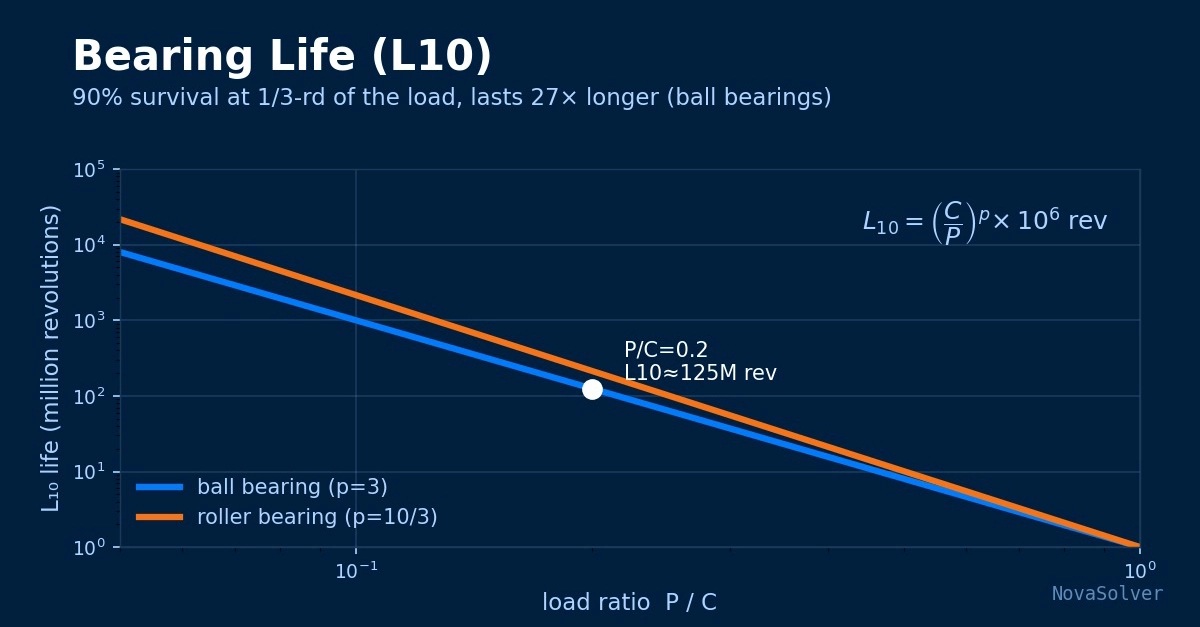
Open any rolling-bearing catalog and you will find, next to each part, a number called the dynamic load rating, C. It is tempting to read it as "the load this bearing can carry." It is not. C is a reference figure tied to a specific, statistical definition of life — and once you understand that definition, the catalog stops being a mystery and becomes a design tool. Bearing life is fundamentally a fatigue and probability calculation, not a static strength check.
This article explains what L10 life means, works the calculation from load rating to service hours, and connects it to the contact stress that ultimately sets the limit.
Why this calculation matters
A bearing rarely fails because it is overloaded in one moment. It fails because rolling contact, repeated millions of times, drives subsurface fatigue cracks until a piece of the raceway spalls. Because fatigue is inherently scattered, two identical bearings under identical loads will not fail at the same time. There is no single "the bearing lasts X hours."
So bearing life is quoted as a statistic. L10 life is the life that 90 % of a population of bearings will reach or exceed before the first sign of fatigue — equivalently, the life at which 10 % are expected to have failed. Designing to L10 is designing with a defined, 90 % reliability. Treat C as a maximum allowable load and you have no idea what reliability you are buying.