(Image credit: Tom's Hardware)
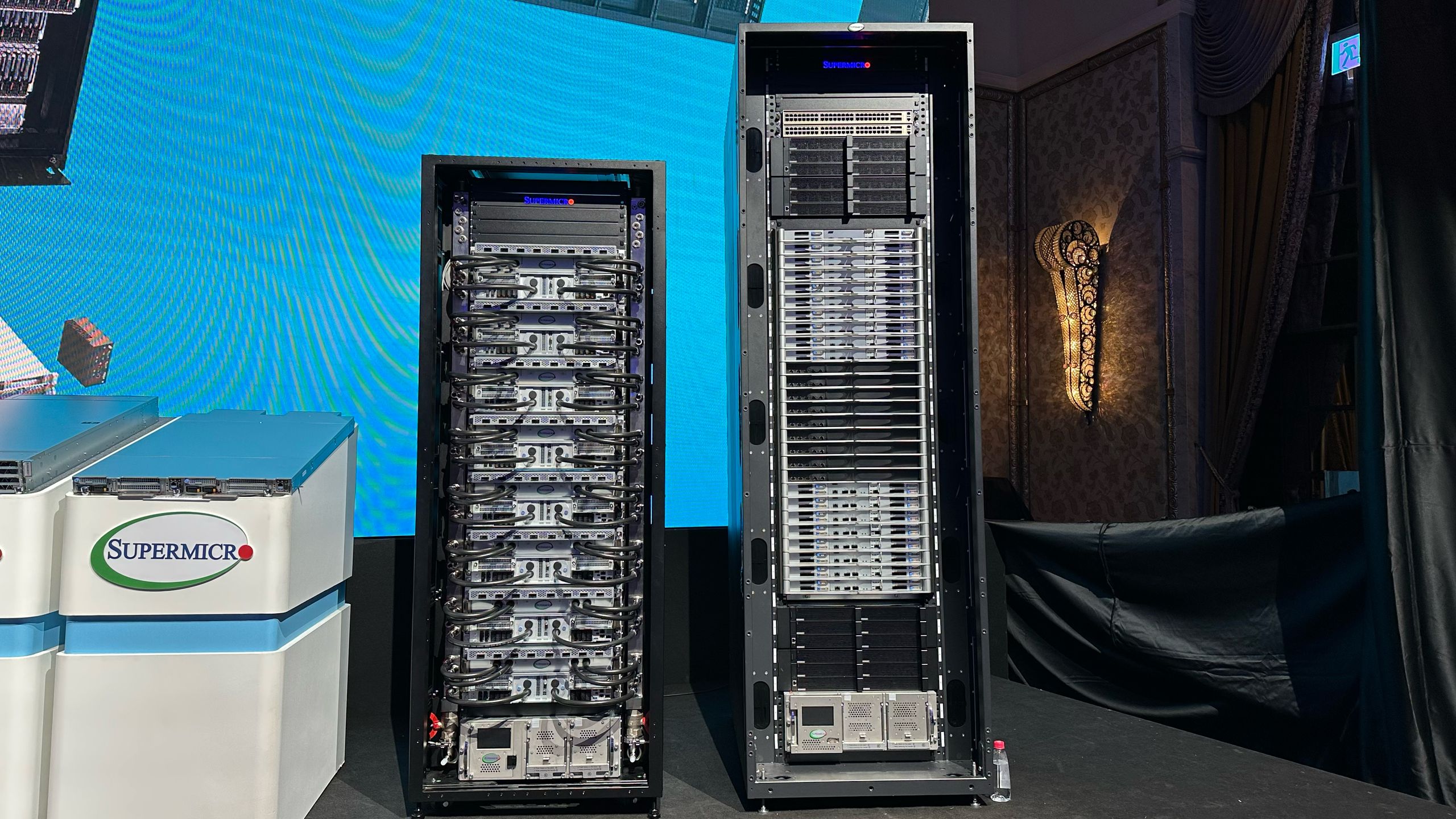
Supermicro is showing off its upcoming machines based on AMD’s 6th Generation EPYC ‘Venice’ processors, Instinct MI450 accelerators, and, of course, Nvidia’s Vera Rubin-based solutions. Arguably, the most important product that the company demonstrated at its CEO’s keynote is the VR200 NVL72 rack that uses Vera CPUs and Rubin GPUs. The machine, just like other upcoming liquid-cooled systems from Supermicro will use the company’s all-new coolant that has a 1000x higher electrical impedance compared to today’s mixtures, which may be quite important for next-generation AI machines.Go deeper with TH Premium: AI and data centers“Our new coolant [uses a new] formula [and] reaches up to 1,000 times higher electrical impedance than a standard cooler,” said Charles Liang, chief executive of Supermicro, during his keynote speech at Computex. “In case there are small leaks, when you have a high electrical impedance, the system will not [shut down] [and will] keep running.”Conventional water-based coolants used in direct liquid cooling systems have electrical conductivity (albeit lower than water), so if coolant leaks onto a motherboard, GPU, power delivery circuitry, or connectors, it can create leakage currents or even short circuits. A coolant with 1000 times higher electrical impedance is far more resistant to current flow, which reduces the likelihood that a minor leak will immediately shut down a system or damage electronic components. This is important as modern rack-scale AI solutions like Nvidia’s VR200 NVL72 are rumored to cost around $8 million, so their protection is crucial. Also, reducing downtime in AI data centers is important as these machines must make money for their owners.Unfortunately, Supermicro’s claim is difficult to evaluate because the company does not disclose specifications of the coolant, such as conductivity (µS/cm), resistivity (MΩ·cm), or dielectric strength (kV/mm). It also remains tight-lipped about the baseline coolant used for comparison. Since modern water-glycol coolants are already fairly resistant, a 1000-fold improvement sounds significant, but without the actual details, it is impossible to determine the practical magnitude of the advancement. What Supermicro claims is that a minor coolant leak would be less likely to force an immediate server shutdown, which means lower downtime risk in large AI deployments. However, we have no idea whether the new coolant behaves more like a dielectric fluid and less like water-glycol coolants.