Nursing documentation has become an operational bottleneck that AI cannot fix without deep workflow alignment and disciplined change‑management.
Nurses now spend up to 41% of their time on EHRs, according to the U.S. Department of Health and Human Services, and validated stress‑monitoring studies show they spend more time interacting with the EHR than on any other task during a four‑hour shift.
Systematic reviews link EHR burden directly to clinical burnout, with roughly 40% of studies reporting negative or inconclusive impacts on clinician well‑being.
At the same time, the American Nurses Association and the Online Journal of Issues in Nursing emphasize that AI improves nursing practice only when it is deliberately integrated, continuously, and with sustained frontline involvement. Nearly half of clinical decision support evaluations show mixed or negative results — underscoring why AI adoption fails when organizations underestimate workflow complexity or skip change‑management fundamentals.
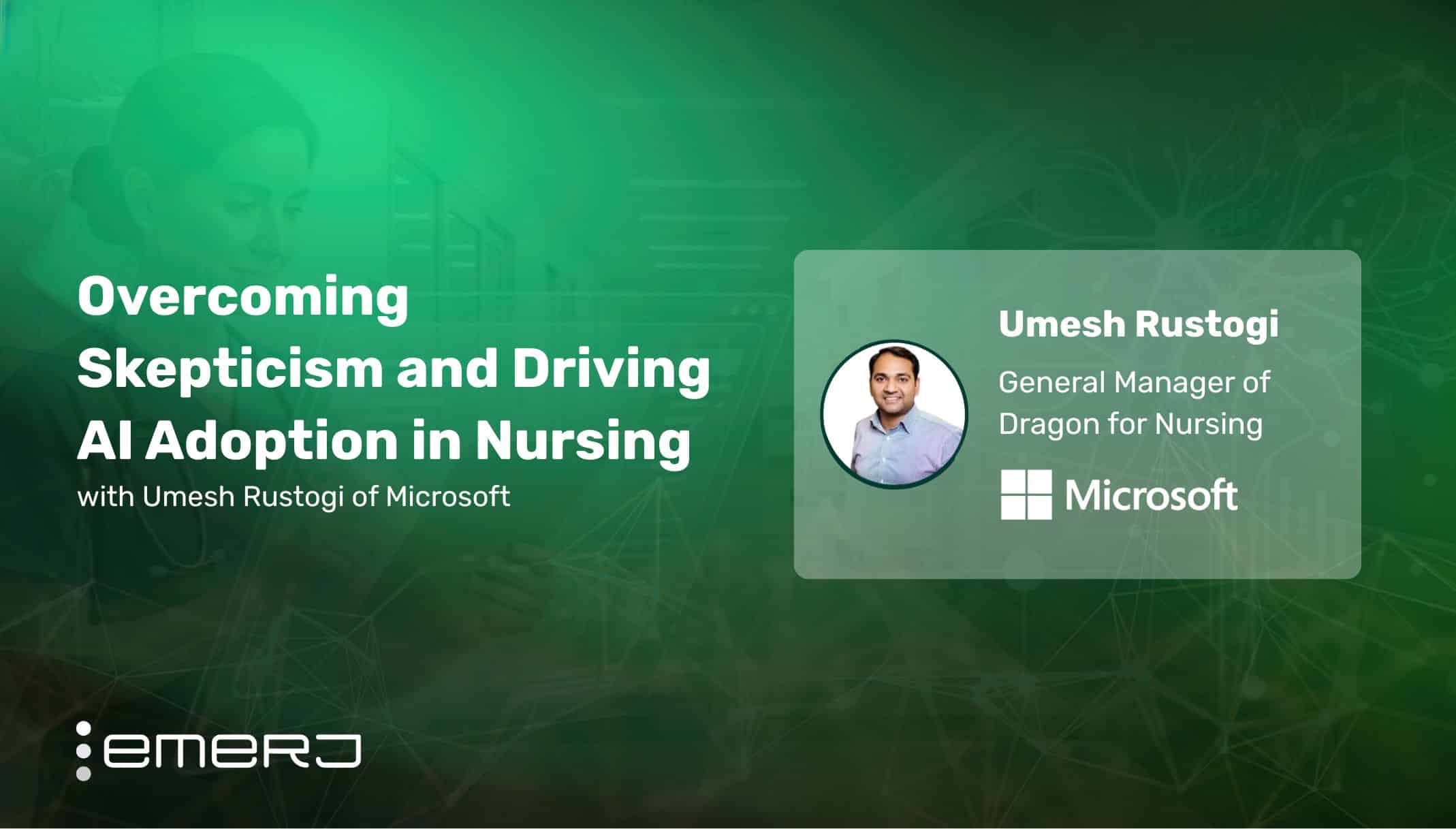
Emerj’s Matthew DeMello was joined by Umesh Rustogi, General Manager of Dragon for Nursing at Microsoft Health & Life Sciences, to examine what it actually takes to scale AI safely and effectively across clinical environments — from accuracy tuning to frontline adoption — on the AI in Business podcast.