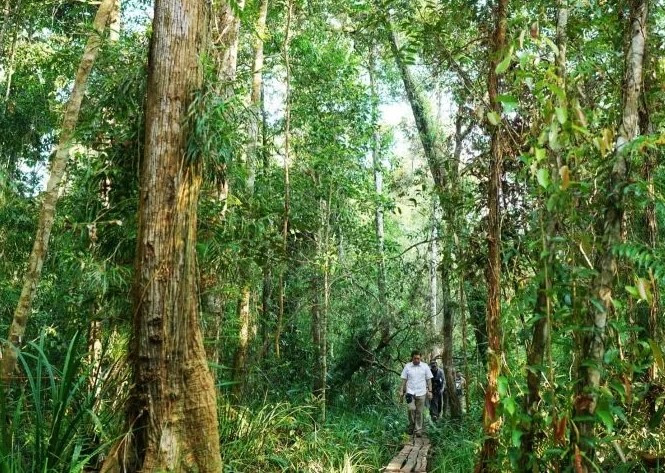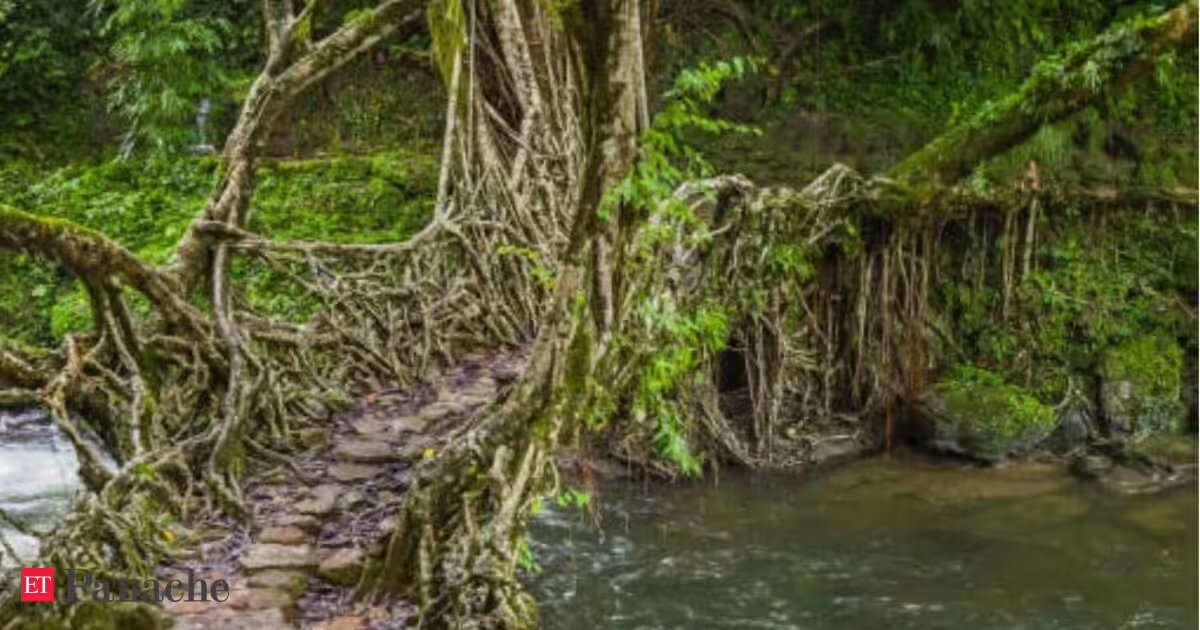
Long before climate conferences, carbon credits and biodiversity targets entered global vocabulary, communities in the hills of Meghalaya were already protecting forests with something far older — custom, belief and collective responsibility.In several villages, strict rules remain in force against indiscriminate logging and destructive fishing methods. (Image sourced from Incredible India)A new study published in the Journal of Environmental Studies and Sciences found that centuries-old Khasi community institutions continue to play a crucial role in conserving forests, water sources and biodiversity across Meghalaya, even as mining, quarrying and commercial farming place growing pressure on fragile ecosystems.The study, conducted by Bhogtoram Mawroh of the North East Society for Agroecology Support (NESFAS), offers a detailed look into how traditional Khasi governance systems continue to regulate the use of forests, rivers and agricultural land in parts of East Khasi Hills.The research paints a layered picture at a time when environmental degradation dominates conversations around the Northeast -- one where indigenous knowledge systems are not relics of the past but active conservation tools still shaping everyday life.The study focused on five villages — Ladmawphlang, Nongwah, Umsawwar, Nongtraw and Dewlieh — documenting how local institutions continue to enforce rules governing tree felling, fishing, hunting and use of water.Among the most significant practices highlighted are the “Law Adong”, or restricted forests, community-protected areas where extraction of forest produce is either tightly controlled or entirely prohibited. These forests are often preserved to protect springs, streams and biodiversity-rich habitats.Other forest areas are designated for limited community use, allowing regulated timber extraction and the collection of non-timber forest produce.In several villages, strict rules remain in force against indiscriminate logging and destructive fishing methods. Washing vehicles near water sources is banned in certain areas. Using chemicals to catch fish is prohibited. A few villages have even established community fish sanctuaries to allow aquatic life to regenerate naturally.“These systems are not informal or random arrangements,” the study notes. “They are embedded within Khasi governance structures and cultural practices that have evolved over centuries.”The Human ConnectFor the Khasi community — an indigenous Austro-Asiatic community believed to have inhabited the region for nearly 4,000 to 5,000 years -- forests are not viewed merely as economic assets -- They are tied deeply to spirituality, identity and social order.Traditional institutions such as the Dorbar Shnong and the Hima continue to play central roles in enforcing community norms and resolving disputes related to natural resources.The research argues that these customary systems have helped Meghalaya retain more than 70 per cent forest cover despite mounting ecological and developmental pressures.That figure stands out sharply in a region where rapid land-use changes have become increasingly visible. Hills once covered with thick forests now bear scars from stone quarrying and mining; streams that once flowed year-round dry up during winter; commercial broom grass cultivation continues to expand across slopes.Grim warningsThe study warns that ecological stress is intensifying across several parts of Meghalaya.Traditional jhum cultivation cycles, which historically allowed land to regenerate over periods exceeding 20 years, have reportedly shrunk to nearly a decade in some villages because of growing population pressure and shrinking land availability.That shortening cycle, researchers say, reduces soil recovery time and places additional strain on forest ecosystems.Acute water scarcity during the dry season has also become a concern in parts of East Khasi Hills, with some villages already experiencing frequent shortages.The study identifies broom cultivation, mining and stone extraction as some of the most significant emerging threats to traditional landscape management systems.Forest degradation is not newYet one of the paper’s more striking observations is that environmental change in Meghalaya is not purely a modern phenomenon.According to the research, forest degradation in parts of the region dates back nearly 2,000 years, linked partly to ancient iron-smelting activities and the transportation of megaliths — the massive stone structures that continue to define Khasi cultural Landscapes even today.In other words, human impact on Meghalaya’s ecology has always existed. What allowed ecosystems to survive, the study suggests, was the simultaneous presence of strong community rules governing how resources could be used.That balance, however, appears increasingly fragile.Across Meghalaya, tensions between state-led conservation efforts and customary land ownership have surfaced repeatedly over the years. Much of the state’s land remains under community or clan ownership, making conventional top-down conservation models difficult to implement.The study argues that policies designed without recognising indigenous governance systems often fail to gain acceptance at the grassroots level.It points to conservation initiatives and forest regulations that overlooked Khasi customary rights and traditional ecological knowledge, creating friction instead of cooperation.The paper arrives at a moment when climate-linked programmes such as ecosystem restoration projects and carbon credit schemes are beginning to gain traction across the Northeast.But researchers caution that such initiatives may struggle unless they work alongside local governance systems rather than bypassing them.The way forward“The future of conservation in Meghalaya,” the study suggests, “depends not only on scientific intervention but also on recognising the legitimacy of indigenous ecological governance.”That message resonates strongly in villages where conservation is not framed through the language of global climate policy but through inherited obligations.In places like Mawphlang’s sacred groves — among the best-known examples of community-protected forests in the Khasi Hills — people still speak of forests with reverence rather than ownership. For generations, customary rules survived not because they were enforced by distant authorities but because communities themselves believed the forests deserved protection.Today, modern pressures are testing those systems in unprecedented ways. Young people migrate. Land values rise. Commercial extraction offers quick income. Climate variability alters rainfall patterns. Traditional institutions themselves face questions about how they adapt to a rapidly changing economy.And yet, despite all that, the study suggests that the foundations of Khasi ecological governance remain remarkably resilient.Perhaps that resilience lies in a worldview older than modern conservation itself — one that sees forests not as commodities to be maximised, but as living spaces that sustain both nature and community.For Meghalaya, where debates over development and ecology often collide head-on, the findings offer a reminder that some of the most effective conservation practices may not need to be invented anew. They may already exist, quietly preserved in village councils, sacred groves and unwritten community rules passed down through generations.
Sacred groves, living laws: How Khasi traditions quietly protect Meghalaya’s forests
Traditional institutions such as the Dorbar Shnong and the Hima continue to play central roles in enforcing community norms | India News
1,027 words~5 min read